
TL;DR:
- Cultural immersion in language learning connects language to real social and cultural experiences, enhancing proficiency. Effective techniques involve local, relevant content and structured interactions, including VR-based environments, to improve motivation and long-term retention. Barriers such as insufficient preparation, weak networks, and passive exposure can hinder immersion success, emphasizing the importance of scaffolding and authentic engagement.
Cultural immersion in language learning is defined as the process of acquiring a language through direct, sustained engagement with its cultural and social contexts, not just its grammar rules. The role of cultural immersion in language learning goes far beyond vocabulary drills. It connects language to lived experience, social identity, and real communication. Research from 2025 and 2026 confirms that learners who engage with culture alongside language develop stronger vocabulary use, better tonal awareness, and higher motivation. Tools like VR-based immersion platforms, sociolinguistic frameworks from Tasnim 2025, and local culture-based teaching methods are reshaping how educators and adult learners approach fluency.
How does cultural immersion enhance language proficiency?
Language proficiency and cultural understanding are inseparable. A 2025 sociolinguistic review found that cultural and social identity are essential, not optional, for second language mastery. Linguistic skills alone cannot produce full communicative competence. A learner who knows every grammar rule but misreads social cues will still struggle in real conversations.
Immersion works because it places you inside the social fabric of a language. When you interact with native speakers, you absorb tone, register, humor, and context that no textbook captures. This is what researchers call sociocultural adaptation, the process of adjusting your behavior and communication style to fit a new cultural environment.
The mechanisms behind this are concrete:
- Social identity integration: You begin to see yourself as a participant in the target culture, not just a student of its language. This shift increases motivation and risk-taking in conversation.
- Authentic communication: Real interactions force you to process language at full speed, without the safety net of a controlled exercise.
- Sociocultural adjustment: A 2026 systematic review of 37 papers confirmed that meaningful immersion combining target-language use with sociocultural adaptation boosts engagement significantly.
- Motivation through relevance: When language connects to real cultural experiences, learners find personal meaning in the process.
Pro Tip: Structured social opportunities matter more than passive cultural exposure. Attending a Thai cultural event without speaking Thai is tourism. Joining a Thai conversation group where you are expected to participate is immersion.
The difference between classroom learning and immersion is the difference between studying a map and walking the streets. Both have value, but only one builds the instincts you need for fluency. Educators who understand this design lessons around authentic interaction, not just content delivery.
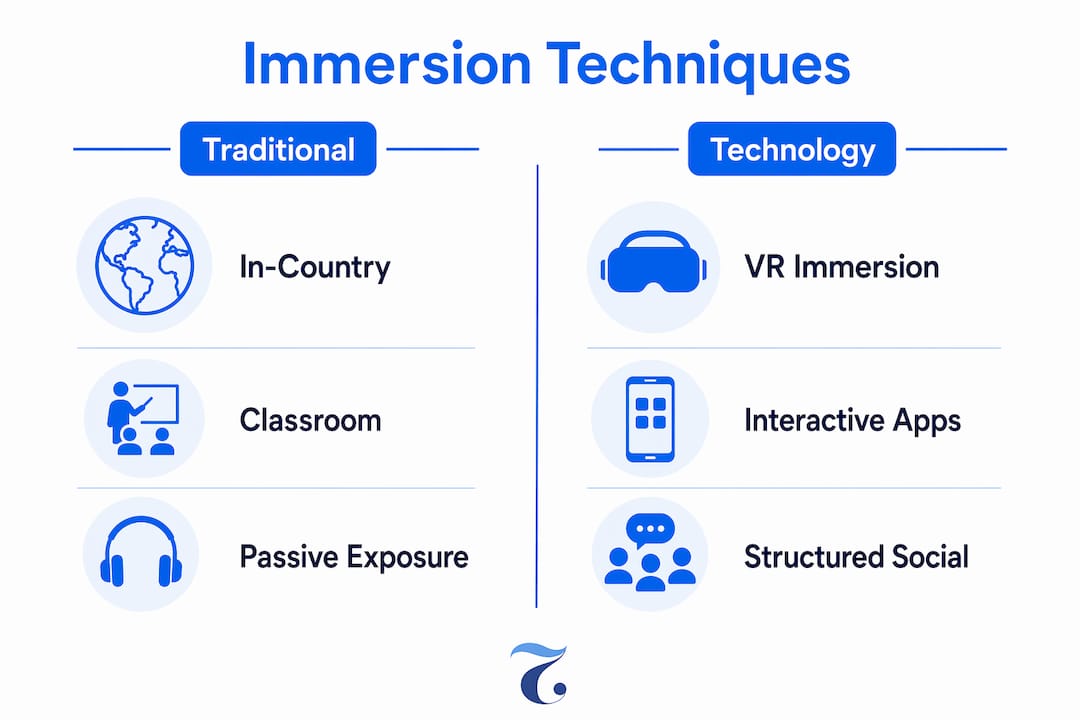
What cultural immersion techniques actually work?
Effective cultural immersion techniques share one quality: they connect language to contexts that feel real and relevant to the learner. Abstract cultural trivia does not produce fluency. Grounded, locally relevant cultural content does.
Local culture-based teaching
A 2026 systematic literature review analyzing 10 studies found that local culture-based teaching boosts motivation and communicative competence. The catch is that it depends heavily on teacher readiness and the availability of culturally responsive materials. Many educators default to foreign cultural content because it is easier to source, but this creates a disconnect for learners.

Effective local culture-based techniques include contextual storytelling using scenarios from the learner’s own environment, role-play exercises built around real social situations like ordering food or negotiating at a market, and games that require cultural knowledge to win. These approaches make language learning feel purposeful rather than academic.
VR and technology-assisted immersion
Virtual reality is changing what immersion means for learners who cannot travel. A 2026 systematic review of randomized controlled trials found that VR-based immersion shows promising effects on long-term retention, particularly for interactive environments that require active language use. Immediate gains vary by study design, but the retention data is encouraging.
The table below compares the core immersion approaches by accessibility, depth, and retention impact:
| Technique | Accessibility | Cultural Depth | Retention Impact |
|---|---|---|---|
| In-country immersion | Low (requires travel) | Very high | Very high |
| Local culture-based teaching | High | High (if locally grounded) | High |
| VR-based immersion | Medium | Medium | Moderate to high |
| Passive cultural exposure | High | Low | Low |
Pro Tip: Avoid building your curriculum around foreign cultural trivia. A 2026 literature review found that authentic, locally grounded content consistently outperforms foreign cultural material for motivation and communicative outcomes. Prioritize what feels real to your learners.
For adult learners in Singapore studying Thai, this means using Thai cultural content that connects to their actual lives: business etiquette, travel scenarios, and social customs they will encounter directly. The key aspects of learning Thai include understanding how cultural context shapes every conversation.
What are the barriers to effective cultural immersion?
Cultural immersion programs fail for predictable reasons. Understanding those reasons lets you build a program that avoids them.
-
Language proficiency as a barrier. A 2026 study with 281 expatriates showed that host-country language proficiency improves sociocultural adjustment through social support. But the reverse is also true: learners with low proficiency struggle to access the social interactions that would improve their language. This creates a cycle that requires deliberate scaffolding to break.
-
Small or weak social networks. The same expatriate study found that language gains matter more when local social networks are smaller. If you have few native-speaker contacts, your language proficiency carries the full weight of your cultural integration. Building even a small network of native speakers dramatically changes your learning trajectory.
-
Teacher preparedness gaps. Research identifies teacher professional development and culturally contextualized resources as the primary bottlenecks in local culture-based teaching. Many instructors want to teach with cultural content but lack the training or materials to do it well.
-
Mismatch between cultural activities and learner readiness. Immersion programs fail when they throw learners into high-context cultural situations before they have the language tools to participate. A 2026 study-abroad review found that scaffolding social language skills before high-context cultural activities is critical to success.
-
Reliance on passive exposure. Attending cultural events, watching films, or listening to music in the target language has value, but it is not sufficient. Active, structured interaction with native speakers is what drives proficiency gains.
The solution to most of these barriers is sequencing. Build language skills first, then introduce cultural complexity. Create structured social opportunities rather than hoping organic interaction will happen. Work with instructors who are both linguistically qualified and culturally informed. Native Thai teachers, for example, bring an authenticity to cultural instruction that no textbook can replicate. Understanding the role of native Thai teachers in immersive learning is a practical starting point for any adult learner.
How does immersion affect motivation and long-term retention?
Immersion does not just improve language skills. It changes how learners feel about the learning process itself. That motivational shift is one of the most powerful and underappreciated benefits of cultural immersion.
When language connects to lived cultural experience, vocabulary becomes meaningful rather than arbitrary. You remember the Thai word for “respect” differently when you have witnessed how it operates in a real social context. This is cognitive elaboration: the brain encodes information more deeply when it is tied to emotion, context, and experience.
The psychological and social benefits of immersion include:
- Higher intrinsic motivation: Learners pursue the language because it opens real doors, not because they are completing an assignment.
- Greater communicative confidence: Regular authentic interaction reduces the fear of making mistakes.
- Stronger long-term retention: VR research and study-abroad data both point to immersion’s advantage in retention over time compared to traditional classroom methods.
- Improved sociocultural adjustment: For learners using Thai in professional or travel contexts, cultural fluency reduces friction in real-world interactions.
The data on retention is particularly striking. The 2026 VR review found that interactive immersive environments support cognitive elaboration in ways that passive study cannot match. Immediate test scores may not always reflect this, but long-term retention data consistently favors immersive approaches.
| Learning Method | Immediate Recall | Long-Term Retention | Motivation Impact |
|---|---|---|---|
| Traditional classroom | Moderate | Low to moderate | Low |
| Cultural immersion (in-person) | High | Very high | Very high |
| VR-assisted immersion | Moderate to high | High | High |
| Self-study with cultural media | Low to moderate | Moderate | Moderate |
For adult learners with professional or travel goals, the motivational dimension is decisive. Understanding why learning a new language matters in 2026 goes beyond career advancement. It includes the social and psychological rewards that only immersion can deliver.
Key takeaways
Cultural immersion accelerates language mastery by connecting language use to real social identity, cultural context, and structured interaction rather than passive exposure alone.
| Point | Details |
|---|---|
| Culture and language are inseparable | Social identity and cultural context are required for full communicative competence, not optional extras. |
| Locally grounded content outperforms foreign trivia | Teaching with culturally relevant, local material drives higher motivation and better communicative outcomes. |
| Scaffolding prevents immersion failure | Build language skills before high-context cultural activities to avoid the readiness mismatch that derails programs. |
| Social networks amplify immersion gains | Smaller native-speaker networks make language proficiency even more critical for sociocultural adjustment. |
| VR extends immersion beyond the classroom | Interactive VR environments show strong long-term retention benefits for learners without access to in-country immersion. |
What i’ve learned about immersion that most guides get wrong
Most articles on cultural immersion treat it as a destination. Go abroad, surround yourself with the language, and fluency will follow. That framing is wrong, and it sets learners up for frustration.
The research is clear: immersion without preparation is just confusion with a passport. The learners who gain the most from immersive environments are those who arrive with enough language scaffolding to actually participate. They can ask questions, make mistakes, and recover. Learners who lack that foundation often retreat into their native language and miss the immersive benefit entirely.
What I find most compelling in the 2026 research is the role of social networks. The expatriate study showing that language proficiency matters more when your local network is small is a finding that should reshape how every adult learner approaches their study plan. If you are learning Thai in Singapore without a large Thai-speaking social circle, your language skills are doing extra work. That means you need to invest more in structured practice, not less.
For educators, the bottleneck is almost always teacher readiness and materials. The best cultural immersion instruction comes from teachers who are both native speakers and trained to contextualize culture for their specific learner group. That combination is rarer than it should be, and it is the single biggest factor separating good immersion programs from great ones.
The forward-looking trend I am watching is VR integration. Not as a replacement for human interaction, but as a bridge for learners who cannot access in-country immersion. The retention data is promising, and as the technology matures, it will become a standard tool in any serious language program.
— Paul
Learn thai with real cultural immersion at thai explorer
Thai Explorer builds cultural context into every lesson, not as a supplement but as the foundation. Adult learners in Singapore studying conversational or business Thai work with qualified native Thai instructors who are bilingual in Thai and English, bringing authentic cultural insight to every class.
Whether you prefer group classes, private sessions, or online Zoom learning, Thai Explorer’s curriculum connects language directly to real-world Thai culture, from social etiquette to professional communication. Courses are structured around practical outcomes, so you build both fluency and cultural confidence. Explore the full range of adult Thai courses or go deeper with a structured Thai language program designed for real-world use. Thai Explorer is located at 10 Anson Road, #22-07, International Plaza, Singapore 079903, right above Tanjong Pagar MRT.
FAQ
What is the role of cultural immersion in language learning?
Cultural immersion accelerates language acquisition by connecting vocabulary, tone, and grammar to real social and cultural contexts. Research confirms that sociocultural adaptation and language proficiency reinforce each other, making immersion more effective than classroom study alone.
How does culture affect language learning outcomes?
Culture shapes how language is used, including tone, register, and social meaning. A 2025 sociolinguistic review found that separating culture from language instruction undermines communicative competence, because language is socially situated and reflects cultural identity.
What are the most effective cultural immersion techniques for adults?
Local culture-based teaching, structured conversation with native speakers, and VR-assisted immersion are the most effective techniques for adult learners. The key is grounding content in contexts that are directly relevant to the learner’s real-world goals.
Why do some immersion programs fail to produce fluency?
Immersion programs fail when learners lack the language scaffolding needed to participate in cultural activities. A 2026 study-abroad review identified a mismatch between cultural activity level and learner readiness as the primary cause of immersion program failure.
How does immersion improve long-term language retention?
Immersion supports cognitive elaboration by tying language to emotion, context, and lived experience. VR-based immersion research and study-abroad data both show that interactive, culturally grounded learning produces stronger long-term retention than traditional classroom methods.