TL;DR:
- Thai reading involves decoding, pronunciation, and comprehension, not just alphabet recognition.
- Understanding script mechanics, tone rules, and word segmentation is essential for functional reading.
- Adult learners succeed with structured strategies that emphasize pattern recognition and error analysis.
Reading Thai is not just about recognizing letters on a page. Many learners reach the point where they can recite the alphabet but still freeze when they encounter a real Thai sign, menu, or news headline. That gap between letter recognition and actual reading competence is exactly what this guide addresses. Foundational reading gaps exist even among educated Thai adults, which tells you something important: true reading skill runs much deeper than knowing the script. If you are learning Thai in Singapore for travel, personal enrichment, or professional reasons, understanding how Thai reading actually works will transform your progress.
Table of Contents
- What does Thai reading skill really mean?
- Cracking the code: How Thai script works
- Adult learning strategies: Building Thai reading skills step by step
- Mastering the nuances: Common challenges and how to overcome them
- Why mastering Thai reading is more about strategy than memorization
- Take your Thai reading to the next level in Singapore
- Frequently asked questions
Key Takeaways
| Point | Details |
|---|---|
| Functional reading matters | True Thai reading skill goes beyond letter recognition and enables everyday understanding and usage. |
| Script mechanics are unique | Thai script combines tones, vowel positions, and missing word spaces that challenge even advanced learners. |
| Adult strategies drive success | Context-based routines, translation methods, and regular practice are essential for mastering Thai reading. |
| Challenges have patterns | Issues like silent letters and inconsistent spelling can be overcome by learning to spot recurring rules. |
| Structured learning options | Courses and apps tailored for adults in Singapore make improving Thai reading efficient and accessible. |
What does Thai reading skill really mean?
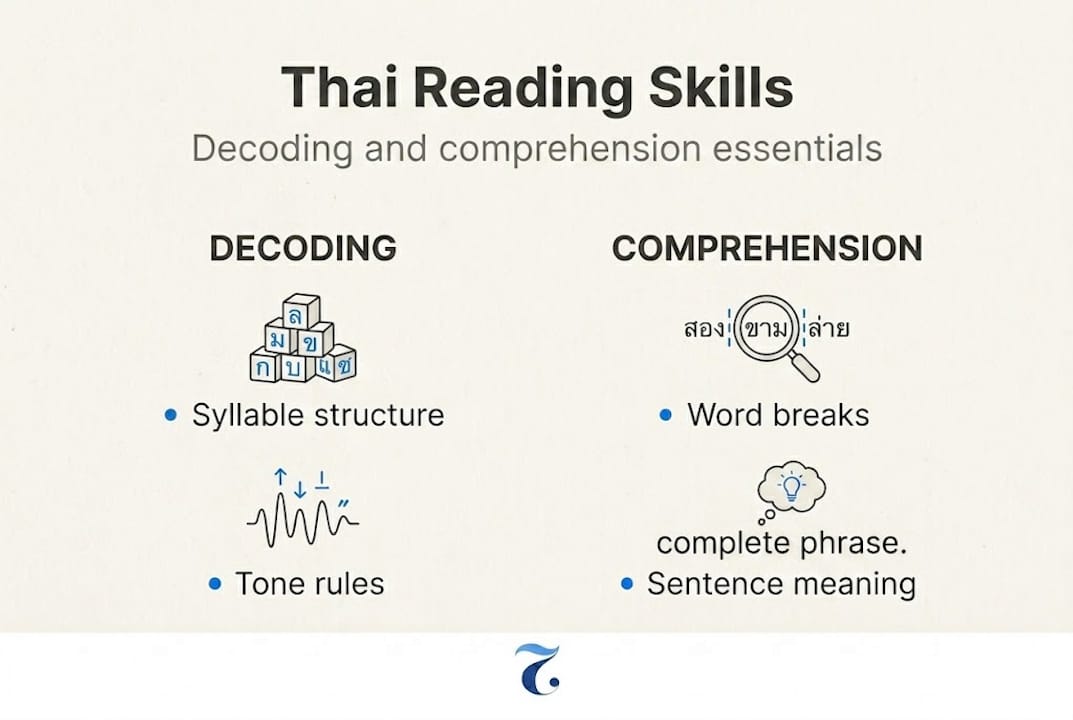
Most people assume that once you learn the Thai alphabet, reading follows naturally. It does not. Thai reading skill is a layered ability that includes three distinct competencies: decoding, pronunciation, and comprehension. You need all three working together before reading becomes useful in the real world.
Decoding means breaking a written word into its syllable parts and identifying its letters correctly. Pronunciation means applying the correct tone and sound to each syllable. Comprehension means understanding what the full sentence means in context. A learner who can only decode is like someone who can sound out words in a foreign language without knowing what they mean. That is not reading. That is just noise on a page.
Here is what makes Thai particularly demanding. The Thai language reads left-to-right without word spaces, which means your brain has to figure out where one word ends and the next begins, all while managing tones, vowel positions, and consonant sounds at the same time. This is fundamentally different from reading English, where spaces do the heavy lifting for you.
Consider this striking reality: Thailand reports an adult literacy rate near 99%, yet 64.7% of Thai adults fall below the foundational reading threshold, meaning they cannot reliably read short practical texts like medical instructions. That statistic reframes everything. It proves that being “literate” and being a competent reader are two completely different things.
Core aspects of functional Thai reading
To read Thai with genuine competence, you need to develop all of the following:
- Script mechanics: Recognizing consonants, vowel symbols, and tone marks in combination
- Tone awareness: Applying the correct tone based on consonant class, syllable type, and any tone mark present
- Word segmentation: Knowing where words begin and end without visual cues
- Vocabulary depth: Recognizing enough words to infer meaning from context
- Comprehension strategies: Using surrounding sentences to fill in gaps when a word is unfamiliar
Alphabet recognition vs. functional reading ability
| Skill | Alphabet recognition | Functional reading |
|---|---|---|
| What you can do | Name and write letters | Decode full sentences with correct tone |
| Vocabulary needed | Minimal | Intermediate to advanced |
| Word spacing | Not required | Critical for comprehension |
| Tone application | Not tested | Essential for meaning |
| Real-world use | Road signs with romanization | Menus, contracts, social media |
If you want a strong head start on the letters themselves, reviewing Thai alphabet basics is a smart first move before working on the functional skills described above.
Cracking the code: How Thai script works
Understanding script mechanics is the foundation everything else is built on. Thai has 44 consonants, and each one belongs to one of three consonant classes: high, middle, or low. These classes directly influence the tone of a syllable even when no tone mark is present. That means two syllables using the same vowel and same tone mark can sound completely different depending on which consonant class anchors the syllable.
Steps to decode a Thai syllable
- Identify the initial consonant and note its class (high, middle, or low).
- Locate the vowel symbol, which may appear above, below, before, or after the consonant.
- Check for a tone mark (mai ek, mai tho, mai tri, or mai jattawa) positioned above the consonant.
- Identify the final consonant if one exists, and determine whether the syllable is live or dead.
- Apply the tone rule based on the combination of consonant class, syllable type, and tone mark.
- Pronounce the full syllable with the correct tone and vowel length.
That six-step process happens automatically for a fluent reader, but for a learner, it takes conscious effort on every single syllable. Tone rules work predictably once you internalize the consonant classes, which is why spending time on those classes early pays off enormously.
Thai consonant classes and their default tones
| Consonant class | Example letters | Live syllable tone | Dead syllable tone |
|---|---|---|---|
| Middle class | ก จ ด ต | Mid | Low (short) / Low (long) |
| High class | ข ฉ ถ | Rising | Low |
| Low class | ง น ม ย | Mid | Falling (long) / High (short) |
“Silent letters from Pali and Sanskrit origins, inconsistent historical spellings, and consonant clusters all add layers of complexity. Even native Thais sometimes misspell words because the script reflects ancient pronunciation rather than modern usage.”
This is one of the most surprising facts for new learners: the Thai writing system was not designed to reflect modern spoken Thai perfectly. It preserves older pronunciations and loan words from religious languages, which is why silent letters appear regularly. The final letter of a word might not be pronounced at all. Learning the consonant names used for spelling in Thai (similar to how English speakers say “B for Bob”) helps enormously when deciphering unfamiliar words.
Another critical point: Thai has no punctuation marks in the traditional sense. No periods. No commas. Paragraphs flow until a space appears, which typically marks a sentence boundary rather than a word boundary. Once you understand this, reading Thai text feels less overwhelming because you stop looking for punctuation that was never there.
Pro Tip: Do not try to memorize vocabulary before you have a working understanding of syllable structure. A single Thai syllable is the base unit of everything, and getting comfortable with how syllables are formed will make every new word easier to absorb. Study your Thai tones explained alongside the alphabet mechanics so both systems develop together.
Adult learning strategies: Building Thai reading skills step by step
Adults learn differently from children. You bring logic, pattern recognition, and life experience to the table, but you also have less time and more mental resistance when things feel chaotic. The good news is that structured, context-driven methods work especially well for adult Thai learners.
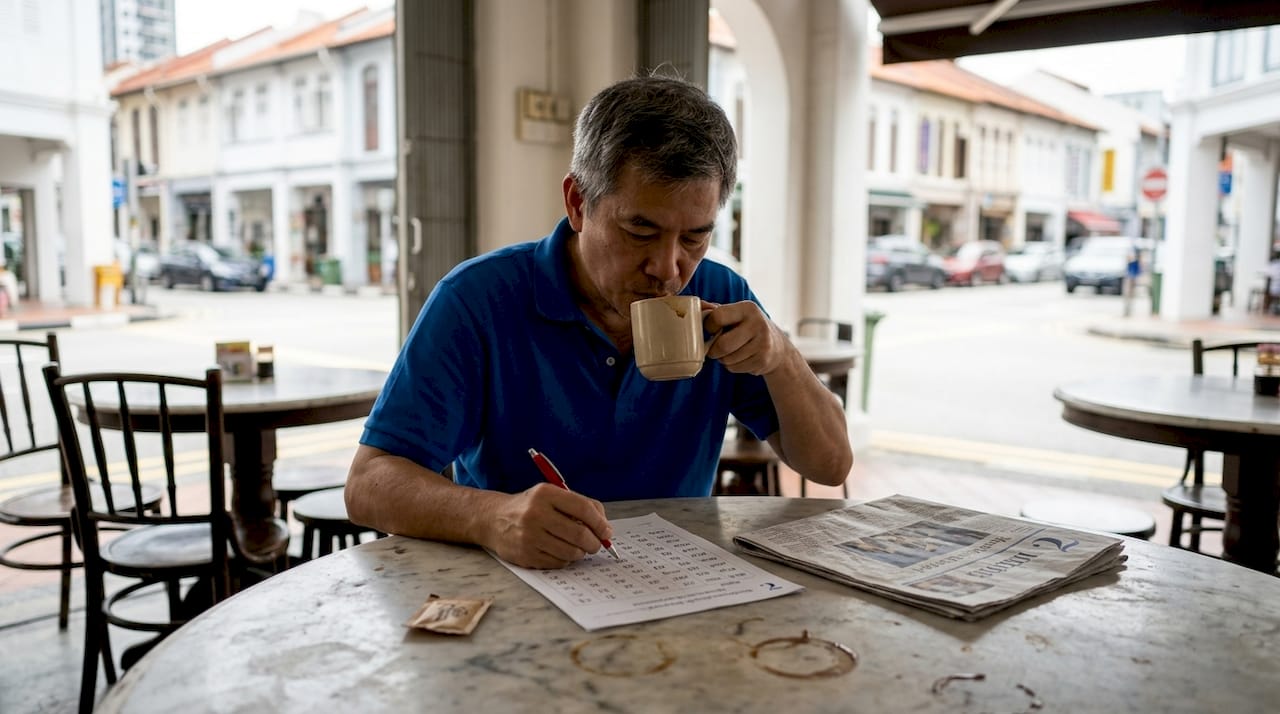
The most effective methodology for adults is the deconstruction approach. You take a short Thai sentence or phrase, copy it, separate the words, underline anything unfamiliar, translate what you already know, look up what you do not, and then reconstruct the full meaning. This process forces you to engage with grammar, vocabulary, and script mechanics simultaneously, which accelerates retention far more than drilling vocabulary lists alone.
A practical weekly reading routine for adult learners
- Monday and Wednesday: Study a new syllable type or tone rule using a structured reference. Write 10 example words using that rule.
- Tuesday and Thursday: Read one short Thai text (a menu item, a sign, a product label) and apply the deconstruction method.
- Friday: Use a spaced repetition app to review characters, words, and tone rules from the week.
- Weekend: Read for meaning, not perfection. Choose something you actually want to understand, like a Thai social media post or a travel phrase.
The script encodes pronunciation predictably enough that patterns will start emerging within weeks if you practice consistently. The key is progressing from known phrases to slightly harder texts rather than jumping into long-form material too soon.
Recommended tools and resources
- Anki: Spaced repetition flashcard app that works well for Thai consonants and tone rules
- Google Translate camera function: Lets you point your phone at Thai text and get instant translations, useful for checking your own decoding attempts
- Thai language learning apps with reading modules that progress from syllables to short sentences
- Graded readers designed for Thai learners, starting with simple, high-frequency vocabulary
If you are based in Singapore and want a more structured path, Thai courses for adults provide guided progression that removes the guesswork. Pairing structured classes with everyday Thai practice outside the classroom consistently produces faster results than either approach alone.
Pro Tip: Context beats memorization every time. Instead of drilling isolated characters, attach each new letter or tone rule to a real word or phrase you actually care about. Learners who connect script knowledge to meaningful language move to functional reading much faster than those who study abstract rules in isolation.
Mastering the nuances: Common challenges and how to overcome them
Even after you grasp the core mechanics, Thai script will still throw surprises at you. These challenges are not signs that you are failing. They are signs that you are moving into intermediate territory, where real fluency is built.
Classic challenges that trip up Thai readers
- Silent letters: Words borrowed from Pali and Sanskrit preserve letters that are no longer pronounced. The letter ร at the end of certain words is a common example. Silent letters from ancient languages appear across everyday vocabulary, so you need to learn which words carry them rather than expecting a consistent rule.
- Consonant clusters: Some words begin with two consonants together, and the rules for how these affect tone are specific to each cluster. Practice with common clusters rather than trying to memorize all possibilities at once.
- Non-linear vowel placement: In English, vowels sit between consonants. In Thai, vowel symbols can appear before, after, above, or below the consonant they modify, and some wrap around the consonant on two sides. This makes visual scanning very different from what English readers are used to.
- Live vs. dead syllables: Whether a syllable ends in a sonorant consonant or a stop consonant determines whether it is “live” or “dead,” which then affects tone calculation. This is one of the trickier systems to internalize.
- Non-standard spelling: Thais themselves sometimes write words incorrectly, especially in informal digital communication. If you see something that breaks the rules you have learned, it may simply be a spelling error by a native speaker.
“Despite Thailand’s near-total official literacy rate, the functional reading gap shows that exposure to complex, real-world texts is where lasting skill actually develops.”
One underrated strategy for overcoming these nuances is learning the Thai consonant names used for spelling. When a Thai speaker spells out a word verbally, they say something equivalent to “ก as in ไก่” (chicken). Knowing these reference words helps you look up unfamiliar characters in dictionaries and recognize which consonant is being used in tricky clusters.
Another practical move is studying writing Thai for reading alongside your reading practice. The act of writing characters by hand reinforces shape recognition in a way that passive reading alone cannot achieve. Learners who practice writing consistently tend to decode unfamiliar words faster because their visual memory for character shapes is stronger.
Why mastering Thai reading is more about strategy than memorization
Here is something most Thai learning resources will not tell you plainly: the learners who plateau at alphabet recognition are almost always the ones who treated learning Thai like memorizing a new keyboard layout. They drilled letters until they knew them, then hit a wall when those letters did not translate into readable text.
The learners who break through to functional reading share a different approach. They treat Thai script as a system with patterns rather than a list of facts to store. They get comfortable being wrong early, because errors in reading are information. When you decode a word incorrectly, the mismatch between your output and the actual meaning tells you exactly which rule you have not fully internalized yet.
Adaptive strategy beats raw memorization in adult language learning consistently. Pattern recognition, contextual guessing, and systematic error analysis are far more powerful than longer drill sessions. Many adults trying to self-teach Thai miss this because formal schooling conditioned them to associate effort with repetition. Real progress in reading comes from exposure to varied, meaningful texts and from reflecting on why certain words tripped you up.
Embracing mistakes and building tolerance for ambiguity are not soft skills. They are core reading competencies. If you want a framework for accelerating this process, exploring quick Thai learning strategies can help you build a smarter study plan that fits your schedule and goals.
Take your Thai reading to the next level in Singapore
You now understand what Thai reading actually requires, how the script works at a mechanical level, and what strategies will actually move you forward. The next step is applying this knowledge in a structured environment where a qualified instructor can give you real-time feedback.

Thai Explorer offers in-person Thai courses at its Tanjong Pagar location, designed for learners at every level from complete beginner to advanced. If you prefer focused, personalized guidance, private Thai lessons let you move at your own pace and target the exact skills you need most. Not able to attend in person? The online Thai course brings the same qualified native instructors to you wherever you are. All courses are built around practical communication, which means your reading skills will connect directly to real-world use from day one.
Frequently asked questions
What are the main components of Thai reading skill?
Thai reading skill involves decoding syllables, understanding tone rules, and comprehending sentences written without word spaces, all of which must work together for functional reading ability.
Is reading Thai considered difficult for English speakers?
Yes, English speakers typically find Thai challenging because the script, tone system, and lack of word breaks are all unfamiliar, but structured step-by-step strategies make steady progress very achievable.
Can Thai script be learned efficiently by adults?
Yes, adults can learn Thai script efficiently by using sentence deconstruction techniques, apps, and progressive reading materials that build from syllables to more complex texts over time.
Why do so many Thais have high literacy rates but struggle with reading in practice?
Many Thai adults pass basic literacy benchmarks but lack the skills to read and apply complex practical texts, with 64.7% falling below foundational thresholds needed for tasks like reading medical instructions.