
TL;DR:
- Learning Thai requires consistent practice, understanding tones, and engaging in real conversations.
- Adults can achieve fluency by early speaking, structured feedback, and mastering script-based pronunciation.
Thai looks nothing like any language most adults have tried before. No alphabet you recognize, five distinct tones that change meaning entirely, and spoken dialogue that moves fast enough to leave even confident learners behind. Yet thousands of adults successfully learn language every year using strategies that go well beyond downloading an app and hoping for the best. This guide lays out a realistic, step-by-step approach to learning Thai as an adult, covering everything from the right mindset before you start to the feedback loops that keep you improving long after the basics feel familiar.
Table of Contents
- Key takeaways
- What you need before you start learning Thai
- Building vocabulary and pronunciation from scratch
- From vocabulary to real conversation
- Common mistakes adult Thai learners make
- How to measure progress and maintain momentum
- My honest take on learning Thai as an adult
- Start learning Thai the right way with Thai Explorer
- FAQ
Key takeaways
| Point | Details |
|---|---|
| Apps alone won’t cut it | Real fluency requires sustained exposure and feedback, not just app streaks. |
| Tones are non-negotiable | Thai has five tones; getting them wrong changes your meaning entirely, so pronunciation practice starts on day one. |
| Script unlocks pronunciation | Learning Thai script as a phonological system, not just letters, is the fastest path to reading and correct tone production. |
| Progress needs benchmarks | Using recognized frameworks like CEFR gives you clear milestones to track speaking, listening, and reading growth. |
| Human interaction accelerates fluency | Native teachers and language partners provide the real-world feedback that no app or textbook can replicate. |
What you need before you start learning Thai
Most adults approach a new language the same way they approached school subjects: gather materials, start reading, and hope retention follows. Thai does not cooperate with that plan. Before you spend a single hour studying vocabulary, three things need to be in place.
Realistic goals and honest commitment. Thai is classified as a Category IV language for English speakers, meaning it takes significantly more hours to reach conversational proficiency than French or Spanish. That is not a warning to give up. It is a signal to plan for months of consistent practice, not weeks. Adults who focus on strategy and feedback rather than worrying about being “too old” make measurable progress at any age.
The right toolkit. Your toolkit should cover at minimum:
- A spaced repetition app (Anki works well) for vocabulary
- A structured textbook or course that explains Thai grammar in English
- Flashcard sets with audio so you hear words, not just see them
- Access to native Thai media: YouTube channels, podcasts, Thai dramas
- A language partner or tutor for weekly speaking practice
A clear framework for goal setting. The CEFR Companion volume in Thai, launched in 2024, gives you a standardized map from beginner (A1) to advanced (C2). Use it to define what “good enough” looks like for your purpose. Travel Thai looks very different from business Thai, and knowing your target level keeps your study time focused.
Pro Tip: Before memorizing a single word, spend your first two study sessions only listening to Thai. Watch Thai content without subtitles for 20 minutes, then with subtitles. You are training your ear to the rhythm and tone patterns of the language before your brain starts loading vocabulary onto them.
Building vocabulary and pronunciation from scratch
Here is where most beginners make their first big mistake: they learn words silently. They type them into apps, read them on flashcards, and recognize them on a screen, but they have never actually heard the word spoken naturally or tried to reproduce the tone themselves. That leads to a vocabulary that exists only in your eyes.
Thai has five tones: mid, low, falling, high, and rising. The word “mai” means completely different things depending on which tone you use, ranging from “new” to “not” to “silk” to “wood” to a question marker. Memory and a good ear for intonation are critical factors in Thai learning success, which means pronunciation training is not something you add later. It starts now.
Follow this sequence when building your early foundation:
- Learn Thai script as a system, not a list. The Thai script has consonant classes (high, mid, and low) that directly determine which tone a syllable takes. Understanding these phonological rules reduces confusion and improves reading far faster than memorizing letters one by one. Spend your first two to three weeks here.
- Add high-frequency vocabulary with audio. Start with the 500 most common Thai words, but only learn them with audio attached. Repeat each word aloud, mimicking the tone you hear. Do not move on until your pronunciation is close.
- Practice tone drills with minimal pairs. A minimal pair in Thai is two words that are identical except for tone. Drilling these trains your ear and your mouth at the same time. Ten minutes of this daily beats an hour of silent flashcard review.
- Use spaced repetition for retention. Schedule your vocabulary reviews using an app that surfaces words right before you forget them. This approach builds a durable long-term memory bank rather than short-term cramming.
- Record yourself weekly. Play it back next to a native speaker saying the same phrase. The gap between the two recordings is your roadmap for improvement.
Pro Tip: When you learn a new Thai word, always look up which consonant class its initial consonant belongs to. That tells you the tone rule immediately. Linking the script to the sound from the start saves you from relearning everything later.
Checking your Thai pronunciation progress regularly against a structured guide keeps your self-study honest.

From vocabulary to real conversation
Passing a vocabulary quiz and holding a conversation are two completely different skills. Many adult learners discover this gap painfully around the three-month mark: they recognize words but cannot follow a real exchange. This happens because understanding rarer words and natural responses in dialogue requires a different kind of training than vocabulary lists provide.
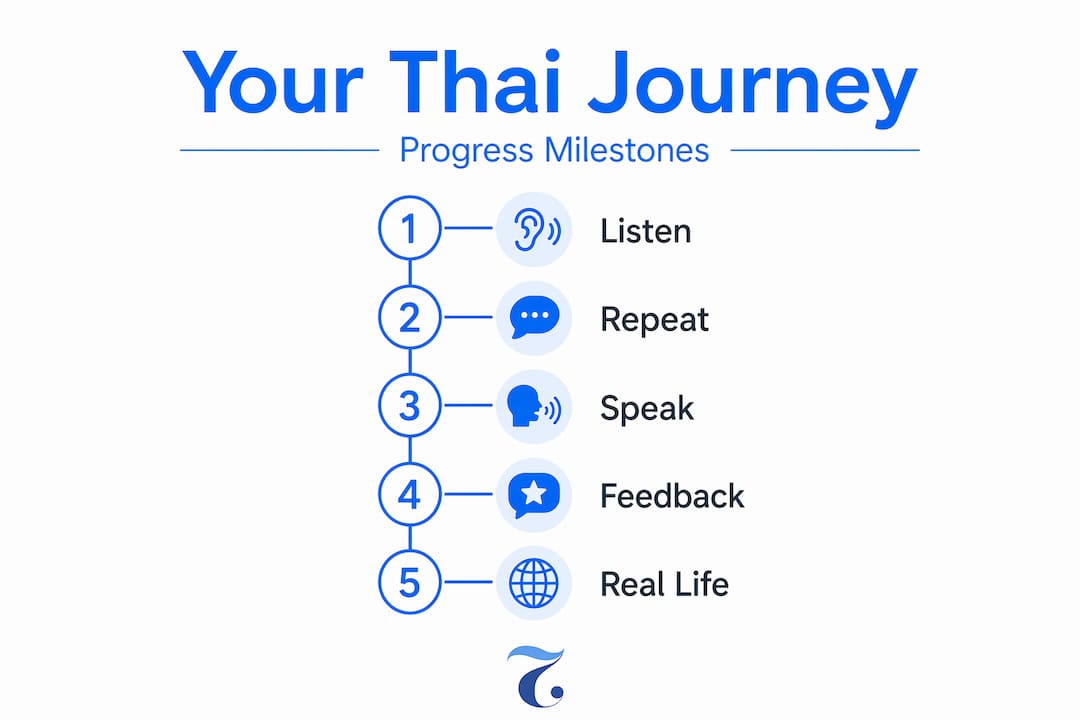
The fix is sustained exposure combined with actual speaking. Listening to real dialogues with feedback is what bridges the comprehension gap. Passive listening to Thai media helps, but you also need to speak out loud and receive correction.
Here is how the transition phase looks in practice:
- Shadowing: Listen to a sentence of native Thai audio, pause, then repeat it immediately, matching the rhythm and tone as closely as you can. This builds speech fluency faster than any translation exercise.
- Weekly speaking sessions: Even one 30-minute conversation with a native speaker per week gives your brain a real-world context to attach vocabulary to.
- Controlled output before free conversation: Before open-ended dialogue, practice set phrases in specific situations: ordering food, asking for directions, describing your day. This builds confidence without the overwhelm of open topics.
- Active listening with transcripts: Find a Thai audio clip with a written transcript. Listen first, then check the text. This reveals how spoken Thai differs from written Thai in real usage.
The table below compares common study methods by their effectiveness for moving from vocabulary into real conversation:
| Study method | Good for vocabulary? | Good for conversation? |
|---|---|---|
| Flashcard apps | Yes | No |
| Shadowing native audio | Moderate | Yes |
| Grammar textbooks | Moderate | No |
| Weekly tutoring sessions | Yes | Yes |
| Thai dramas with subtitles | Yes | Moderate |
| Language exchange partners | Moderate | Yes |
The pattern is clear. Apps and tech complement human instruction but cannot replace it for building real conversational ability.
Common mistakes adult Thai learners make
Learning Thai as an adult comes with a specific set of traps. Knowing them in advance saves you weeks or months of frustration.
- Treating app progress as fluency. Hitting a 90-day streak on a language app is satisfying, but it does not mean you can hold a conversation. Apps test recognition, not production.
- Skipping tone and pronunciation practice. Thai people will often struggle to understand even grammatically correct sentences if the tones are wrong. Pronunciation is not a detail you polish later. It is the foundation.
- Approaching the Thai script as a memorization task. Most learners try to memorize all 44 consonants individually before understanding the system. Learning the Thai script as a structured system first cuts your script-learning time significantly.
- Avoiding speaking until you feel “ready.” That moment almost never comes. Speaking from week two, even badly, accelerates your learning more than waiting six months to feel confident.
- Underestimating the time required. Real conversational fluency takes many months of sustained practice with feedback and social use. Budget accordingly.
“The biggest obstacle for adult Thai learners is not the language itself. It is the gap between what they study and what they actually practice saying out loud.”
Understanding common Thai mistakes before you make them puts you ahead of most self-taught learners from the start.
How to measure progress and maintain momentum
Progress that you cannot measure is progress you cannot trust. The good news is that Thai language learning has clear benchmarks you can use.
| Milestone | What it looks like in practice |
|---|---|
| A1 (Beginner) | Introduce yourself, order food, count money, ask basic questions |
| A2 (Elementary) | Describe your day, navigate transport, understand simple signs |
| B1 (Intermediate) | Hold a conversation about work or travel, read short texts |
| B2 (Upper-Intermediate) | Discuss opinions, understand most Thai media, write short messages |
The CEFR framework for Thai provides clear descriptors for each level across speaking, listening, reading, and writing. Checking yourself against these descriptors every 8 to 10 weeks tells you where your real gaps are, not just where you feel uncertain.
Beyond frameworks, feedback loops are what actually sustain momentum. A tutor who corrects your tone mistakes, a language partner who tells you when you have been misunderstood, and a recognized proficiency test that verifies your level objectively all serve this function. Cultural immersion also deepens language skills in ways pure study cannot. Knowing why Thai speakers use particles like “krub” and “ka” differently is not just interesting. It changes how naturally you speak. Explore cultural fluency in Thai alongside language study for the fastest route to sounding natural.
Pro Tip: Set a 10-week goal with one specific, observable outcome: “I will be able to order a full meal in Thai without switching to English.” Small, specific targets generate more motivation than vague ambitions like “get better at Thai.”
My honest take on learning Thai as an adult
I have watched a lot of adult learners try to learn language the “comfortable” way. They study vocabulary every morning, get through an app level or two, and feel like they are making progress. Then they land in Bangkok or sit across from a Thai colleague and realize they cannot follow a word of the actual conversation. That disconnect is real, and it is not because Thai is uniquely hard. It is because they trained for recognition, not for real use.
What actually worked for me, and what I have seen work for learners who reach genuine fluency, is starting to speak out loud far earlier than feels natural. Week two, not month six. Embarrassing, yes. Effective, absolutely. The adult brain is neurologically ready for language acquisition. What it needs is quality input and honest feedback, not more silent flashcard practice.
The other shift that changed everything was treating the Thai script as a logical system rather than a decorative puzzle to memorize. Once you understand how consonant classes control tones, the script becomes a pronunciation guide, not an obstacle. It took me about three focused weeks to crack it, and from that point forward, every new word I learned came with its correct tone built in.
My advice: celebrate small wins, get a good teacher early, and accept that you will sound awkward for a while. That awkward phase is not a sign you are doing it wrong. It is the actual learning happening.
— Paul
Start learning Thai the right way with Thai Explorer
If you have been self-studying and hitting a ceiling, or if you are just starting out and want to build the right habits from day one, a structured course with native speakers makes a measurable difference.

Thai Explorer offers adult Thai courses in Singapore covering conversational Thai, business communication, and fully online Zoom-based classes for learners at every level. Lessons are taught by qualified native Thai instructors who are bilingual in Thai and English, so nothing gets lost in translation. The curriculum follows recognized proficiency standards, giving you clear benchmarks for every stage of your progress. Whether you want to explore Thai courses for travel and culture, prepare for a recognized Thai proficiency test, or fast-track your skills with private Thai lessons, Thai Explorer has a format that fits your schedule and goals. Thai Explorer is located right above Tanjong Pagar MRT at 10 Anson Road, #22-07, International Plaza, Singapore 079903.
FAQ
Can adults really learn Thai from scratch?
Yes. Adult brains are fully equipped for language learning. Progress depends on input quality and consistent practice, not age.
How long does it take to hold a basic Thai conversation?
Most motivated adult learners reach basic conversational ability in three to six months with regular speaking practice and structured feedback.
Do I need to learn the Thai script to speak Thai?
You do not need it to speak, but learning the Thai script makes your pronunciation and tone accuracy significantly better because the script encodes tone rules directly.
What is the best way to learn Thai fast?
Combine daily vocabulary study using spaced repetition with weekly speaking sessions with a native teacher. Interactive speaking and feedback prevent the plateau that stops most self-learners.
Can I learn languages online effectively?
Yes, provided your online study includes live conversation practice with feedback. Passive online tools like apps and videos support learning but need to be paired with real interaction to build speaking fluency.