
TL;DR:
- Practical language training emphasizes completing real-world tasks to develop fluency more effectively than traditional grammar drills. Consistent daily routines combining input, flashcards, and conversation practice accelerate progress within 90 days. Explicit instruction in sociopragmatic norms and immediate feedback are crucial for achieving authentic and socially appropriate communication skills.
Practical language training is the process of acquiring language skills by completing realistic, meaningful tasks that mirror everyday communication rather than abstract textbook exercises. Unlike grammar drills or vocabulary memorization in isolation, this approach connects what you learn directly to what you need to say, ask, or understand in real situations. Whether you are ordering food, conducting a business meeting, or navigating a new city, the method known formally as task-based language teaching (TBLT) builds fluency through doing. Research from 2026 confirms that task-based methodology accelerates fluency by prioritizing task completion over grammar drills.
What is practical language training and why does it work?
Practical language training is defined as task-based language teaching, a methodology where learners complete meaningful real-world objectives rather than textbook exercises. The core idea is simple: you learn a language by using it, not by studying it. This shift from passive study to active communication is the single most important change any learner can make.
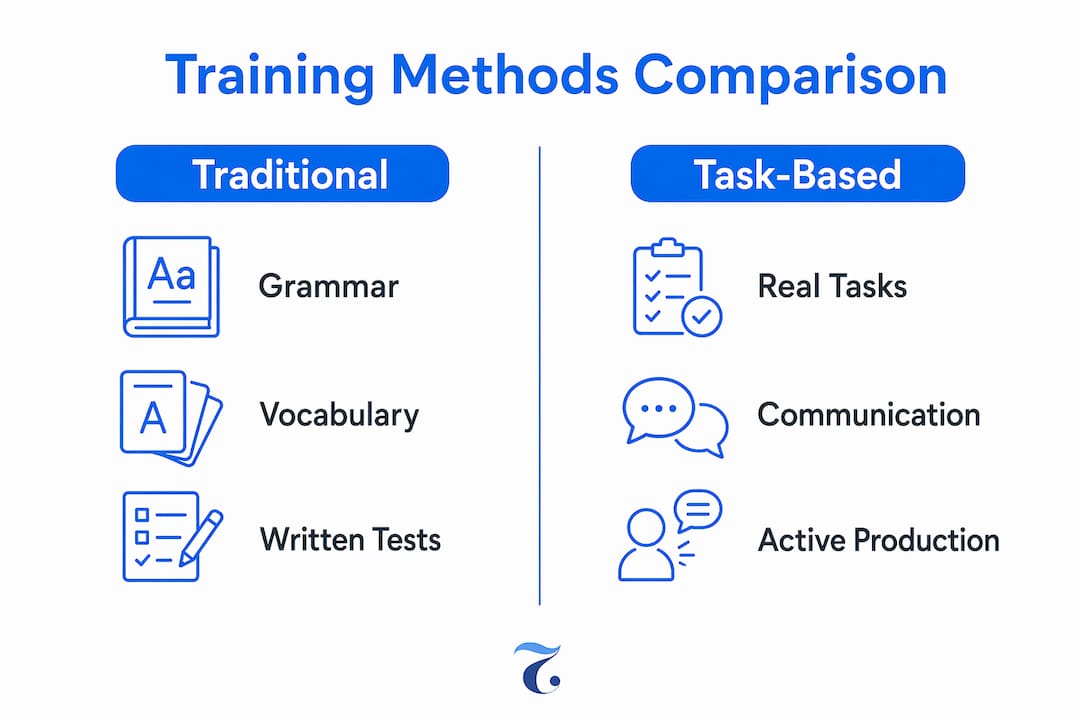
Traditional classroom instruction typically focuses on grammar rules, vocabulary lists, and written tests. Task-based practical training flips that model. You practice ordering food in Thai before you have memorized every polite particle. You rehearse a job interview in your target language before you have mastered every tense. The gaps you encounter during those tasks tell you exactly what to study next.
Communicative competence requires engineering teaching conditions where communication is unavoidable, not just curriculum delivery. That distinction matters enormously. A curriculum can be delivered to a passive student. Communicative competence only develops when the student is forced to produce language under real pressure.
Traditional vs. task-based training: a direct comparison
| Feature | Traditional Grammar-Based | Task-Based Practical Training |
|---|---|---|
| Primary focus | Grammar rules and structure | Completing real-world communication tasks |
| Feedback source | Test scores and written corrections | Conversation outcomes and comprehension gaps |
| Motivation driver | Grades and curriculum completion | Achieving a meaningful goal in the language |
| Skill transfer | Slow, requires separate practice | Immediate, built into every session |
| Error treatment | Errors are penalized | Errors reveal gaps and guide next steps |
The table above shows why task-based learners reach conversational fluency faster. Every session produces a result you can measure in real terms: did you get what you needed from that conversation or not?
Pro Tip: Pick one real task you will need to perform in your target language this week, such as asking for directions or making a reservation, and use it as your entire practice session. The urgency of a real goal beats any textbook exercise.
What does an effective daily training routine look like?
A structured daily routine is the backbone of practical language learning. Research supports a 90-day sprint built around three daily activities: 30 minutes of comprehensible input, 15 minutes of spaced-repetition flashcards, and 15 minutes of live conversation practice. That 60-minute daily commitment divides into three phases: habit building in the first month, vocabulary expansion in the second, and fluency refinement in the third.

The 90-day structure works because it forces you to build all three skill layers simultaneously. Input (listening and reading) builds your passive understanding. Spaced-repetition tools like Anki or Quizlet lock vocabulary into long-term memory. Conversation practice forces retrieval, which is the hardest and most valuable skill of all.
Deliberate practice sessions of 30 minutes targeting specific weak points with immediate feedback outperform passive study. That means you do not just talk and hope for the best. You identify one specific gap, such as polite request forms or number pronunciation, and drill it with a partner or instructor who corrects you in real time.
Here is a numbered weekly routine grounded in that research:
- Monday: 30 minutes of listening to native-level content at your current comprehension level, such as a Thai podcast or short video clip.
- Tuesday: 15 minutes of Anki flashcard review targeting vocabulary from Monday’s input, plus 15 minutes of speaking practice using those words in sentences.
- Wednesday: Complete one full real-world task simulation, such as a mock phone call or a scripted shopping scenario, with a language partner or instructor.
- Thursday: Review errors from Wednesday’s task. Study the specific grammar or vocabulary that caused breakdowns.
- Friday: Repeat Wednesday’s task from scratch without notes. Measure improvement directly.
- Weekend: One unstructured conversation session in the target language, focused on fluency over accuracy.
Pro Tip: Record your task simulations on Wednesdays. Listening back to yourself is uncomfortable but reveals pronunciation and grammar errors that you miss in the moment.
A needs analysis identifies the specific linguistic demands of your real-world environment and tailors study tasks to mirror those scenarios. If you are learning Thai for business meetings in Singapore, your tasks should simulate boardroom introductions and negotiation phrases, not tourist vocabulary. Tailored practice produces higher engagement and faster skill transfer than generic curricula.
Why does sociopragmatic competence matter in language training?
Sociopragmatic competence is the ability to use language in ways that are socially appropriate for a given context, not just grammatically correct. This is the skill most learners underestimate and most courses underteach. You can construct a perfect sentence in Thai and still offend someone if you use the wrong level of formality or miss a cultural cue.
Pragmatic competence involves knowledge of speech acts and sociopragmatic norms, and explicit instruction accelerates its acquisition because immersion alone is insufficient. That finding surprises many learners who assume that living in a country or spending time with native speakers will automatically teach them social language norms. It does not. Without explicit instruction, most learners absorb vocabulary and grammar but miss the subtle rules governing when and how to say things.
Common areas where sociopragmatic gaps cause problems include:
- Politeness levels: Thai uses different vocabulary and particles depending on the relationship between speakers. Using casual speech with a senior colleague reads as disrespectful, even if every word is technically correct.
- Indirect speech: Many cultures, including Thai, favor indirect communication to preserve face. Learners trained only on direct question-and-answer patterns often miss the real meaning of a response.
- Non-verbal cues: Neglecting sociopragmatic norms produces grammatically correct but socially inappropriate language use. Observing how native speakers use gestures, pauses, and tone is as important as the words themselves.
- Speech acts: Requests, apologies, and refusals each follow culturally specific scripts. Knowing the script for a Thai apology, for example, is different from knowing how to apologize in English.
To build sociopragmatic skills alongside task-based training, watch Thai films or television with subtitles and pay attention to how characters address each other in different social situations. Work with a native instructor who can explain the cultural logic behind specific phrases. Thai Explorer’s cultural fluency approach integrates these cultural layers directly into structured lessons, which is exactly the kind of explicit instruction the research recommends.
How do you overcome the hardest challenges in practical training?
The biggest obstacle most learners face is confusing recognition with retrieval. You hear a word and understand it. You assume you know it. Then you try to use it in conversation and it disappears. Recognition and retrieval are entirely different skills, and only retrieval matters in real conversation. The discomfort you feel when a word will not come is not failure. It is the signal that effective learning is happening.
The task-feedback-revision loop is the most reliable method for turning that discomfort into progress. The loop works like this: attempt a task, identify the gaps that blocked you, study the specific grammar or vocabulary involved, and then repeat the task. Each cycle produces measurable improvement because you are studying exactly what you need, not what a textbook thinks you need.
Other common challenges and how to address them:
- Avoiding output: Many learners spend months on input and delay speaking. Set a rule that every study session must include at least 10 minutes of spoken output, even if it is just talking to yourself.
- Ignoring social context: Grammar practice without cultural context produces awkward speakers. Pair every new structure with a real scenario that shows when and with whom you would use it.
- Feedback that is too vague: “That sounded good” is not useful. Ask your instructor or language partner to flag every error and explain the correct form immediately.
Pro Tip: After every conversation practice session, write down the three moments where you hesitated or used the wrong word. Those three points become your study targets for the next 48 hours.
You can also explore immersive Thai learning methods that combine task-based practice with cultural immersion to close both the linguistic and sociopragmatic gaps at the same time.
Key takeaways
Practical language training works because it forces active language production in real contexts, which builds both communicative competence and sociopragmatic skill faster than any passive study method.
| Point | Details |
|---|---|
| Task-based learning accelerates fluency | Completing real-world tasks reveals gaps and builds transferable skills faster than grammar drills. |
| Daily structure matters | A 60-minute daily routine combining input, flashcards, and conversation produces measurable progress within 90 days. |
| Retrieval beats recognition | Forcing active production, not passive understanding, is what builds real conversational ability. |
| Sociopragmatic skills require explicit teaching | Immersion alone does not teach social language norms; structured instruction with a native speaker is necessary. |
| Tailor tasks to your real life | A needs analysis that matches practice scenarios to your actual communication goals produces faster, more relevant results. |
Why i think most language learners are practicing the wrong way
I have watched hundreds of adult learners spend months on apps, grammar books, and vocabulary lists, then freeze completely the first time a native speaker responds at full speed. The problem is not effort. The problem is that passive study feels productive while active output feels terrifying, so learners default to what is comfortable.
The research on deliberate practice is unambiguous: 30 focused minutes of output with immediate feedback beats two hours of passive input every single time. But most learners never get there because no one tells them that the discomfort of retrieval is the point, not a sign they are not ready.
What changed my perspective was watching learners who committed to task-based practice from day one. They made more errors in the first two weeks than grammar-focused learners made in two months. But by week six, they were holding real conversations. The grammar learners were still conjugating verbs on paper.
The sociopragmatic piece is the one that most courses skip entirely, and it is the one that separates functional speakers from truly fluent ones. Knowing when to use formal Thai versus casual Thai, how to soften a request, or how to read silence in a conversation, these are not advanced skills. They are the skills that make you sound like a person rather than a textbook. Native instructors who can explain the cultural logic behind language choices are worth more than any app for this reason.
If you are serious about reaching fluency, stop optimizing your study schedule and start having more conversations. The gaps you encounter in those conversations are your curriculum.
— Paul
Start learning thai the practical way with thai explorer
Thai Explorer offers adult Thai courses in Singapore built around the exact principles this article covers: task-based practice, communicative competence, and cultural context taught by qualified native instructors.

Whether you prefer group classes, private Thai lessons tailored to your specific goals, or online Thai courses via Zoom, every program is designed to move you from studying Thai to actually using it. Corporate training options are also available for teams that need practical Thai communication skills for professional contexts. Classes are held at 10 Anson Road, #22-07, International Plaza, Singapore 079903, right above Tanjong Pagar MRT. Explore the full range of Thai language courses and find the format that fits your life.
FAQ
What is task-based language teaching?
Task-based language teaching is a methodology where learners complete real-world communication tasks, such as ordering food or conducting an interview, rather than studying grammar in isolation. Research confirms this approach accelerates fluency by connecting language use directly to meaningful outcomes.
How long does practical language training take to show results?
A structured 90-day program combining daily input, spaced-repetition flashcards, and conversation practice produces measurable fluency gains within the first month. Progress depends on consistency and the quality of feedback you receive during output sessions.
Is immersive language training the same as practical training?
Immersive language training and practical language training overlap significantly but are not identical. Immersive training refers to surrounding yourself with the language constantly, while practical training specifically emphasizes completing real-world tasks. The most effective approach combines both.
Why is sociopragmatic competence important for language learners?
Sociopragmatic competence allows you to use language in socially appropriate ways, not just grammatically correct ones. Explicit instruction is required because immersion alone does not reliably teach politeness levels, indirect speech, or cultural communication norms.
What is the best way to get feedback during language practice?
The most effective feedback is immediate and specific: your instructor or language partner flags each error and explains the correct form in context. Vague positive feedback does not improve production. Recording your practice sessions and reviewing them with a native speaker is one of the most reliable methods available.