TL;DR:
- Using authentic Thai media like dramas, films, music, and podcasts enhances language skills by exposing learners to real speech and cultural context. Active engagement through speaking and note-taking, supported by tools like VPNs and flashcards, accelerates fluency more than passive watching alone. Consistent, structured media practice combined with speaking exercises significantly improves comprehension, confidence, and conversational ability.
Thai media immersion is the practice of using authentic Thai content, including dramas, films, music, and podcasts, as a structured tool for language acquisition. Knowing how to use Thai media for learning gives you direct access to real speech patterns, cultural context, and vocabulary that no textbook can fully replicate. The key is active, progressive engagement rather than passive watching. When you combine the right media types with the right tools and speaking exercises, your comprehension and confidence grow faster than classroom study alone can deliver.
What types of Thai media work best for language learning?
Thai media covers a wide range of formats, and each one builds different skills. Choosing the right type for your level and goal makes a measurable difference in how fast you progress.

Thai TV dramas and series are the most effective starting point for most learners. They use natural conversational Thai, repeat common phrases across episodes, and give you visual context that helps decode meaning. Thai lakorn (soap operas) and modern streaming dramas on platforms like Netflix Thailand expose you to both formal and informal registers.
Thai films work well once you have basic listening skills. Using Thai films for education builds cultural literacy alongside vocabulary, because films reflect social norms, humor, and regional identity in ways that structured lessons rarely cover.
Thai music trains your ear for tone and rhythm. Thai is a tonal language with five tones, so hearing those tones in song helps your brain recognize patterns. Pop artists like Bird Thongchai and contemporary acts on YouTube give you a wide range of vocabulary and emotional register.
Thai podcasts and YouTube channels are ideal for intermediate learners. They deliver natural speech at conversational speed, often with topic-specific vocabulary for travel, business, or daily life. The best Thai podcasts for language learners focus on slow, clear delivery before moving to native-speed content.
Here is a quick breakdown of each format by skill focus:
- Thai dramas: Listening comprehension, conversational vocabulary, cultural norms
- Thai films: Advanced listening, cultural storytelling, formal and informal registers
- Thai music: Tone recognition, pronunciation, emotional vocabulary
- Thai podcasts: Listening stamina, topic-specific vocabulary, natural speech rhythm
- YouTube channels: Visual context, slang, current cultural references
One challenge is geo-restricted content. Some Thai streaming libraries are only available inside Thailand. The tools section below addresses how to solve that.
What tools do you need before starting?
Setting up the right environment before you begin saves hours of frustration. A few key tools make the difference between productive sessions and wasted time.
| Tool | Purpose | Best for |
|---|---|---|
| VPN service | Unlocks Thai Netflix and streaming libraries | Accessing geo-restricted content |
| Anki | Spaced repetition flashcards for vocabulary | Retaining new words from media |
| Subtitle toggle | Switch between Thai and English subtitles | Progressive comprehension practice |
| Notebook or note app | Log new vocabulary and phrases | Active review after viewing |
| Thai script guide | Read subtitles accurately | Beginners building reading speed |
VPN access lets learners outside Thailand unlock Thai media libraries for a much broader content selection. That matters because local Thai Netflix carries dramas and documentaries not available in international catalogs.
Anki flashcards complement media learning through spaced repetition, which means the app shows you a word right before you are likely to forget it. This method consistently outperforms simple review lists for long-term retention.
Learning the Thai script early also pays off. Early script mastery accelerates media-based acquisition because you can read subtitles instead of relying on romanized transliterations, which are inconsistent across sources.
Pro Tip: Set your phone and streaming account language to Thai. Even small daily exposures to Thai menus and notifications build reading familiarity over time.
How to structure your Thai media learning sessions step by step
A structured approach to learning Thai through media produces far better results than random watching. The most effective progression moves through three clear stages.
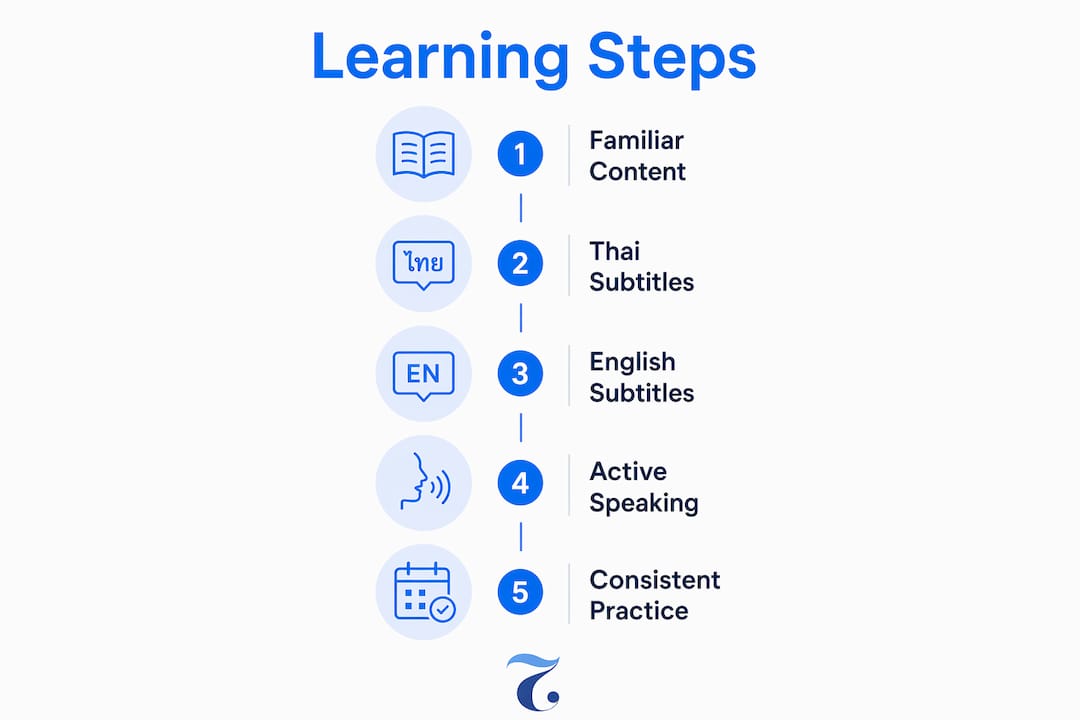
Stage 1: Familiar content with Thai subtitles. Start with a show or film you already know well in English. Turn on Thai subtitles. Because you already understand the plot, your brain focuses on matching Thai text to meaning rather than decoding both language and story at once. This builds reading speed and vocabulary recognition without overwhelming you.
Stage 2: Thai content with English subtitles. Now watch Thai dramas or films you have never seen, but keep English subtitles on. Your listening is active, but you have a safety net for comprehension. This stage builds your ear for natural Thai speech, including the speed, tone shifts, and filler words that textbooks skip.
Stage 3: Thai audio with Thai subtitles. This is full immersion. You read and listen in Thai simultaneously. Thai audio with Thai subtitles is the most challenging stage, but it trains your brain to process Thai as Thai rather than translating through English.
Follow this numbered process within each session:
- Watch a 20–30 minute episode or segment. Daily viewing at this length builds auditory familiarity without fatigue.
- Pause when you hear an unfamiliar word or phrase. Write it down with the sentence context.
- After the episode, look up your noted words and add them to Anki.
- Rewatch one short scene (2–3 minutes) without subtitles to test your listening.
- Speak out loud. Summarize what happened in the episode using Thai words you know. Even a few sentences counts.
- Record yourself once a week doing a short summary. Play it back to catch pronunciation errors.
The biggest mistake learners make is passive watching. Sitting through episodes without pausing, noting, or speaking produces very little language gain. Treat each session as a workout, not entertainment.
Pro Tip: Pick one Thai drama and commit to finishing the full series. Consistency with a single show builds familiarity with recurring vocabulary and character speech patterns faster than jumping between different programs.
How does active speaking after media viewing improve your Thai?
Watching alone builds passive understanding. Speaking after watching converts that passive knowledge into active fluency. The research on this is clear: post-screening interaction such as Q&A and reflective commentary showed a 71% improvement in spontaneity and speaking confidence among learners. That is a significant gain from a simple habit change.
Digital storytelling projects take this further. Creating an 8–10 minute spoken narrative in Thai, whether a retelling of a film scene or a personal story inspired by a drama, builds spontaneous speaking in ways that drills cannot replicate. Over 71% of learners who used project-based storytelling reported increased confidence in real-time Thai conversation.
Audiovisual projects also develop creativity, teamwork, and problem-solving skills that go beyond language. These are the competencies that make you a confident communicator, not just a technically correct one.
Practical ways to add active speaking to your media routine:
- After each episode, record a 2-minute spoken summary in Thai
- Find a language exchange partner and discuss the show’s plot or themes in Thai
- Join an online Thai learner community and post short video reactions in Thai
- Use the speaking confidence methods from structured language programs to build from written notes to spontaneous speech
“The learners who made the fastest progress were not the ones who watched the most Thai content. They were the ones who talked about what they watched. Interaction after media exposure is where passive input becomes active language.”
— NUS Teaching Connections, 2026
How do you troubleshoot common challenges in media-based Thai learning?
Every learner hits the same walls. Knowing how to get past them keeps your progress moving.
- Fast speech feels impossible: Native Thai speakers talk fast and drop syllables. Slow down playback speed to 0.75x on YouTube or Netflix. Once you follow at reduced speed, return to normal. Your ear adjusts faster than you expect.
- Slang and regional dialects confuse you: Central Thai is the standard for media, but slang varies by generation and region. Keep a slang log separate from your main vocabulary list. Context usually reveals meaning over time.
- Burnout from daily sessions: Drop from 30 minutes to 10 minutes on difficult days rather than skipping entirely. Consistency matters more than duration.
- Grammar gaps from media alone: Media provides cultural context and authentic vocabulary, but it does not teach tonal rules or sentence structure systematically. Formal study fills those gaps. Media and courses work best together, not as substitutes for each other.
- Tracking progress: Rewatch an episode you watched three months ago without subtitles. The improvement in comprehension will surprise you and reset your motivation.
Accessing content legally is also worth addressing. Thai YouTube channels are free and vast. Netflix Thailand requires a subscription and a VPN outside Thailand. Many Thai films are available on regional streaming platforms with proper licensing.
Key Takeaways
Combining progressive media exposure with active speaking practice is the most effective method for building real Thai fluency outside a classroom.
| Point | Details |
|---|---|
| Use a three-stage progression | Start with familiar content and Thai subtitles, then advance to full Thai audio and subtitles. |
| Active speaking beats passive watching | Post-viewing summaries and discussions produce measurably higher speaking confidence. |
| Tools matter before you start | A VPN, Anki, and Thai script knowledge remove the biggest barriers to media-based learning. |
| Media supplements formal study | Thai media builds vocabulary and cultural context but cannot replace structured grammar instruction. |
| Digital storytelling accelerates fluency | Creating short spoken narratives in Thai develops spontaneous communication skills faster than drills. |
What I have learned from years of watching learners use Thai media
The learners who get the most from Thai media are the ones who treat it as a conversation starter, not a finish line. I have seen adults go from zero Thai to confident conversational speakers in under a year, and almost every one of them had the same habit: they talked about what they watched.
The mistake I see most often is treating media as a passive shortcut. People binge three seasons of a Thai drama and wonder why their speaking has not improved. Watching builds recognition. Speaking builds production. You need both, and the gap between them only closes through deliberate practice.
Digital storytelling changed the game for many learners I have worked with. When you take a scene from a Thai film and retell it in your own words, you are not just recalling vocabulary. You are constructing sentences under pressure, which is exactly what real conversation demands. That pressure is productive.
My honest advice: pick one media format you genuinely enjoy, build a daily habit around it, and speak Thai about it every single day. Even two minutes of spoken summary after a podcast episode compounds into real fluency over months. The practical adult learning guide at Thai Explorer outlines how to combine this kind of self-study with structured instruction for the fastest results.
— Paul
How Thai Explorer’s courses strengthen your media learning
Thai Explorer’s adult courses are built to complement exactly the kind of media-based learning this article describes. When you watch Thai dramas and pick up vocabulary, a structured course gives you the tonal and grammatical framework to use that vocabulary correctly.
Thai Explorer offers conversational, business, online Zoom, and corporate training courses for adults at all levels. Lessons are taught by qualified native Thai instructors who are bilingual in Thai and English, so you can ask about the slang you heard in last night’s episode and get a real answer. The curriculum aligns with the CU-TFL (Chulalongkorn University Proficiency Test of Thai as a Foreign Language) standard, giving your self-study a clear benchmark. Browse the full range of adult Thai courses at Thai Explorer, or explore structured Thai language programs designed to take you from media learner to confident speaker.
FAQ
What is the best Thai media for beginners?
Thai TV dramas with English subtitles are the best starting point for beginners. They use natural conversational language, repeat common phrases, and provide visual context that supports comprehension.
How long should I watch Thai media each day?
Daily sessions of 20–30 minutes build auditory familiarity and vocabulary without causing fatigue. Consistency over time matters more than session length.
Can I learn Thai fluency from media alone?
Media builds vocabulary, listening skills, and cultural context, but it does not teach tonal rules or grammar systematically. Formal course instruction fills those gaps and is necessary for true fluency.
How do I access Thai Netflix outside Thailand?
A VPN service lets you connect to a Thai server and unlock the Thai Netflix library. This gives you access to dramas and films not available in international catalogs.
Does speaking after watching really make a difference?
Research from NUS shows that post-screening interaction, such as summaries and Q&A, improved spontaneous speaking confidence by 71% among language learners. Speaking about what you watch is one of the highest-impact habits you can build.