
TL;DR:
- Language proficiency levels are standardized benchmarks describing what a person can do with a language across skills like listening and speaking. Recognized frameworks such as CEFR, ACTFL, and ILR provide clear, testable criteria to measure and certify these levels accurately. Certified test scores are preferred by employers and institutions over self-assessments as they objectively verify language ability.
Language proficiency level is a standardized benchmark that describes how well a person can use a language across listening, speaking, reading, and writing. Knowing what is proficiency level in languages gives you a clear picture of where you stand and what you need to work on next. Global frameworks like the Common European Framework of Reference for Languages (CEFR), the American Council on the Teaching of Foreign Languages (ACTFL) scale, and the Interagency Language Roundtable (ILR) scale turn vague self-descriptions into verifiable, universally understood ratings. Whether you are preparing for a job application, planning to study abroad, or simply tracking your own progress, understanding these levels is the most direct way to set realistic goals and measure real growth.
What is proficiency level in languages, and which frameworks define it?
A language proficiency level is a defined point on a recognized scale that describes what a speaker can do with a language, not just what they know about it. The distinction matters. Knowing grammar rules does not equal the ability to negotiate a contract or follow a fast-paced conversation. Frameworks solve this by describing observable, testable behaviors at each level.

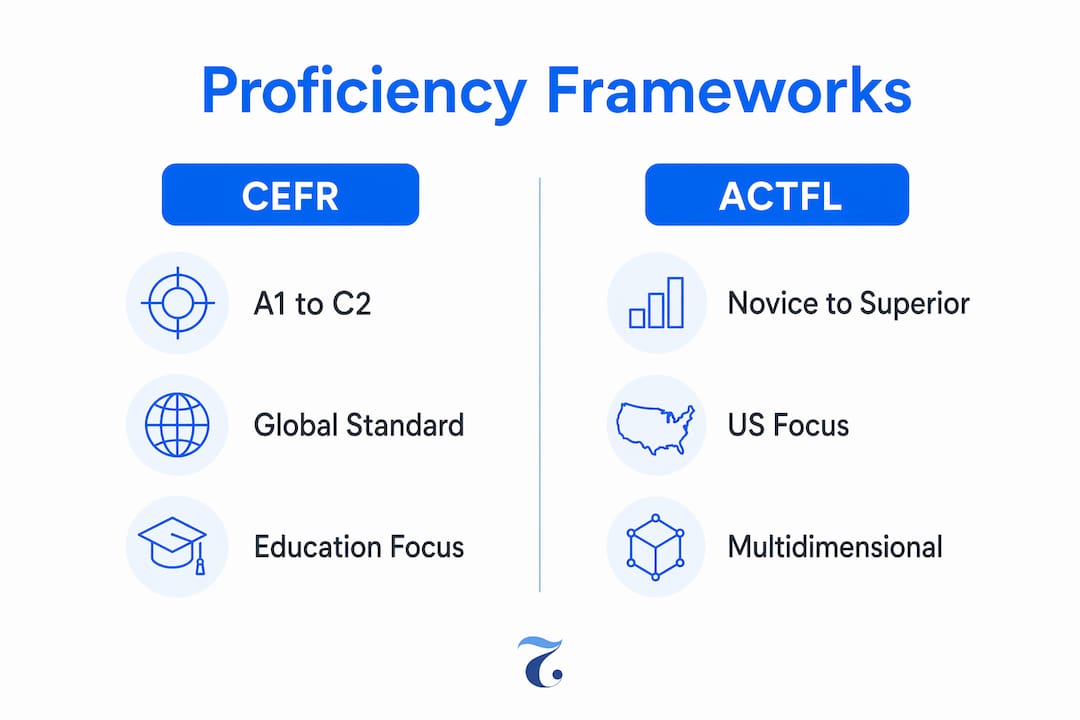
The CEFR is the most widely adopted language proficiency framework globally, consisting of six progressive levels from A1 to C2. These six levels group into three bands: Basic User (A1, A2), Independent User (B1, B2), and Proficient User (C1, C2). In Europe and increasingly across Asia, CEFR serves as the benchmark for employment qualifications and academic admissions. That reach makes it the closest thing the world has to a universal language passport.
The ACTFL scale uses a multidimensional approach that assesses language through Functions, Accuracy, Context, and Text type, known as the FACT criteria. ACTFL runs from Novice Low through Distinguished, with sublevels at each major band to capture finer progress. This granularity makes ACTFL especially useful for tracking communicative ability over time, not just at fixed checkpoints.
The ILR scale ranges from no proficiency to native or bilingual fluency and is used primarily in U.S. government and defense contexts. ILR has six broad levels with sublevels for more detailed assessment, mirroring the structure of global frameworks. For most adult learners and professionals outside government work, CEFR or ACTFL will be the more relevant reference point.
| Framework | Levels | Primary Use |
|---|---|---|
| CEFR | A1 to C2 (6 levels) | Education, employment, academic admissions globally |
| ACTFL | Novice to Distinguished (with sublevels) | U.S. language education and communicative assessment |
| ILR | 0 to 5 (with sublevels) | U.S. government, defense, and diplomatic contexts |
All three frameworks assess the same four core skills: listening, speaking, reading, and writing. The difference lies in how they describe and weight those skills.
How are language proficiency levels measured and certified?
Standardized testing is the most reliable method to certify a language proficiency level. Self-assessment has its place for personal planning, but employers and universities consistently prefer a verified score from a recognized test. The gap between how learners perceive their own level and how they actually perform on a test is often significant.
Tests like the EF SET align directly with CEFR levels and are accepted by employers and institutions worldwide. The EF SET takes around 60 minutes and offers both free and paid options, making it one of the most accessible entry points for CEFR certification. Cambridge English qualifications such as B2 First and C1 Advanced are longer, more rigorous, and carry strong recognition in academic contexts.
For Thai language learners specifically, the CU-TFL (Chulalongkorn University Proficiency Test of Thai as a Foreign Language) is the recognized standard. Thai Explorer’s curriculum aligns with CU-TFL requirements, which means learners build skills that map directly to a certifiable outcome. You can find a full breakdown of recognized Thai language tests and what each one covers on the Thai Explorer website.
Key factors to consider when choosing a proficiency test:
- Alignment: Confirm the test maps to CEFR, ACTFL, or another recognized scale so scores are portable.
- Recognition: Check that your target employer or institution accepts the specific test.
- Format: Some tests are fully online; others require an in-person testing center.
- Cost: Free options like EF SET provide a useful baseline. Paid tests like Cambridge carry more institutional weight.
- Validity period: Many certified scores expire after two years, so time your test strategically.
Pro Tip: Take a free diagnostic test before investing in a paid certification. It tells you which band you are likely to score in and whether you need more preparation first.
What do different proficiency levels actually mean for learners?
Proficiency levels describe what you can do, not just what you have studied. That shift in framing changes how you approach learning entirely. A learner at A1 can introduce themselves and ask simple questions. A learner at B2 can follow a native-speed news broadcast and write a structured argument. The gap between those two points is not just vocabulary. It is fluency, automaticity, and the ability to handle unpredictable language in real time.
Language proficiency is domain-specific. A professional may perform at B2 in a business meeting but struggle at A2 in a casual market conversation. This is not a failure of learning. It reflects the fact that proficiency varies by skill and context, not uniformly across all communication situations. Understanding this prevents learners from either overestimating or underestimating their actual ability.
Here is what each major CEFR band looks like in practice:
- A1 and A2 (Basic User): You can handle very familiar topics, fill in simple forms, and follow slow, clear speech. Real-world use is limited to predictable, scripted situations like ordering food or asking for directions.
- B1 (Independent User, lower): You can manage most travel situations, describe experiences, and follow the main points of clear standard speech. Conversations become possible but require patience from native speakers.
- B2 (Independent User, upper): You can interact with a degree of fluency that makes regular contact with native speakers quite possible. Reading complex texts and writing detailed arguments become realistic tasks.
- C1 and C2 (Proficient User): You can express ideas fluently and spontaneously without much obvious searching for expressions. At C2, you can understand virtually everything heard or read and summarize information from different sources coherently.
Pro Tip: Track your four skills separately. Most learners advance faster in reading than in speaking. Knowing your weakest skill lets you allocate study time where it actually moves the needle.
Standardized frameworks solve the problem of imprecise labels like “conversational” by providing clear, verifiable benchmarks that transcend cultural differences. “Conversational” means something different to every person who writes it on a resume. B2 means the same thing in Singapore, Germany, and Brazil.
How can knowing your proficiency level improve learning and career outcomes?
Knowing your exact level on a recognized scale gives you a planning tool, not just a label. Learners who set goals tied to specific CEFR or ACTFL benchmarks progress faster than those who aim vaguely at “getting better.” A concrete target like “reach B1 in Thai by june” is measurable, adjustable, and motivating in a way that “improve my Thai” simply is not.
Certified proficiency levels on resumes give employers a transparent, standardized benchmark beyond vague terms like “fluent” or “basic.” Employers and universities prefer recognized scale results for evaluating candidates’ real language capabilities. A certified B2 in English or a CU-TFL score in Thai tells a hiring manager exactly what you can do on day one.
Practical ways proficiency levels improve outcomes:
- Resume clarity: Replace “intermediate Thai” with a specific level or test score. It signals professionalism and saves the recruiter from guessing.
- Academic admissions: Many universities require a minimum CEFR level for language-medium programs. Knowing your level early lets you plan preparation time accurately.
- Learning efficiency: Language proficiency as a developmental continuum means tracking skills separately across listening, speaking, reading, and writing. This approach reveals exactly where to focus next.
- Cultural competence: Reaching B2 or above in a language opens access to native media, humor, and social norms that no textbook covers. That cultural layer is often what separates a technically proficient speaker from one who actually connects with people.
- Professional credibility: For roles in international business, diplomacy, or tourism, a certified level signals commitment and verifiable skill, not just a line on a CV.
You can also use language standards in learning as a curriculum guide, not just an assessment tool. When your course is built around a recognized framework, every lesson connects to a measurable outcome.
Key Takeaways
Language proficiency levels are standardized, skill-based benchmarks that give learners, employers, and institutions a shared language for describing ability.
| Point | Details |
|---|---|
| CEFR is the global standard | Six levels from A1 to C2 are recognized for employment and academic admissions worldwide. |
| Proficiency is domain-specific | A speaker may perform at different levels in professional versus casual contexts across the same language. |
| Certified tests outperform self-assessment | Tests like EF SET and CU-TFL provide verified scores that employers and universities trust over self-reported labels. |
| Track four skills separately | Listening, speaking, reading, and writing advance at different rates; separate tracking reveals where to focus. |
| Levels improve career outcomes | A certified proficiency score replaces vague resume labels and signals real, verifiable capability to hiring managers. |
Why proficiency frameworks matter more than most learners realize
I have spent years watching adult learners plateau not because they stopped studying, but because they stopped measuring. They practiced Thai every week, felt like they were improving, and then froze when asked to describe their level in a job interview. The honest answer was that they had no idea.
Proficiency frameworks fix that problem, but only if you treat them as living tools rather than one-time checkpoints. The most useful insight I keep coming back to is that CEFR level categories are broad. Two learners both classified as B1 can have meaningfully different abilities. One might be near the B1 floor; the other might be weeks away from B2. That gap matters enormously for curriculum planning and for self-directed study.
The other thing most articles skip is the fluency versus proficiency distinction. Fluency describes ease of communication, while proficiency includes mastery of grammar, vocabulary, and syntax. Some speakers are fluent but grammatically shaky. Others are structurally precise but slow and hesitant. Both gaps are real, and both need different solutions. Knowing which one you have is the first step to fixing it.
My honest advice: get a certified score at least once a year. Use it to recalibrate your study plan. And if you are learning Thai, align your goals to the CU-TFL framework from day one. It gives every lesson a destination, and destinations make the work feel worth it. You can also use an online accent assessment as a complementary tool if English is part of your professional language portfolio.
— Paul
Thai Explorer: structured Thai courses built around your level
Thai Explorer offers adult Thai language courses in Singapore designed for conversational, travel, and business use, with every course level mapped to recognized proficiency standards including the CU-TFL framework. Whether you are starting from zero or working toward professional fluency, the right course level is determined by where you actually are, not where you think you might be.

Group classes, private lessons, and online Zoom sessions give you the flexibility to learn around a full work schedule. Corporate training programs are also available for teams that need practical Thai communication skills for business operations in Thailand. Qualified native Thai instructors, all bilingual in Thai and English, teach every session at the International Plaza campus above Tanjong Pagar MRT. Browse the full range of adult Thai courses and find the level that matches your current proficiency today.
FAQ
What is a language proficiency level?
A language proficiency level is a standardized rating that describes what a person can do with a language across listening, speaking, reading, and writing. Frameworks like CEFR, ACTFL, and ILR define these levels with specific, observable criteria.
What are the six CEFR levels?
The six CEFR levels are A1, A2, B1, B2, C1, and C2, grouped into Basic User, Independent User, and Proficient User bands. Each level describes increasingly complex language tasks a learner can perform reliably.
How do I measure my language proficiency level?
The most reliable method is a standardized test aligned to a recognized framework, such as the EF SET for CEFR or the CU-TFL for Thai. Free diagnostic tests provide a useful starting estimate before you invest in a formal certification.
Is fluency the same as proficiency?
Fluency and proficiency are related but distinct. Fluency describes ease and speed of communication, while proficiency covers mastery of grammar, vocabulary, and syntax across all four language skills.
Why do employers prefer certified proficiency scores?
Certified scores from recognized tests give employers a transparent, standardized benchmark that replaces vague self-descriptions like “fluent” or “intermediate.” A specific level score tells a hiring manager exactly what communication tasks a candidate can handle on day one.