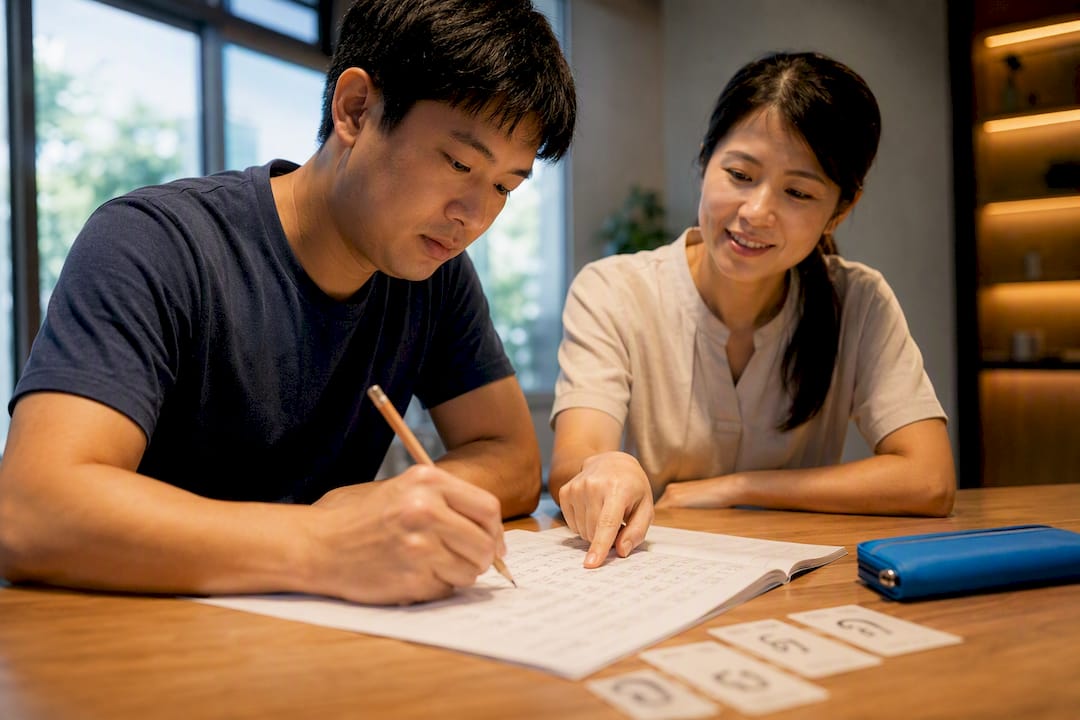
If your goal is to speak Thai confidently for work, travel, or daily life in the shortest realistic time, a one to one Thai class is usually the fastest route to get there. Private lessons let a teacher build every session around your goals, pace, and vocabulary gaps instead of splitting attention across a group. Two things back that up: a curriculum aligned with CU-TFL benchmarks, and lessons led by native, bilingual teachers who catch pronunciation errors in real time.
The next move is simple: book a trial lesson or a short consultation call before committing to a package.
- You get a level check and a goal-setting conversation in the first session.
- Pricing is usually transparent, quoted per hour or per package.
- You keep the same teacher across sessions, which matters more than most learners expect.
Quick fact: short online trial or demo lessons are a common industry practice, letting you judge teaching style and fit before spending on a full package.
Key Takeaways
Private one-to-one Thai lessons deliver faster, more targeted progress than group classes because every session is built around your specific goals, pace, and schedule.
| Point | Details |
|---|---|
| Book a trial first | Use a short consultation or demo lesson to judge teacher fit before buying a package. |
| Confirm teacher continuity | Ask directly whether you keep the same teacher for every session. |
| Calculate the real hourly cost | Factor in cancellation policy and expiry terms before comparing package prices. |
| Expect a 12-week arc | Foundational phrases first, then tone and dialogue work, then roleplay and business vocabulary. |
| Thai Explorer offers CU-TFL-aligned private lessons | Native bilingual teachers, consistent teacher assignment, and both Zoom and in-person formats from its Tanjong Pagar location. |
Table of Contents
- Who Benefits Most From a Private Thai Tutor?
- How Do One-to-One Thai Lessons Actually Run?
- What Should Private Thai Lessons Cost?
- How Do You Choose the Right Private Thai Teacher?
- What Happens in Your First Thai Lesson?
- How Do You Book a Trial Lesson?
- What Makes Thai Explorer a Strong Choice for Private Lessons?
- Ready to Book a Private Thai Lesson?
- Sources
- FAQ
Who Benefits Most From a Private Thai Tutor?
Private lessons pay off fastest for people with a specific, time-bound goal. Think of a finance professional flying to Bangkok for a client meeting in six weeks, or an expatriate who needs to handle landlord calls and market haggling without switching to English. Group classes are cheaper per hour and work well for open-ended learning, but they move at the pace of the slowest student and rarely touch the exact vocabulary you need this month.
Private lessons typically deliver three things a group setting struggles to match:
- Corrected tone and pronunciation on every attempt, not just occasionally.
- Vocabulary drawn from your actual job, industry, or travel itinerary.
- A pace that speeds up or slows down based on what you show in the room that day.
Best-fit learners include busy professionals with irregular schedules, travelers with a fixed departure date, and anyone preparing for an interview, exam, or presentation in Thai. If your timeline is loose and your budget is tight, a group class is a reasonable starting point instead.
How Do One-to-One Thai Lessons Actually Run?
Format matters less than most learners assume, but it changes the experience. Online lessons over Zoom cut out commute time and let you log in from a desk during a lunch break; in-person lessons add a layer of immersion, since body language, tone, and classroom materials all come through more naturally when a teacher is sitting across from you. Neither format is objectively better. It comes down to whether convenience or immersion matters more to your week.
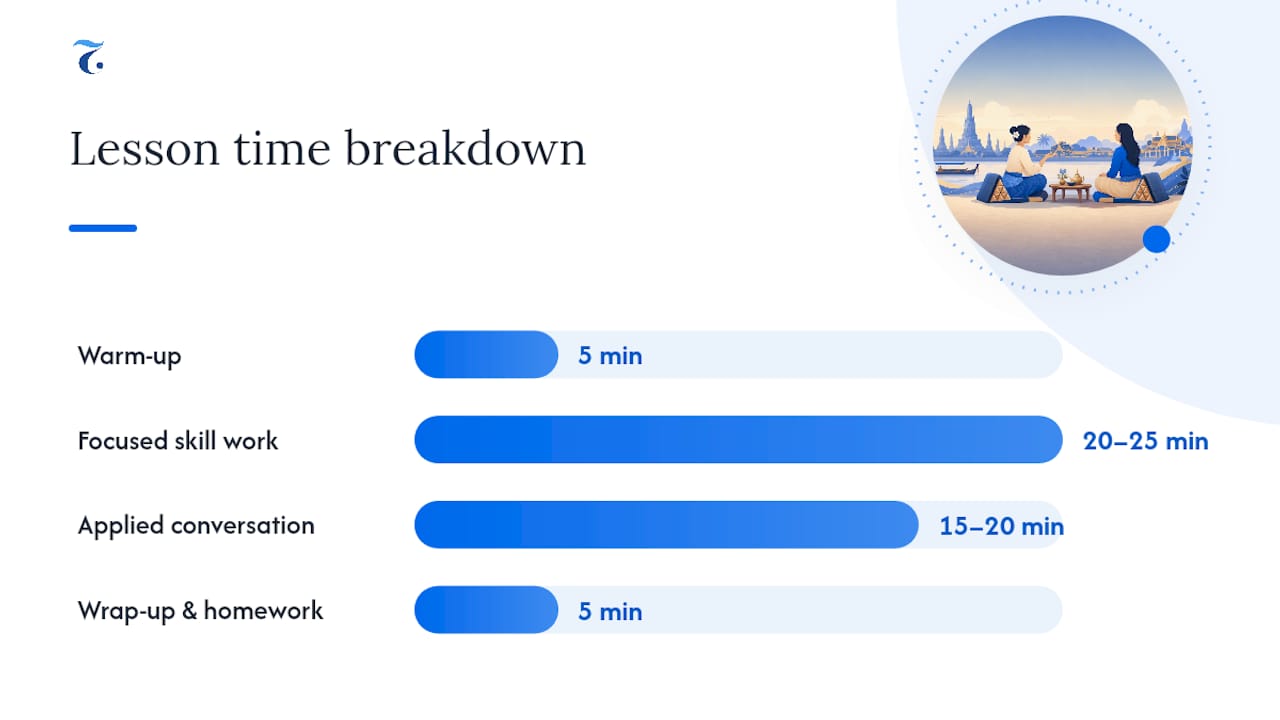
A typical private session runs 50 to 60 minutes, and many providers structure it as 50 minutes of active study followed by a short break when lessons are booked back-to-back. A standard hour usually breaks down like this:
- A five-minute warm-up reviewing last week’s vocabulary or homework.
- Twenty to twenty-five minutes of focused skill work: tone drills, roleplay, or a specific grammar point.
- Fifteen to twenty minutes applying that skill in conversation, often through a scenario relevant to your goals (ordering food, a business call, asking directions).
- A five-minute wrap-up where the teacher assigns homework and flags what to review before the next session.
Scheduling is flexible by design. Most students book weekly, though biweekly works for slower-paced learning or a tight budget. Reasonable providers allow rescheduling with 24 to 48 hours’ notice and offer a make-up class when you cancel within that window.
Pro Tip: Book your first four to six sessions on a fixed weekly slot rather than an ad-hoc basis. Momentum matters more in language learning than almost any other skill, and a locked-in slot removes the friction of rebooking every week.
What Should Private Thai Lessons Cost?
Pricing for one-on-one Thai lessons usually takes one of two shapes: a flat hourly rate, or a bundled package (commonly 10 or 20 hours) sold at a lower effective rate than paying session by session. Private lesson pages commonly list both options side by side, letting learners choose based on how much they want to commit upfront.

To judge whether a package is actually a good deal, calculate the effective per-hour price after any cancellation or expiry policy. A 20-hour package that expires in three months and offers no rescheduling flexibility can end up costing more per usable hour than a slightly pricier package with generous rebooking terms. Do the math before you commit, not after.
Watch for these red flags before paying for anything:
- A trial that’s advertised as free but requires a non-refundable “registration fee” buried in the fine print.
- Lesson length advertised as 60 minutes but billed or delivered as 45.
- Administrative charges added after you’ve already agreed to a package price.
- No clear policy on what happens to unused hours if you need to pause.
Ask for the full pricing breakdown in writing before booking anything beyond a trial. A provider confident in its value has no reason to keep pricing vague.
How Do You Choose the Right Private Thai Teacher?
Picking a teacher is less about credentials on paper and more about fit, consistency, and whether the curriculum actually maps to a recognized standard. Here’s a working checklist:
- Confirm the teacher is native or fully bilingual in Thai and English, with real classroom experience, not just conversational fluency.
- Check whether the curriculum is aligned with a recognized proficiency standard like CU-TFL, which gives you a way to benchmark your progress against something external.
- Ask whether you’ll keep the same teacher for every session. Continuity is one of the strongest predictors of fast progress, since a private tutor sticking with you across lessons builds a tailored study plan instead of restarting cold each time.
- Ask what materials you get between lessons, since homework, audio files, and vocabulary lists compound your progress outside the session itself.
- Read the cancellation and rescheduling policy before you pay for anything.
During a trial call, ask directly: “Will I have the same teacher every week?” “How do you measure progress?” “Can you show me a sample lesson plan for someone at my level?” A provider that answers those without hesitation, and can produce sample lesson notes or a short instructor background summary on request, is worth trusting with your money.
What Happens in Your First Thai Lesson?
Expect the first session to function as a diagnostic, not a full lesson. A good teacher spends the opening 15 to 20 minutes on a needs assessment: what’s your current level, what’s the deadline or goal driving you, and where do you specifically struggle (tones, reading, formal versus casual register). A short diagnostic conversation follows, giving the teacher a real read on your speaking ability rather than relying on self-reported level.
From there, most private programs follow a predictable 12-week arc for someone starting from scratch or near-beginner level:
- Weeks 1 to 4: Foundational listening, tone recognition, and basic survival phrases (greetings, numbers, simple questions).
- Weeks 5 to 8: Focused tone and pronunciation correction alongside functional dialogues: ordering, directions, small talk.
- Weeks 9 to 12: Roleplay-heavy sessions and, for professionals, business-specific phrases (meetings, negotiations, emails read aloud).
| Point | Details |
|---|---|
| Diagnostic first session | Expect a level check and goal-setting conversation, not a full lesson, in week one. |
| Weeks 1 to 4 target | Basic listening and survival phrases, focused on tone recognition. |
| Weeks 5 to 8 target | Pronunciation correction paired with functional, real-world dialogues. |
| Weeks 9 to 12 target | Roleplay practice and business-specific vocabulary for working professionals. |
How Do You Book a Trial Lesson?
Booking usually starts with a short form or call covering your current level, your goal (travel, business, general conversation), and your preferred format (Zoom or in-person). Many providers use scheduling tools like Calendly to set up trial calls with minimal back-and-forth.
A fair trial typically runs 15 to 30 minutes as a consultation, sometimes paired with a short demo lesson so you can feel the teaching style firsthand. Before locking in a schedule, decide whether block booking (paying for several weeks upfront) or flexible weekly slots suit your calendar better, and check the provider’s help documentation for its cancellation notice period, usually 24 to 48 hours.
What Makes Thai Explorer a Strong Choice for Private Lessons?
Thai Explorer runs private, group, and online Thai courses from a training center at 10 Anson Road, #22-07, International Plaza, Singapore 079903, right above Tanjong Pagar MRT. Every private lesson is led by a native Thai teacher who is also fluent in English, and the curriculum is built around CU-TFL benchmarks so your progress maps to a standard you can actually reference.
- Consistent teacher assignment across your full course, not a rotating roster.
- Cultural context woven into lessons, so vocabulary comes with the situations it’s actually used in.
- Flexible formats: Zoom-based online lessons for convenience, or in-person sessions for full immersion.
A curriculum that maps to an external proficiency standard gives you something a casual conversation exchange never can: a way to prove, not just feel, that you’ve improved.
Is Private Tutoring Worth the Investment?
For a professional with a deadline, a scoped goal, and no patience for a slow group pace, private lessons are close to a guaranteed return on the hours you put in. Expect two realistic outcomes: confident small talk and transactional Thai within eight to ten weeks, or functional business vocabulary for a specific role within twelve.
— Paul
Ready to Book a Private Thai Lesson?
If you already know a one to one Thai class fits your schedule and goals better than a group setting, the next step is straightforward: book a trial through the Thai Course page and come prepared with three things, your target goal, your preferred format (Zoom or in-person), and your general weekly availability.
Pricing is quoted upfront per hour or per package, with no hidden administrative add-ons tacked on after you’ve committed. If your priority is remote convenience, the online Thai course page covers Zoom-based scheduling and format details directly. Either way, the trial call is where you confirm teacher fit, confirm the curriculum lines up with your timeline, and lock in your first weekly slot before momentum has a chance to stall.
Sources
External sourcing on trial practices, lesson structure, and booking tools appears throughout; internal course and booking pages are linked above for course specifics.
FAQ
How Long Is a Typical One-to-One Thai Lesson?
Most private sessions run 50 to 60 minutes, sometimes structured as 50 minutes of study plus a short break when lessons are booked consecutively.
Can I Keep the Same Teacher Throughout My Course?
Yes, and you should ask for this explicitly during your trial call. Consistent teacher assignment, like the model Thai Explorer uses, is one of the strongest factors behind faster progress.
How Much Does a Private Thai Class Cost?
Pricing is usually structured as an hourly rate or a bundled package (commonly 10 or 20 hours), with the effective per-hour rate dropping as package size increases.
What Happens During a Trial Lesson?
Expect a short consultation covering your goals and level, sometimes paired with a demo lesson to help assess the teacher’s style before booking a full package.
Is Online or In-Person Better for Learning Thai?
Neither is objectively superior. Online Zoom lessons offer convenience and flexible scheduling, while in-person lessons add immersion through body language and physical materials.