TL;DR:
- Many affordable Thai language classes are available in Singapore, suitable for learners of all levels and goals. Choosing between group, private, or online formats depends on your budget, schedule, and desired learning speed, with blending methods often most effective. Consistent practice and cultural engagement significantly enhance progress, making Thai learning both practical and enjoyable in Singapore.
Most people assume that picking up conversational Thai means booking a flight to Bangkok or spending hundreds of dollars on private tutoring. That assumption keeps a lot of potential learners stuck. The reality in Singapore is surprisingly different. Affordable group classes, live online sessions, and structured school programs are all within reach, often at rates that make consistent study genuinely practical. This guide walks you through every class type, cost range, and learning strategy you need to choose the right Thai class and actually make progress.
Table of Contents
- Understanding Thai language classes in Singapore
- Comparing group, private, and online classes
- What to expect from a Thai language class
- Maximizing your Thai learning experience
- Why most people underestimate learning Thai in Singapore
- Ready to start your Thai journey?
- Frequently asked questions
Key Takeaways
| Point | Details |
|---|---|
| Affordable class options | Group Thai language classes in Singapore can cost as little as S$12.50–18/hour with even cheaper online options available. |
| Choose the right format | Group, private, and online classes each suit different learning styles, budgets, and schedules. |
| Set realistic goals | Consistent participation leads to conversational Thai, but ‘instant fluency’ isn’t typical. |
| Practical focus | Singapore-based courses emphasize everyday conversation and cultural context over formal testing. |
| Maximize learning | Supplement classes with apps, real-life practice, and cultural immersion for the best results. |
Understanding Thai language classes in Singapore
Singapore has a more developed Thai learning scene than most people expect. Whether you are a Singaporean planning regular trips to Thailand, an expat building professional connections, or simply someone who loves Thai culture, there is a format built for you. The key is knowing what is available before you commit to anything.
Most schools and platforms in Singapore welcome learners aged 16 and above, covering everything from absolute beginner to advanced levels. The main class types you will encounter are:
- Group classes: Structured sessions with a small cohort, usually 4 to 10 students, ideal for building conversational confidence in a social setting
- Private lessons: One-on-one instruction tailored entirely to your pace and goals
- Online classes: Live or self-paced sessions delivered via platforms like Zoom, offering flexibility for those with irregular schedules
- Intensive programs: Condensed, high-frequency courses designed to accelerate progress over a short period
People come to these classes for very different reasons. Some want to order food confidently at a Thai restaurant or navigate a market in Chiang Mai. Others are building toward professional fluency for business relationships or work assignments. A growing group is motivated purely by a love of Thai drama, music, or culture, and wants to engage with that content in its original language.
On the cost side, group rates range from S$12.50 to S$18/hour, while private lessons can reach around S$87/hour. Some online providers offer live group lessons for as little as S$5 to S$6 per hour. That range is wide enough that budget is rarely a genuine barrier to starting.
“I was shocked how many options existed locally. I thought I’d have to do everything online with a tutor in Thailand, but Singapore actually has real classroom options that fit my schedule.” — a common sentiment among new learners exploring Thai classes in Singapore
Pro Tip: Before signing up for anything, write down your single clearest goal. Do you want to hold a basic conversation? Read Thai script? Handle business communication? Your goal determines the format, intensity, and curriculum that will work best for you. Don’t let a school talk you into a format that doesn’t match your actual purpose.
Once you have clarity on your goal, you can look at flexible Thai course options that align with both your schedule and your learning intent.
Comparing group, private, and online classes
With several formats available, the hardest decision is usually picking the right one. Each has genuine advantages and real trade-offs, and the best choice depends on factors that are specific to you.
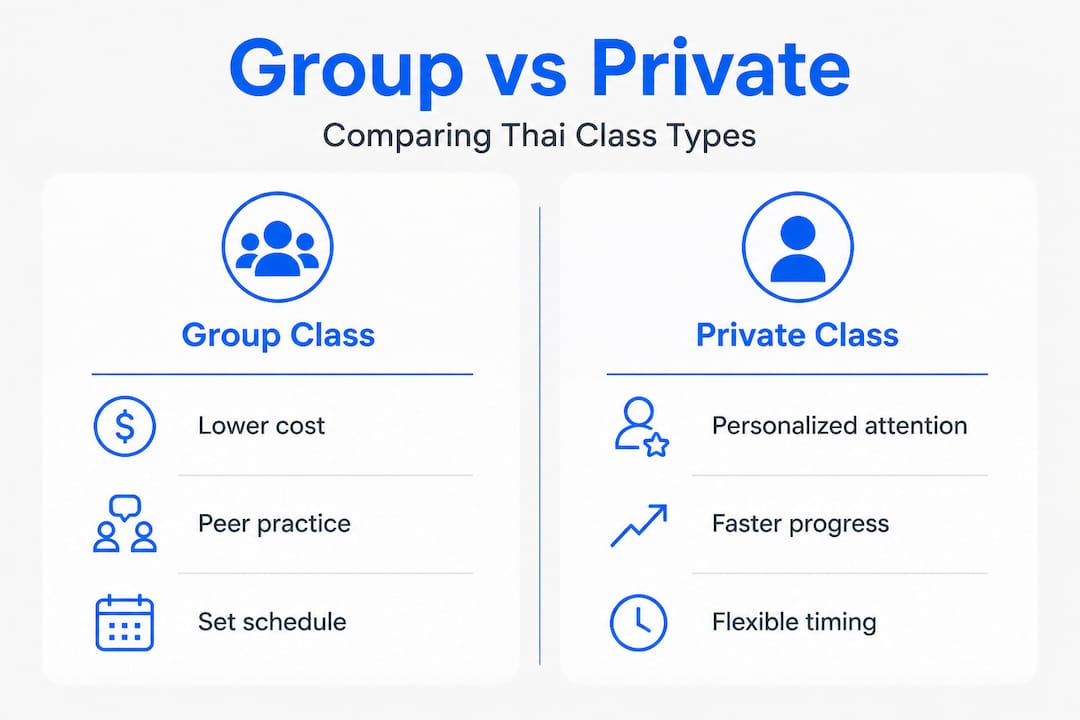
Group classes are the most popular starting point for good reason. The cost is manageable, the social pressure pushes you to practice speaking out loud, and the shared learning environment means you hear other students make mistakes and learn from them too. Group energy keeps many learners going when individual motivation dips.
Private lessons are the fastest route to progress if you can afford them. Your instructor focuses entirely on your weak points, moves at your pace, and can customize every lesson around your specific vocabulary needs. For someone preparing for a specific professional situation or a trip in six weeks, private sessions deliver results quickly. The trade-off is cost: at around S$87/hour for private sessions, the investment adds up fast.
Online options sit somewhere in the middle. Studying Thai online in a live group format gives you the social element at a fraction of classroom group prices. Self-paced platforms are even cheaper but lack real-time feedback, which is especially important for a tonal language like Thai where your pronunciation needs correction, not just confirmation.
Here is a clear comparison to help you decide:
| Format | Typical cost (Singapore) | Best for | Key trade-off |
|---|---|---|---|
| Group class | S$12.50–18/hour | Social learners, beginners | Fixed schedule, shared pace |
| Private lessons | ~S$87/hour | Fast progress, specific goals | High cost |
| Live online group | S$5–6/hour | Budget-conscious, flexible schedule | Less face-to-face interaction |
| Self-paced online | Varies, often lower | Supplementary study | No real-time feedback |
| Intensive program | Varies by provider | Short-term immersion | High time commitment |
A few factors that should directly shape your choice:
- Budget: If cost is the main constraint, live online groups or local group classes are the practical starting point
- Schedule: If your work hours are unpredictable, online options protect your consistency
- Learning speed: Faster learners often feel held back in group settings, where private Thai lessons may be worth the investment
- Motivation style: If you know you need accountability, a scheduled group class beats a self-paced app every time
Pro Tip: Many successful learners use a combination. Attend a weekly group class for structure and speaking practice, and use cheaper online resources for vocabulary and listening between sessions. This hybrid approach gives you discipline plus flexibility without paying full private lesson rates.
What to expect from a Thai language class
Before your first session, it helps to understand what Singapore-based Thai courses actually deliver, day to day and over several months.
The first thing to adjust is the expectation that classes here follow a rigid, textbook-only curriculum. Most good Thai schools in Singapore prioritize practical, real-world communication. You will spend time on greetings, polite phrases, numbers, and directions in early lessons, then gradually build toward full conversational exchanges. Grammar is woven into context rather than drilled in isolation, which makes retention stronger.
A typical beginner class might follow this kind of progression:
- Greetings and self-introduction in Thai, with correct tones modeled by the instructor
- Basic vocabulary sets (food, transport, places, numbers) built over three to four lessons
- Listening exercises using native-speed audio clips or instructor dialogue
- Short speaking drills where students respond to prompts without translation as a crutch
- Introduction to Thai script, usually starting with vowels and consonant classes
Progress depends heavily on consistency rather than raw hours in class. A student who attends every week and practices for 15 minutes daily between sessions will outpace someone who attends twice as many classes but does nothing in between.

Here is a realistic look at what different time investments typically produce:
| Study commitment | Expected milestone | Approx. timeframe |
|---|---|---|
| 1 class/week + light practice | Basic greetings and phrases | 1–2 months |
| 2 classes/week + daily review | Simple conversations | 3–5 months |
| Intensive + daily study | Functional conversational Thai | 4–8 months |
| Long-term consistent study | Confident reading and speaking | 12+ months |
It is also worth understanding that Singapore-based courses are not built around test certification. Thailand intensives at places like Chulalongkorn University claim rapid fluency through 30 hours per week of instruction, but they also carry high dropout rates because the intensity is not sustainable for most learners. Singapore’s approach is slower but designed for people with jobs, families, and regular lives.
“The Singapore method is not slower because it is easier. It is designed for long-term retention in learners who are not living in a Thai-speaking environment. That is a fundamentally different and often smarter challenge to solve.”
Visit Thai language schools in Singapore for a detailed look at how local schools compare, and use the Thai language levels guide to identify where you currently stand before enrolling.
Maximizing your Thai learning experience
Signing up for a class is the easy part. Making real progress takes strategy, and the students who advance fastest are almost always the ones who supplement formal study with active daily practice.
Here are the most effective ways to accelerate your learning outside the classroom:
- Use language apps daily: Tools like Anki for flashcards or specific Thai vocabulary apps reinforce what you cover in class. Even 10 minutes of review each morning prevents vocabulary from fading
- Watch Thai media with subtitles: Thai dramas, variety shows, and YouTube content expose you to natural speech patterns, slang, and cultural references that textbooks skip
- Join a language exchange: Look for Thai speakers in Singapore who want to practice English. You get real conversation practice with zero cost
- Attend cultural events: Thai temples, food festivals, and cultural community events in Singapore offer low-pressure environments to use what you have learned
- Practice ordering in Thai at local restaurants: Even a single transaction in Thai builds enormous confidence and locks in practical vocabulary
Setting small, time-bound goals makes a measurable difference. Instead of a vague goal like “get better at Thai,” try “order my full meal in Thai at a restaurant within four weeks” or “introduce myself in five sentences without notes within two months.” These goals give you something concrete to work toward and celebrate.
Reading is often neglected by learners focused on speaking, but building Thai reading skills pays off quickly. Once you can read Thai script, you stop relying on romanized transliterations that teach incorrect pronunciation habits. The script looks intimidating at first but follows consistent rules that most learners can crack within a few weeks of deliberate practice.
Cultural knowledge also accelerates language learning faster than most people expect. Understanding Thai social customs, the concept of “face,” and the way politeness markers work in real conversation makes your language use feel natural rather than technically correct but socially awkward. Explore Thai culture and etiquette tips to build that cultural layer alongside your language skills, and bookmark this collection of Thai for travelers phrases for your next trip.
Thailand intensives may log more hours in a week, but the learners who build lasting skills are those who integrate Thai into their regular life over time, not those who cram and burn out.
Pro Tip: Track your wins in a simple notebook or note app. Write down every time you successfully used Thai in a real context, no matter how small. This record becomes surprisingly motivating when progress feels slow, and it shows you concretely how far you have actually come.
Why most people underestimate learning Thai in Singapore
Here is an opinion that not everyone in the language learning world will agree with: local, consistent classes in Singapore often produce better long-term results than high-intensity crash programs in Thailand.
That sounds counterintuitive. More hours, more immersion, faster results, right? The data on intensive language programs tells a more complicated story. High-dropout intensive courses are a well-documented reality. When you combine 30 hours of weekly instruction with the stress of living abroad, learners who were highly motivated in week one often quit by week three. The people who make it through frequently have strong prior language learning backgrounds that make the pace manageable.
The Singaporean learner in a twice-weekly group class, on the other hand, builds something the intensive crash course rarely develops: a sustainable habit. They are not trying to absorb a language in six weeks. They are building conversational ability over months, reinforced by consistent review and real-world practice opportunities in a city that has meaningful Thai community presence.
Singapore-based Thai classes also focus on what actually matters for most learners here. They are not preparing you for a university entrance exam or a formal certification benchmark. They are preparing you to communicate confidently in Thailand, to build genuine relationships with Thai colleagues, or to engage meaningfully with a culture you love. That practical orientation is a feature, not a shortcut.
There is also something underrated about learning alongside other Singaporeans and expats who are at your level. The community aspect of a good group class creates accountability, friendship, and a shared vocabulary of references and jokes that keeps learners coming back. Consistency and community are genuinely worth more than sheer hours spent.
Ready to start your Thai journey?
If this guide has made the path clearer, the next step is straightforward. Thai Explorer offers structured, high-quality Thai language courses that cater to every learning style and schedule, from beginner group classes to focused private Thai lessons for those who want to move faster.
Located right above Tanjong Pagar MRT, the school is easy to get to from anywhere in Singapore. Lessons are taught by qualified native Thai instructors who are bilingual in Thai and English, so explanations are always clear and practical. If getting to a physical location is difficult, online Thai classes give you the same quality instruction from wherever you are. Browse the full course lineup, check current schedules, and take the first step toward Thai fluency that actually sticks.
Frequently asked questions
How affordable are Thai language classes in Singapore?
Group lessons start at S$12.50 to S$18/hour, with live online group options available from S$5 to S$6 per hour through some providers, while private lessons cost significantly more at around S$87/hour.
How fast can I become conversational in Thai?
With regular twice-weekly classes and daily practice, most learners reach basic conversational ability within three to five months, though Thailand-style intensives that promise faster results often come with high dropout rates and are not the norm in Singapore.
Are there Thai language courses for complete beginners over 16?
Yes, virtually all Singapore Thai schools accept learners aged 16 and above at the absolute beginner level, with courses designed to build from zero knowledge up through advanced Thai language levels at a comfortable and sustainable pace.
Do Singapore Thai courses offer certifications?
Most Singapore-based Thai programs focus on practical communication skills and measurable progress rather than formal certification, though some schools align their curriculum with recognized frameworks like the CU-TFL standard for learners who want structured benchmarks.