
TL;DR:
- Effective online Thai study requires structured courses focusing on listening, speaking, and tones.
- Mastering Thai tones early is crucial as mispronunciation impacts comprehension and meaning.
- Combining input with active practice and regular assessments accelerates language proficiency development.
Finding a structured, outcome-driven way to study Thai online in Singapore is harder than it looks. Most apps promise fluency but deliver a scattered mix of vocabulary flashcards and random phrases that leave you no closer to a real conversation. Whether your goal is navigating Bangkok’s street markets, closing a deal with a Thai business partner, or simply connecting more deeply with Thai culture, you need a method that builds genuine proficiency. This guide walks you through everything: what to prepare, how to progress level by level, where most learners go wrong, and what results you can realistically expect.
Table of Contents
- What you need to start studying Thai online
- Step-by-step: How to study Thai online effectively
- Mastering Thai tones, pronunciation, and speaking online
- Troubleshooting: Common mistakes Singaporeans make when studying Thai online
- What results to expect as you study Thai online
- Our perspective: What most Thai learners overlook and what actually gets results
- Ready to accelerate your online Thai studies?
- Frequently asked questions
Key Takeaways
| Point | Details |
|---|---|
| Structured courses matter | Choosing platforms with stepwise lessons and assessments leads to deeper learning and real progress. |
| Thai tones are crucial | Focusing on pronunciation and tonal drills is the fastest way to avoid miscommunication. |
| Mix input and practice | Passive listening helps, but active speaking and quizzes are essential for advancing. |
| Progress is measurable | Passing quizzes and milestone lessons signals when you’re ready to move up levels. |
| Personalize your study | Adapt your learning modules for travel, business, or culture to keep motivation high. |
What you need to start studying Thai online
Having set the stage, let’s clarify what you’ll need before starting your online Thai study journey. Getting the fundamentals right from day one saves you weeks of frustration later.
Technical requirements
Before you open a single lesson, make sure your setup is solid. A slow or unstable internet connection will constantly interrupt audio and video playback, which is especially damaging when you’re trying to pick up tonal differences in Thai speech.
Here is a quick checklist of what you need:
- Stable broadband connection (at least 10 Mbps for smooth video streaming)
- Laptop, tablet, or desktop with updated browser or app support
- Quality headset with microphone for listening exercises and speaking practice
- Quiet study space free from background noise, especially important for tone recognition
- Notebook or digital note app for vocabulary logging and grammar notes
Choosing the right structured course
Not all online Thai platforms are built the same. A good course should include audio and video lessons, structured assessments, cultural context modules, and a clear progression from beginner to advanced levels. ThaiPod101 provides self-paced structured audio/video lessons covering CEFR A1 to C2, real-world dialogues, tone rules, grammar through context, quizzes with a 70% pass requirement, and cultural insights. It is particularly strong for listening and pronunciation but reviews note limited speaking output, with pathways running 25 to 50 lessons per level.

For learners in Singapore who want more accountability and live instruction, exploring a complete Thai course that blends structured modules with instructor feedback is a smarter move. If you qualify for government support, a SkillsFuture Thai language course can reduce your out-of-pocket cost significantly. Those who prefer maximum flexibility should look at a dedicated online Thai language course designed for remote learners.
Matching the course to your purpose
Your goal shapes everything about how you should study. Use the table below to align your purpose with the right focus areas.
| Learning goal | Priority skills | Recommended focus |
|---|---|---|
| Travel and tourism | Speaking, listening | Everyday phrases, scenarios, tones |
| Business communication | Formal registers, writing | Polite vocabulary, email Thai |
| Cultural immersion | All four skills | Dialects, cultural context modules |
| General proficiency | Balanced | Grammar, reading, speaking practice |
Knowing your purpose upfront helps you skip material that doesn’t serve your goals and invest more time where it matters most.
Step-by-step: How to study Thai online effectively
Once you’ve prepared your toolkit and resources, here is how to turn them into real results with a proven learning pathway. Structure and consistency beat intensity every time.
The learning sequence that works
- Complete the beginner audio and video modules first. Do not skip ahead. Thai has five tones and a unique script, and your ear needs time to adjust before your mouth can keep up.
- Study Thai tone marks and phonetic rules. Understanding Thai tone marks early removes the guesswork and gives you a framework for every new word you encounter.
- Engage with real-world dialogue modules. These simulate actual conversations, from ordering food to asking for directions, and they build vocabulary in memorable, contextual ways.
- Complete every quiz before moving to the next level. ThaiPod101 provides thousands of lessons averaging 3 to 15 minutes each, with assessments every 2 to 4 lessons to lock in what you’ve learned.
- Build a weekly study schedule and protect it. Five sessions of 30 minutes each per week beats two hours on a Sunday. Frequency creates the neural pathways that stick.
- Review older material regularly. Spaced repetition, revisiting vocabulary and dialogues at increasing intervals, keeps retention high without extra effort.
- Supplement with a live speaking component. Audio and video input alone will not make you a confident speaker. Adding even one weekly conversation session with an instructor or language partner multiplies your output dramatically.
For a more detailed breakdown of how this sequence plays out from week to week, the step-by-step Thai learning guide covers each stage with practical examples.
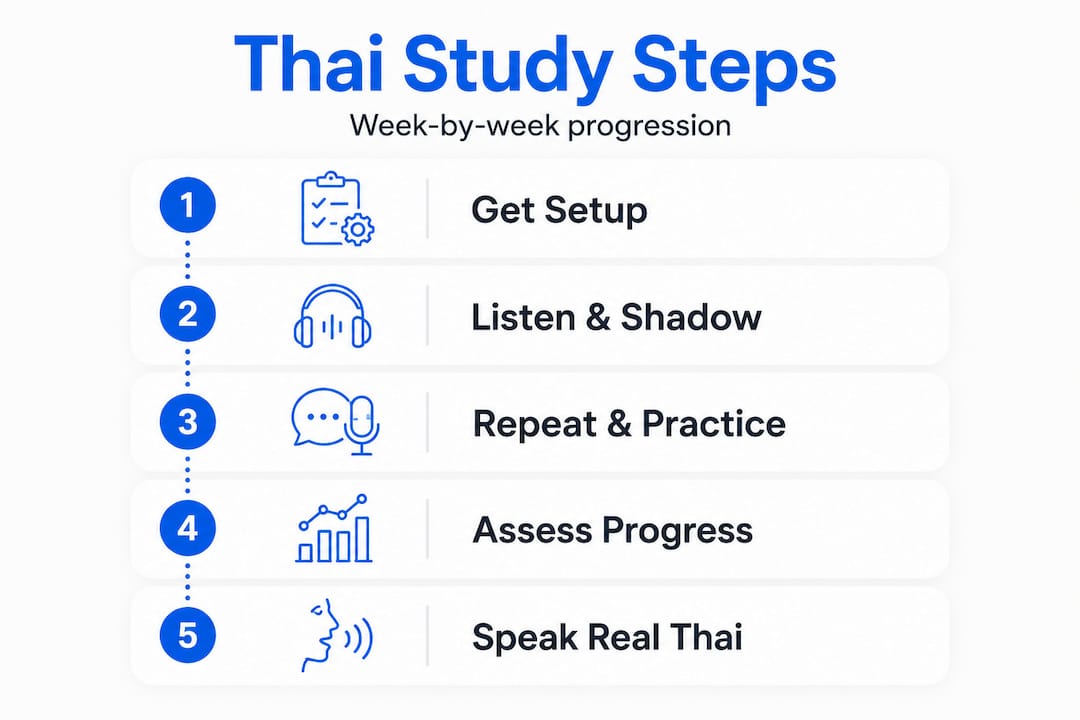
Pro Tip: Practice shadowing, repeating a native speaker’s audio in real time, immediately after each listening module. This is one of the fastest ways to internalize Thai tones and natural speech rhythm. Focus especially on Thai tone exercises at the beginner and elementary stages.
Comparing study approaches
| Study method | Strengths | Weaknesses |
|---|---|---|
| Self-paced audio/video course | Flexible, repeatable, affordable | Limited speaking output |
| Live online class with instructor | Real feedback, pronunciation correction | Requires scheduling commitment |
| Language exchange app | Free, conversational | No structure, inconsistent quality |
| Structured school program | Curriculum, assessments, cultural context | Higher investment of time and money |
The most effective approach combines a structured course for input with live or guided practice for output. Neither alone is enough.
Mastering Thai tones, pronunciation, and speaking online
Now that you know the stepwise approach, let’s zoom in on tackling the most challenging aspect: Thai tones and pronunciation. This is where most online learners either break through or quietly give up.
Why tones are non-negotiable
Thai is a tonal language. That means the same syllable spoken in five different tones produces five entirely different meanings. The word “mai,” for example, can mean new, burn, not, silk, or a question particle depending on how you say it. Mispronouncing tones is not just an accent issue. It can make you completely misunderstood or, in some cases, accidentally offensive.
This is why audio-based repetition is so essential, especially in the early stages. Platforms that are strong for listening and pronunciation give you repeated exposure to correct tone production with context, which is far more effective than memorizing tone rules alone.
Strategies that accelerate tone mastery
- Listen before you speak. Spend the first few weeks purely on input. Let your ear calibrate to the five Thai tones before you attempt output.
- Use shadowing aggressively. Play a 10-second audio clip, pause, repeat it out loud trying to match pitch, speed, and rhythm exactly. Repeat until it feels natural.
- Drill tones in minimal pairs. A minimal pair is two words that differ only in tone. Practicing these side by side sharpens your ear faster than random vocabulary study.
- Leverage the Thai pronunciation guide to understand the rules behind tone marks before relying entirely on audio imitation.
- Record yourself daily. Use your phone or computer. Play back your recordings and compare them honestly against the native speaker audio in your course. This feedback loop is uncomfortable but incredibly effective.
Pro Tip: After each shadowing session, record yourself saying the same phrase without looking at the script. Play it back alongside the native audio. The gap between the two is your real progress metric.
“Audio is great for input but needs live practice to produce real results. Apps are less structured than live courses when it comes to developing output skills.”
For more strategies, context, and examples, the Thai learning blog covers pronunciation topics that go well beyond what most course materials include.
Troubleshooting: Common mistakes Singaporeans make when studying Thai online
After tone mastery, let’s address what often trips up online Thai learners in Singapore and how to avoid these missteps. Identifying these patterns early can save you months of frustration.
The most common pitfalls
- Relying entirely on passive learning. Watching videos and listening to audio is valuable, but learners gain mostly vocabulary and listening skills from passive exposure while speaking lags far behind. You must actively practice output, not just consume input.
- Ignoring tone marks on written Thai. Many beginners skip over tone marks because they look complicated. This creates a ceiling. Every Thai word you learn has a tone, and ignoring the mark means guessing forever.
- Skipping assessments. Quizzes feel optional until you realize you’ve been building on a shaky foundation. If you cannot pass a quiz on lesson material, you are not ready to advance. Skipping assessments creates false confidence.
- Studying inconsistently. One long session per week is far less effective than five shorter sessions. Thai tones and vocabulary require repeated exposure at regular intervals, not marathon cramming.
- Neglecting formality registers for business goals. Thai has distinct formal and informal speech levels, and if your goal is professional communication, casual course material alone will not prepare you for real business interactions.
Pro Tip: Schedule a 20-minute weekly recap every Sunday evening. Review your notes, re-listen to one audio lesson from that week, and take a self-made mini quiz. This habit alone will dramatically improve your retention rate. If you have business goals, specifically look for modules that cover polite vocabulary and formal registers. You can also take a Thai proficiency test to benchmark where you actually stand.
What results to expect as you study Thai online
Let’s wrap up the how-to process by clarifying what milestones to look forward to as you use online courses. Setting realistic expectations keeps you motivated and helps you measure genuine progress.
Realistic milestones at each stage
- First 10 to 15 lessons: You will recognize basic greetings, numbers, and common phrases. Listening comprehension improves noticeably in familiar contexts.
- First 25 to 50 lessons: Vocabulary and listening gains become significant. You can follow simple conversations and handle basic travel scenarios. Check your learning timeline for benchmarks specific to your goal.
- After completing one full level: You should pass all assessments with 70% or higher and feel comfortable with the vocabulary and grammar introduced at that level before moving on.
- Speaking and conversational fluency: This develops more slowly than listening. Expect to supplement your online course with live practice, whether through a language partner, tutor, or structured class, before feeling confident in real conversations.
Stat callout: According to structured course data, typical pathways run 25 to 50 lessons per level, with a 70% quiz pass rate required before advancing. This means completing a single CEFR level can take several months at a steady pace of five sessions per week.
The key insight here is that online courses build a strong foundation but they work best when paired with active speaking practice. Think of them as building the house’s frame. You still need to put up the walls.
Our perspective: What most Thai learners overlook and what actually gets results
With the steps and expectations laid out, here’s our candid take on what works and what learners consistently miss.
Most people who try to study Thai online treat it like a checkbox activity. Open the app, complete the lesson, close the app. They accumulate lesson badges and quiz completions but cannot hold a five-minute conversation after months of study. The problem is not the platform. It’s the assumption that input automatically becomes output.
Apps and audio courses are excellent for building receptive skills, your ability to hear and understand Thai. But they rarely push you to produce language under real communicative pressure. That gap between recognition and production is where most learners stall indefinitely.
The conventional wisdom says “study more, practice more.” But what actually works is targeted repetition paired with scenario-based drills. Practicing the same five restaurant phrases until they are completely automatic is worth more than skimming through 30 new vocabulary words you’ll forget by Thursday. The expert Thai learning guide lays this out clearly: depth beats breadth at every stage of language acquisition.
Here is the uncomfortable truth that most Thai learning content will not tell you: tones are not a side topic. They are the whole game. Singaporean learners often underestimate how much tone errors affect communication because English and even Mandarin tones operate very differently from Thai. Investing disproportionate time in tone training early is not overkill. It is the single highest-return activity in your study plan.
Our advice is to mix structured course modules with simulated real-world scenarios from day one. Even if your conversation partner is imaginary. Role-play ordering food. Practice asking for directions out loud in your apartment. Simulate a business introduction. These simulated outputs accelerate confidence in ways that passive lesson completion simply cannot replicate.
Ready to accelerate your online Thai studies?
If you’re inspired to turn these strategies into tangible skills, here’s where to connect with proven online Thai resources in Singapore.
Thai Explorer offers structured, instructor-led online Thai courses built specifically for Singaporean learners, with curricula aligned to CU-TFL standards and taught by qualified native Thai instructors who are bilingual in Thai and English. Whether you’re preparing for a trip, a business opportunity, or deeper cultural engagement, you’ll find a course track designed for your exact goal, including a dedicated Thai for travelers course and flexible private Thai lessons for learners who want personalized pacing and direct feedback.
Located right above Tanjong Pagar MRT and fully accessible online, Thai Explorer makes it easy to move from self-study to real fluency with structured support every step of the way.
Frequently asked questions
What is the best platform to study Thai online for Singaporeans?
ThaiPod101 offers structured lessons and quizzes for progressive self-paced learning, while Thai Explorer adds live instructor support and cultural immersion suited to travel, business, and personal fluency goals.
How long does it take to reach conversational level in Thai?
Basic conversational skills develop after completing a full proficiency level, which typically covers 25 to 50 lessons per level, though speaking fluency requires additional live practice beyond course completion.
Why are Thai tones and pronunciation so important?
Thai is a tonal language where a single syllable changes meaning entirely based on pitch, which is why audio and repetition are essential foundations and cannot be skipped in favor of text-only study.
Can I study Thai online without any prior experience?
Yes, structured programs designed for absolute beginners guide learners step-by-step from CEFR A1 through advanced levels, requiring no prior knowledge of Thai language or script.
How do I test my Thai proficiency online?
Most structured platforms include quizzes every 2 to 4 lessons with a 70% pass requirement, and Thai Explorer also offers a dedicated proficiency test to help you identify exactly which level to enter.