
TL;DR:
- Thai proficiency is structured into six levels from A1 (beginner) to C2 (proficient).
- Knowing your level ensures appropriate course placement and effective language progression.
- Active use and cultural engagement are key to achieving real Thai fluency beyond test scores.
Most learners who start studying Thai assume the journey begins the same way for everyone: pick up a phrasebook, memorize “sawadee kha,” and head to Bangkok. That assumption costs people months of wasted effort. Thai language learning is built on a structured system of proficiency levels, and knowing where you stand changes everything from the course you choose to the cultural conversations you can actually have. Whether you’re a Singapore-based professional eyeing a Bangkok assignment, a frequent traveler wanting more than tourist-level exchanges, or a culture enthusiast ready to go deeper, understanding Thai proficiency levels is the single most important step you can take before signing up for any class.
Table of Contents
- What are Thai language proficiency levels?
- Comparison of Thai language levels: what can you do at each stage?
- How Thai courses and tests in Singapore are structured by proficiency
- Advancing your Thai language level: study resources and practice tips
- A fresh perspective: why mastering Thai levels is more than passing a test
- Next steps: explore Thai courses and resources in Singapore
- Frequently asked questions
Key Takeaways
| Point | Details |
|---|---|
| Levels guide learning | Thai language proficiency levels help learners choose the right courses and track progress. |
| Comparison is key | Understanding what each level enables you to do builds confidence and sets realistic goals. |
| Course structure matters | Courses in Singapore are organized by proficiency levels, making learning efficient and targeted. |
| Practice accelerates progress | Consistent practice with proven resources advances your Thai language skills faster. |
| Beyond test scores | Mastering Thai is about real-world usage and cultural resonance, not just passing exams. |
What are Thai language proficiency levels?
Thai language learning follows a tiered structure similar to the Common European Framework of Reference for Languages, widely known as CEFR. This framework divides language ability into six levels: A1, A2, B1, B2, C1, and C2. Each level represents a distinct set of skills across speaking, listening, reading, and writing.
Here’s a quick breakdown of what each level means in plain terms:
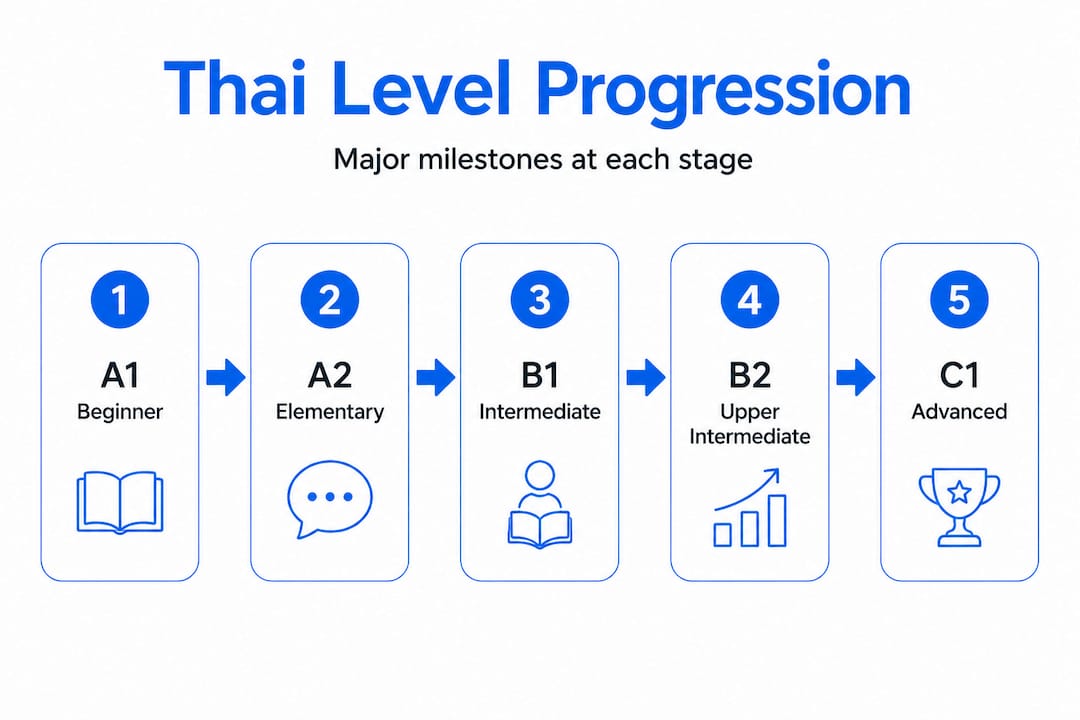
- A1 (Beginner): You can recognize basic words, greet people, and introduce yourself. You rely heavily on repetition and visual cues.
- A2 (Elementary): You can handle simple, routine exchanges like ordering food, asking prices, and understanding short texts.
- B1 (Intermediate): You can manage most everyday situations while traveling and describe experiences with some fluency.
- B2 (Upper Intermediate): You can follow complex conversations, engage with native speakers naturally, and read longer texts with confidence.
- C1 (Advanced): You can express ideas fluently and spontaneously without obvious searching for words, including in professional and academic contexts.
- C2 (Proficiency): You understand virtually everything, can produce nuanced writing, and communicate with precision across all situations.
Understanding which level applies to you matters for a very practical reason: it determines whether a course will challenge you appropriately or leave you bored or overwhelmed. The course structure in Thai language centers is typically built around these levels, meaning you get placed into a class where the vocabulary, pace, and grammar targets match where you actually are right now.
Real-life scenarios help illustrate the differences clearly. An A1 learner visiting Chatuchak Market can say “how much?” and point at items. A B1 learner can negotiate prices, ask the vendor where the item was made, and understand the response. A C1 speaker can discuss the history of traditional Thai craftsmanship with the same vendor for twenty minutes. That gap is enormous, and it’s defined entirely by level.
For learners who want to understand the grammatical building blocks behind each stage, a detailed A1 grammar guide can show exactly which structures you need to master before moving forward.
| Level | Label | Key skill milestone |
|---|---|---|
| A1 | Beginner | Greetings, numbers, basic phrases |
| A2 | Elementary | Simple transactions, short conversations |
| B1 | Intermediate | Travel scenarios, personal topics |
| B2 | Upper Intermediate | Complex discussions, longer texts |
| C1 | Advanced | Fluent, spontaneous expression |
| C2 | Proficiency | Near-native command across all skills |
Pro Tip: Before enrolling in any course, take a short placement assessment. Many learners who think they are A1 are actually closer to A2 after some casual travel experience. Starting at the right level prevents frustration and speeds up real progress.
Comparison of Thai language levels: what can you do at each stage?
With clear definitions in mind, it’s essential to see how these levels translate into real skills and abilities. The difference between knowing a level exists and understanding what it actually unlocks is the difference between vague ambition and targeted learning.
| Level | Listening | Speaking | Reading | Writing |
|---|---|---|---|---|
| A1 | Simple words and phrases | Basic greetings and introductions | Recognize common signs | Copy basic characters |
| A2 | Short, simple sentences | Handle routine exchanges | Read simple texts | Write short phrases |
| B1 | Main points of clear standard speech | Describe experiences, events, and plans | Understand everyday materials | Write simple connected text |
| B2 | Extended speech on abstract topics | Interact with fluency and spontaneity | Read articles and reports | Write detailed texts |
| C1 | Long, complex, implicit speech | Express ideas fluently without searching | Read demanding texts | Write well-structured, detailed content |
| C2 | Any kind of spoken language | Precise, nuanced, spontaneous speech | Read all text types effortlessly | Write with precision and style |
Vocabulary size also grows significantly with each level. An A1 learner works with roughly 500 core words. By B1, you’re using around 2,000 to 3,000 words. Reaching C1 typically means an active vocabulary of 8,000 words or more, plus the grammatical flexibility to deploy them naturally in context.
Here are common real-world situations mapped to proficiency levels:
- A2: Ordering food at a street stall, asking for directions to the nearest BTS station, buying train tickets
- B1: Chatting with Thai coworkers about weekend plans, following a Thai cooking class, discussing travel experiences with locals
- B2: Participating in a team meeting conducted in Thai, reading Thai business contracts, discussing current events
- C1: Presenting a business proposal in Thai, understanding regional accents and informal slang, mediating professional discussions
For those beginning to navigate the Thai script, a practical beginner Thai writing guide is an excellent way to understand how the alphabet connects to these skill stages.
“The moment I passed my B1 assessment, I noticed something shift. Conversations stopped feeling like a performance and started feeling like actual communication. That confidence change was worth every hour of study.” — Thai Explorer student, Singapore
Assessing your level formally is one of the smartest moves you can make. Structured Thai proficiency testing gives you a reliable benchmark and removes the guesswork from choosing your next course or study focus.

How Thai courses and tests in Singapore are structured by proficiency
With comparisons made, let’s look at how courses and tests in Singapore use these levels to help you learn efficiently.
Reputable language schools design their curricula around proficiency tiers, not arbitrary syllabi. This means each course has a defined entry point, a clear set of exit skills, and a logical bridge to the next level. At Thai Explorer, for example, courses are aligned with the CU-TFL framework, which stands for the Chulalongkorn University Proficiency Test of Thai as a Foreign Language. This alignment ensures that what you learn in class is directly measurable by an internationally recognized standard.
The typical progression looks like this:
- Placement assessment: Before your first class, a short test or consultation determines your current level. This prevents you from sitting through material you already know or struggling with content that’s too advanced.
- Beginner courses (A1 to A2): Focus on the Thai alphabet, tones, core vocabulary, and simple sentence construction. Lessons emphasize spoken communication and basic reading.
- Intermediate courses (B1 to B2): Build grammatical accuracy, expand vocabulary, and introduce reading of longer Thai texts. Students practice real conversations on everyday and professional topics.
- Advanced courses (C1 to C2): Develop nuanced writing, sophisticated listening comprehension, and the ability to engage in complex discussions without preparation.
- Proficiency testing: At key milestones, formal assessments confirm your level and provide documentation useful for professional or academic purposes.
- Review and consolidation: Before moving between major level blocks (from A to B, or B to C), many learners benefit from a short consolidation module to reinforce weak areas.
If you’re eligible for SkillsFuture credits in Singapore, it’s worth exploring SkillsFuture Thai language opportunities, which allow you to offset course fees and make structured learning more accessible. For those who prefer flexible scheduling, an online Thai course structure provides the same level-based progression from anywhere in Singapore.
Pro Tip: Don’t choose a course based solely on the topic description. Choose based on the exit-level skills listed. A good course provider will clearly state which CEFR or CU-TFL level you’ll reach upon completion, so you can map that directly to your personal or professional goals.
Advancing your Thai language level: study resources and practice tips
Understanding how courses and tests are structured, it’s time to dive into practical strategies for advancing your Thai skills.
Many learners plateau between A2 and B1. This is one of the most common frustrations in Thai learning, and it usually happens for one of three reasons: studying vocabulary in isolation without practicing in context, neglecting tones during speaking practice, or relying entirely on classroom hours without reinforcing at home. The good news is that all three problems are solvable with the right approach.
Here are the most effective resources and habits for advancing your Thai level:
- Dedicated daily practice: Short, consistent sessions beat long, infrequent marathons. Even 20 to 30 minutes a day makes a measurable difference over weeks. A practical guide to practicing Thai every day shows exactly how to build this habit sustainably, even with a full work schedule.
- Tone drills: Thai is a tonal language with five distinct tones. Mispronouncing a tone doesn’t just make you sound uncertain, it can completely change the meaning of a word. Structured Thai tone practice drills train your ear and mouth simultaneously, which is far more effective than passive listening.
- Travel-focused vocabulary sets: For learners with an upcoming trip to Thailand, building vocabulary around real scenarios accelerates both learning and confidence. Reviewing essential Thai phrases for travel before a trip gives you immediately useful language to practice in the field.
- Language exchange: Pairing up with a Thai-speaking partner, even informally, gives you unscripted conversation practice that no app or textbook can replicate.
- Multimedia immersion: Thai dramas, YouTube channels, Thai podcasts for learners, and even Thai-language social media accounts help you absorb natural speech patterns at whatever pace you’re ready for.
Common pitfalls to avoid:
- Skipping the Thai script entirely and relying only on romanized transliteration. This limits your ability to read menus, signs, and messages, and it slows reading and writing development significantly.
- Jumping levels too quickly without consolidating current skills. Rushing from A2 to B1 without solidifying grammar leads to shaky foundations that become harder to fix later.
- Practicing only in controlled classroom settings without attempting real conversations.
Pro Tip: Combine all four skill areas in a single study session: spend five minutes reading a short Thai text aloud (reading and speaking), listen to the pronunciation of unfamiliar words (listening), then write three sentences using new vocabulary (writing). This cross-skill approach produces faster, more durable results than drilling one skill at a time.
A fresh perspective: why mastering Thai levels is more than passing a test
Here’s an opinion that might be uncomfortable: too many learners treat language levels like gym badges. They study intensively before a test, pass, and then feel entitled to call themselves B2. Two months later, they can barely hold a five-minute conversation in Thai without reverting to English.
Test scores matter for formal documentation and course placement. They are useful signals. But they are not the finish line. The actual measure of your Thai level is what happens when you’re sitting across from a Bangkok business contact and they shift from English to Thai, not because they assumed you’d follow, but because the conversation naturally moved that way. Can you stay in the room, linguistically speaking?
This is where real proficiency lives. It lives in the gaps between lessons. It lives in the moments you reach for a Thai phrase instead of defaulting to English. It lives in understanding a joke, catching a cultural reference, or navigating a misunderstanding without embarrassment.
We’ve seen this repeatedly at Thai Explorer. Students who move fastest through the levels are not always the ones who study the most hours. They’re the ones who use the language actively outside class, who embrace mistakes as data rather than failures, and who stay curious about Thai culture as much as Thai grammar. The language learning blog insights we share regularly reinforce this point: cultural engagement and language acquisition are not separate tracks. They accelerate each other.
The levels framework is a map. Passing a test is confirming your current location on that map. But the journey, the actual development of fluency and cultural understanding, happens through sustained, intentional use. Treat your proficiency level as a starting point for the next phase, never as a destination.
Next steps: explore Thai courses and resources in Singapore
For those ready to apply what they’ve learned, here’s how to take your next step in mastering Thai.
Thai Explorer offers structured Thai courses designed to match every proficiency level, from complete beginners working on their first Thai syllables to advanced learners refining professional communication skills. Every course is taught by qualified native Thai instructors who are bilingual in Thai and English, so you never lose clarity just because a concept is complex.
If you’re eligible for government subsidies, our SkillsFuture Thai language courses make it easier to invest in your development without the full cost burden. Not sure where you stand right now? Book a Thai proficiency testing session to get an accurate, personalized assessment of your current level and a clear recommendation for your next course. We’re located directly above Tanjong Pagar MRT, making it straightforward to fit a class into your Singapore workweek. Your Thai learning journey starts with one honest question: where am I right now? We’ll help you answer it.
Frequently asked questions
How do I know which Thai language level I am at?
You can take a formal placement assessment or consult a course placement expert who will evaluate your speaking, listening, and reading abilities to give you an accurate level recommendation.
Are there Thai language courses in Singapore for all proficiency levels?
Yes, reputable language centers offer courses from A1 beginner through advanced levels, with each class designed around a specific proficiency tier. You can review the full course offerings by level to find the right fit.
How long does it take to progress from one Thai level to the next?
It varies based on your study commitment and how actively you practice outside class, but learners who build consistent daily habits as outlined in guides like practicing Thai daily typically progress within a few months per level.
What resources help with speaking and listening skills at higher Thai levels?
Structured courses combined with dedicated tone practice drills and regular interaction with native speakers are the most effective tools for building speaking and listening confidence at B1 and above.
Is it possible to learn Thai online from Singapore?
Absolutely. Fully structured online Thai courses are available for Singapore-based learners, offering the same level-based curriculum and qualified instructors as in-person classes.