
TL;DR:
- Language standards provide a shared, measurable foundation for assessing and improving language skills. They enable consistent curriculum design, objective assessment, and clear communication of proficiency levels worldwide.
Language standards are defined frameworks that specify what learners should know and be able to do at each stage of language development. The role of language standards in learning is to provide a consistent, measurable foundation for curriculum design, proficiency assessment, and real-world communication. Without them, educators lack a shared reference point, and learners have no reliable way to gauge their own progress. Frameworks like the Common European Framework of Reference for Languages (CEFR) have made it possible to compare language skills across countries, institutions, and professional contexts. For educators and learners alike, understanding these frameworks is the first step toward more effective language instruction.
What are the main international language standards and frameworks?
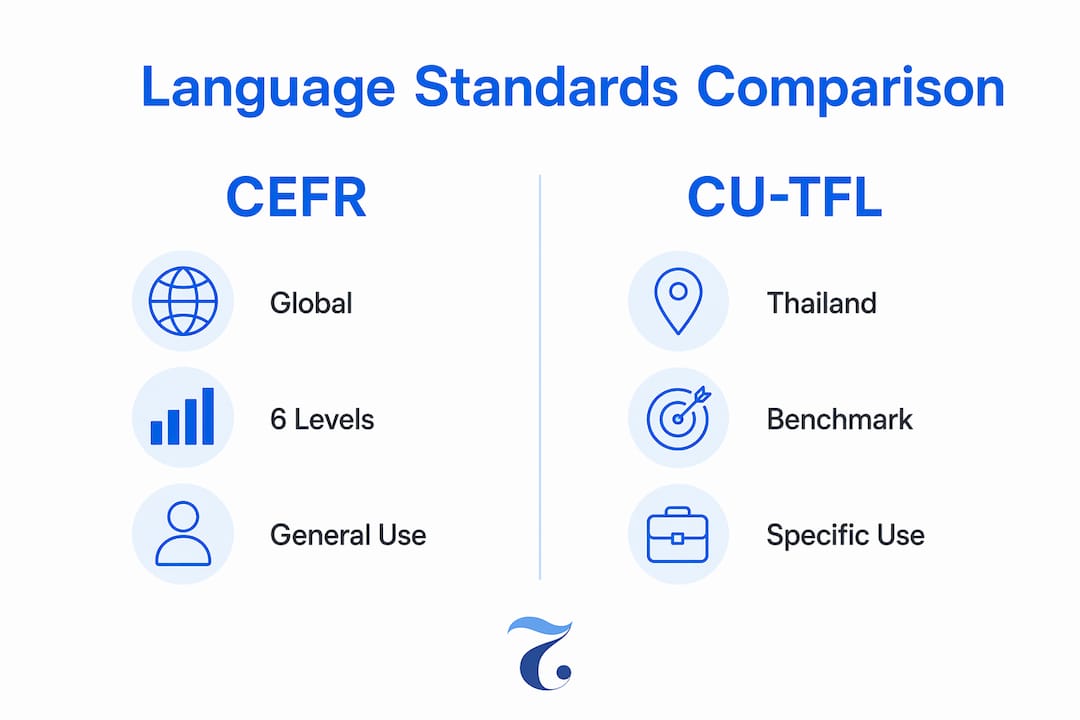
The CEFR is the global benchmark for language achievement, built on a six-level proficiency scale ranging from A1 (beginner) to C2 (mastery). That scale gives learners and educators a shared vocabulary for describing exactly where a student stands and what comes next. Its widespread adoption across Europe and beyond means a B2 certificate earned in Singapore carries the same meaning as one earned in Germany or Brazil.
The CEFR organizes proficiency into three broad bands:
- Basic user (A1, A2): Can handle simple interactions and familiar topics
- Independent user (B1, B2): Can manage most everyday and professional situations
- Proficient user (C1, C2): Can express ideas fluently, precisely, and spontaneously
Beyond the CEFR, other frameworks serve specific regional or institutional needs. The CU-TFL (Chulalongkorn University Proficiency Test of Thai as a Foreign Language) applies the same logic to Thai, giving learners a structured path through reading, writing, listening, and speaking. Thai Explorer aligns its curriculum with the CU-TFL, which means every lesson maps to a recognized proficiency target rather than a vague sense of “getting better.”
| Framework | Scope | Primary Use |
|---|---|---|
| CEFR | Global (European origin) | General language proficiency across all languages |
| CU-TFL | Thailand and Southeast Asia | Thai as a foreign language assessment |
| ACTFL | United States | Proficiency guidelines for American language education |
The value of these frameworks is comparability. A learner who completes a B1-aligned course can transfer that credential to a job application, a university program, or a visa requirement with confidence.
How do language standards impact teaching methods and assessment?
Standard language frameworks serve three primary functions in learning: they act as a curriculum roadmap, they enable objective proficiency assessment, and they reduce communication ambiguity. Each function directly shapes how teachers plan lessons and how learners measure progress.

When a curriculum is built around defined proficiency levels, teachers can sequence content logically. A lesson targeting A2 learners focuses on present-tense verbs and basic greetings. A lesson targeting B2 learners tackles nuanced opinion expression and formal register. Without that structure, teachers often default to covering whatever feels relevant, which leaves gaps in learner development.
Standards also make assessment objective. A learner who passes a CU-TFL level test has demonstrated specific, verifiable skills. That result means the same thing to every employer, institution, or program that reads it. Subjective teacher impressions, while valuable, cannot provide that level of portability.
Plain language principles, as applied by institutions like the Maryland Digital Playbook, show how consistent semantics reduce cognitive load and improve comprehension. The same principle applies in language classrooms: when teachers use standardized terminology and structured explanations, learners spend less mental energy decoding instructions and more energy acquiring the target language.
Practical steps for applying standards in the classroom include:
- Mapping each lesson objective to a specific proficiency descriptor
- Using standardized rubrics for speaking and writing assessments
- Sharing proficiency level descriptions with learners so they can self-assess
- Tracking progress against benchmarks at regular intervals rather than only at course end
Pro Tip: Share the proficiency level descriptors from your framework directly with learners. When students know exactly what a B1 speaker can do, they set more realistic goals and take ownership of their progress.
Why do language standards matter for communication and career success?
Employers use standard language proficiency as a proxy for competence and reliability. Poor grammar, inconsistent punctuation, and unclear expression signal carelessness, regardless of the speaker’s actual knowledge. That perception affects hiring decisions, promotion opportunities, and professional credibility.
This is not simply about following rules for their own sake. Standard language norms enable precise reasoning and clear documentation. A professional who writes an ambiguous contract clause or delivers an unclear presentation creates real costs for their organization. The ability to communicate within recognized standards is a practical skill with measurable consequences.
Research in political science adds a less obvious dimension to this picture. Language standards support nation-building and social cohesion by establishing a shared linguistic reference point across diverse populations. Governments have historically used standardized language to unify communities that speak different dialects or regional varieties. That same logic applies at the organizational level: shared language norms reduce friction and build trust within teams.
“Standard language norms enable explicit reasoning and analytical thinking among diverse populations. Teaching mastery of standard language is not a betrayal of linguistic identity. It is access to the language of power.” — In Defense of the Language Mavens, 2025
The impact on workplace communication extends beyond grammar. Learners who understand proficiency standards know which register to use in which context. They can shift between formal and informal communication deliberately, rather than defaulting to one style in every situation. That flexibility is what distinguishes a competent communicator from a merely fluent one.
How do language standards foster global educational and economic development?
International standards function as development infrastructure, enabling measurement, compatibility, and quality assurance across educational systems and economies. That infrastructure reduces costs, improves outcomes, and creates a level playing field for learners regardless of geography. A student in Singapore who earns a recognized language certification competes on equal footing with a student in London or Tokyo.
The World Development Report 2025 identifies standards as tools for competitiveness, resilience, and inclusive growth. Countries that adopt and align with international standards gain access to global markets, partnerships, and educational exchanges. Those that shape standards gain even more influence over how quality is defined and measured.
The global benefits of language proficiency standards include:
- Portability of credentials: A certified proficiency level transfers across borders without requiring re-evaluation.
- Curriculum alignment: Schools in different countries can design compatible programs, making student exchanges and joint degrees more practical.
- Employer confidence: Multinational companies can hire across markets knowing that a certified B2 speaker meets a consistent threshold.
- Cost reduction: Standardized assessment tools eliminate the need for every institution to develop its own testing infrastructure.
- Inclusive access: Clear proficiency pathways give adult learners and career changers a defined route into new professional fields.
| Benefit | Who gains most |
|---|---|
| Credential portability | International students and professionals |
| Curriculum alignment | Educational institutions and program designers |
| Employer confidence | Multinational organizations |
| Cost reduction | Governments and training providers |
Developing nations face a real challenge here. They often adopt standards shaped by wealthier countries, which means their specific linguistic contexts and learning needs may not be fully represented. Participating in the bodies that shape international frameworks is as important as adopting those frameworks.
What practical steps can educators and learners take to apply language standards effectively?
Applying language standards well requires more than posting a proficiency chart on a classroom wall. Educators need to translate abstract level descriptors into concrete lesson activities, and learners need regular feedback that connects their performance to a recognized benchmark.
The most effective starting point is a placement assessment aligned to the framework in use. For Thai learners at Thai Explorer, that means identifying whether a student operates at a beginner, intermediate, or advanced level before designing a learning plan. That initial mapping prevents two common problems: placing learners in courses that are too easy (which wastes time) and placing them in courses that are too difficult (which kills motivation).
Authentic resources are the next lever. Learners who only practice with textbook dialogues struggle when they encounter real speech, real writing, and real cultural context. Aligning authentic materials to proficiency levels, such as using simple news articles for B1 learners and complex opinion pieces for C1 learners, keeps practice grounded in real-world language use. Thai Explorer’s approach of combining cultural immersion with structured lessons reflects this principle directly.
Key practices for applying standards in individual learning plans:
- Set a target proficiency level before starting a course, not after
- Review the specific “can-do” descriptors for your current level and the next level up
- Use standardized self-assessment checklists monthly to track incremental progress
- Seek feedback from qualified instructors who can map your errors to specific proficiency gaps
- Supplement formal lessons with authentic listening and reading at your current level
Pro Tip: Use the “can-do” statements from your proficiency framework as a weekly checklist. If you cannot yet do something listed at your current level, that gap becomes your next lesson focus.
Plain language principles apply to learners as well as teachers. Disciplined use of punctuation and semantics reduces the cognitive load on your reader or listener, making your communication more effective at every proficiency level.
Key Takeaways
Language standards are the most reliable infrastructure educators and learners have for measuring, comparing, and improving language proficiency across contexts.
| Point | Details |
|---|---|
| Standards define proficiency clearly | Frameworks like the CEFR and CU-TFL give learners and educators a shared, measurable reference for progress. |
| Assessment becomes objective | Standardized benchmarks replace subjective impressions with verifiable, portable credentials. |
| Career credibility depends on standards | Employers use standard language proficiency as a direct signal of competence and reliability. |
| Global development requires standards | International language frameworks reduce costs, align curricula, and create equal access to educational opportunities. |
| Practical application drives results | Placement assessments, authentic materials, and regular benchmark reviews translate standards from theory into measurable learning gains. |
Why I think most learners underestimate language standards
Most learners treat proficiency frameworks as bureaucratic paperwork. They want to “just speak the language” and see level descriptors as something their teacher worries about. That attitude costs them time and opportunity.
After years of working with adult language learners, I have seen the same pattern repeat: learners who understand their proficiency level progress faster than those who do not. Knowing you are at A2 and that B1 requires you to handle unfamiliar situations in conversation gives you a concrete target. Vague goals like “get better at Thai” produce vague results.
The harder truth is that standards also protect learners from poor instruction. A course aligned to a recognized framework like the CU-TFL cannot quietly skip grammar or pronunciation because the instructor finds it inconvenient. The standard holds the curriculum accountable. That accountability is what separates a structured Thai language program from a series of loosely connected conversations.
Linguistic diversity matters, and no standard should erase it. But access to standard language is access to opportunity. Teaching it rigorously, while respecting the learner’s background, is one of the most genuinely useful things an educator can do.
— Paul
Thai language courses built around real proficiency standards
Thai Explorer offers adult Thai language courses in Singapore designed around recognized proficiency standards, including the CU-TFL framework. Every course, whether group, private, or online via Zoom, maps to specific proficiency levels so you always know where you stand and what comes next.

Qualified native Thai instructors, all bilingual in Thai and English, guide learners through speaking, listening, reading, and writing in a structured sequence. Courses cover conversational Thai, business Thai, and online formats for professionals who need flexibility. Thai Explorer is located at 10 Anson Road, #22-07, International Plaza, Singapore 079903, right above Tanjong Pagar MRT. Explore the full range of Thai language courses and find the format that fits your schedule and goals.
FAQ
What is the role of language standards in learning?
Language standards define proficiency levels and guide curriculum design, assessment, and communication goals. They give educators a structured roadmap and give learners a clear, measurable path to follow.
What is the CEFR and why does it matter?
The CEFR is a six-level proficiency scale used globally to describe language achievement. It enables learners to compare and transfer their credentials across countries and institutions.
How do language standards affect career prospects?
Standard language proficiency signals competence and reliability to employers. Poor adherence to language norms negatively affects professional credibility, regardless of the speaker’s actual knowledge.
What is the CU-TFL?
The CU-TFL is the Chulalongkorn University Proficiency Test of Thai as a Foreign Language. It provides a recognized benchmark for Thai language skills and is the framework Thai Explorer uses to structure its curriculum.
How can learners use language standards practically?
Learners can start with a placement assessment, review the “can-do” descriptors for their current level, and use those descriptors as a monthly self-assessment checklist to track progress against a recognized proficiency benchmark.