TL;DR:
- English speakers in Thailand face significant communication challenges due to fundamental linguistic and cultural differences. Mastering Thai requires understanding its tonal system, social pronouns, high-context communication style, and social hierarchy to achieve effective interaction. Cultural fluency and practical practice are essential alongside language rules for meaningful integration.
If you assume English will carry you through daily life in Thailand the way it does in Singapore, you are in for a genuine surprise. The difference between Thai and English language goes far beyond alphabet and accent. Thai operates on a completely different set of rules: tonal pronunciation, a complex social pronoun system, no verb conjugations, and a high-context communication style that makes even fluent English speakers feel like beginners. For language learners and cultural enthusiasts in Singapore, understanding exactly where these two languages diverge is the first step toward real communication in Thailand.
Table of Contents
- Distinct linguistic features of Thai and English
- Social hierarchy and language use: Thai pronouns versus English pronouns
- Communication challenges for English speakers in Thailand
- Practical differences in sentence structure and communication style
- Applying Thai language knowledge for effective communication and integration
- Why mastering the cultural context is as crucial as language rules
- Explore Thai language courses tailored for adults in Singapore
- Frequently asked questions
Key Takeaways
| Point | Details |
|---|---|
| Thai is tonal and context-dependent | Thai uses tones and frequently omits subjects, making context key to understanding. |
| Pronouns reflect social hierarchy | Thai pronouns vary widely by the speaker’s social relationship, unlike English pronouns. |
| English proficiency is limited in Thailand | Outside major cities, English is often insufficient, so learning Thai is essential. |
| Cultural context is vital | Success in Thai communication requires grasping social norms beyond just grammar. |
| Listening comprehension is challenging | Many learners struggle with the high-context, subject-omitting nature of spoken Thai. |
Distinct linguistic features of Thai and English
Thai and English are built on fundamentally different foundations. Where English relies on a 26-letter Roman alphabet with relatively predictable spelling patterns, Thai uses its own script of 44 consonants, 15 vowel symbols, and four tone markers. That script is not just cosmetic. It is phonetically precise in ways that English simply is not, directly encoding tones into the written form.
The most dramatic difference for new learners is tone. Thai is a five-tone language, meaning the same syllable spoken in a different pitch carries an entirely different meaning. The syllable maa can mean “come,” “horse,” “dog,” or “value” depending on tone. English has no equivalent mechanism. We use tone for emotion or emphasis, not meaning. Getting a Thai tone wrong does not just sound foreign. It says a completely different word.
Grammar diverges just as sharply. English requires verb conjugation (“I go,” “she goes,” “they went”), gendered article choices in many related European languages, and clearly marked plurals. Thai has none of these. Verbs never change form. Nouns do not carry gender. Plurals are either implied by context or indicated by quantity words. Instead, Thai uses classifiers, which are counting units that categorize nouns. You count “three sheets of paper” or “two long objects” rather than just “three papers” or “two pens.” This is a feature English learners of Thai consistently underestimate.
Review the core contrasts:
| Feature | Thai | English |
|---|---|---|
| Tones | Five tones change meaning | No tonal meaning system |
| Verb conjugation | None | Required across tenses and subjects |
| Plurals | Context-based, no fixed marking | Marked with “s” or irregular forms |
| Writing system | Unique script with tone markers | Roman alphabet |
| Classifiers | Required with numbers | Partial (sheet of paper, head of cattle) |
| Word order | Subject-verb-object (flexible) | Subject-verb-object (stricter) |
Key features that shape learning Thai compared to English:
- The Thai script is written without spaces between words, which makes reading comprehension particularly challenging for beginners
- Polite particles like krap (male) and ka (female) are added to sentences the way “please” functions in English, but their use is socially mandatory, not optional
- Thai grammar basics are actually simpler in some ways than English because there is no conjugation to memorize
- Thai pronunciation relies on proper vowel length (short vs. long sounds create different words), a distinction English speakers rarely practice
Pro Tip: Before focusing on vocabulary, invest time in the Thai pronunciation fundamentals. Mispronouncing tones produces wrong words, not accented versions of the right one. That distinction changes how you study.
Social hierarchy and language use: Thai pronouns versus English pronouns
Understanding the structural distinctions leads us to one of the most socially loaded differences between the two languages: pronouns.

English gives you a small, fixed set. I, you, he, she, we, they. These words carry no information about your social rank, age, relationship to the speaker, or gender identity (increasingly so in modern English). They are neutral containers.
Thai pronouns are nothing like this. The language encodes social status and relational distance directly through pronoun choice. There are at least 49 recognized pronouns in Thai, and selecting the wrong one signals something specific about how you view the other person.
How this plays out in real life:
- A young woman might use chan (ฉัน) for “I” in formal situations and nuu (หนู) when speaking to elders to signal deference
- A man in a formal business meeting uses phom (ผม) for “I”; in casual settings among friends, he might switch to raw (เรา) or even his own nickname
- Addressing someone older or senior as Phi (พี่, meaning older sibling) is polite and warm; using the wrong term can feel abrupt or even disrespectful
- Many Thais drop pronouns entirely in conversation, relying on context so completely that learners miss who is doing what
“In Thai, who you are in relation to the other person is not just social context. It is literally encoded in the words you choose to say ‘I’ or ‘you.’”
Using incorrect Thai pronouns is one of the fastest ways to create unintended awkwardness. This is not a grammar mistake in the usual sense. It signals a misread of the social situation. Understanding this dynamic is central to cultural fluency in Thai that no grammar textbook alone will teach you.
Communication challenges for English speakers in Thailand
After examining linguistic and social divergence, let’s look at the concrete obstacles English speakers face when navigating Thai society.
Here is the number that usually surprises people: Thailand ranks 106th out of 116 countries in English proficiency. That places it among the lowest-ranked countries globally for a language that has been taught in Thai schools for decades. The gap between classroom exposure and functional street-level English is enormous.
What this means in practice:
- Bangkok and Phuket are exceptions, not the rule. In international hotels, multinational offices, and tourist-facing restaurants, English works. Step outside those zones and it stops being reliable very quickly.
- Public services operate in Thai. Hospitals outside major cities, government offices, local markets, and transportation hubs typically have no English-language interface. A simple errand can become a real communication barrier.
- Listening comprehension is harder than speaking. Conversational Thai omits subjects and pronouns constantly. You might understand individual words but lose the thread of who is doing what to whom.
- Tonal mistakes cause real confusion. Unlike a French accent in English that is understood despite being imperfect, a wrong Thai tone produces the wrong word. The listener does not hear a foreign accent; they hear a different sentence.
“Relying on English outside Bangkok does not just limit convenience. It effectively removes you from participation in everyday social and commercial life.”
The practical communication gap between English-speaking visitors and local Thai speakers is not going to be closed by speaking slower or louder in English. It requires actual Thai.
Pro Tip: Learn the Thai words for basic transactional phrases first: numbers, food names, directions, and polite requests. Even minimal Thai signals goodwill to locals and opens doors that a confident English sentence cannot.
Practical differences in sentence structure and communication style
Having explored pronunciation and social dimensions, we now focus on how Thai and English construct meaning through grammar and conversation style.
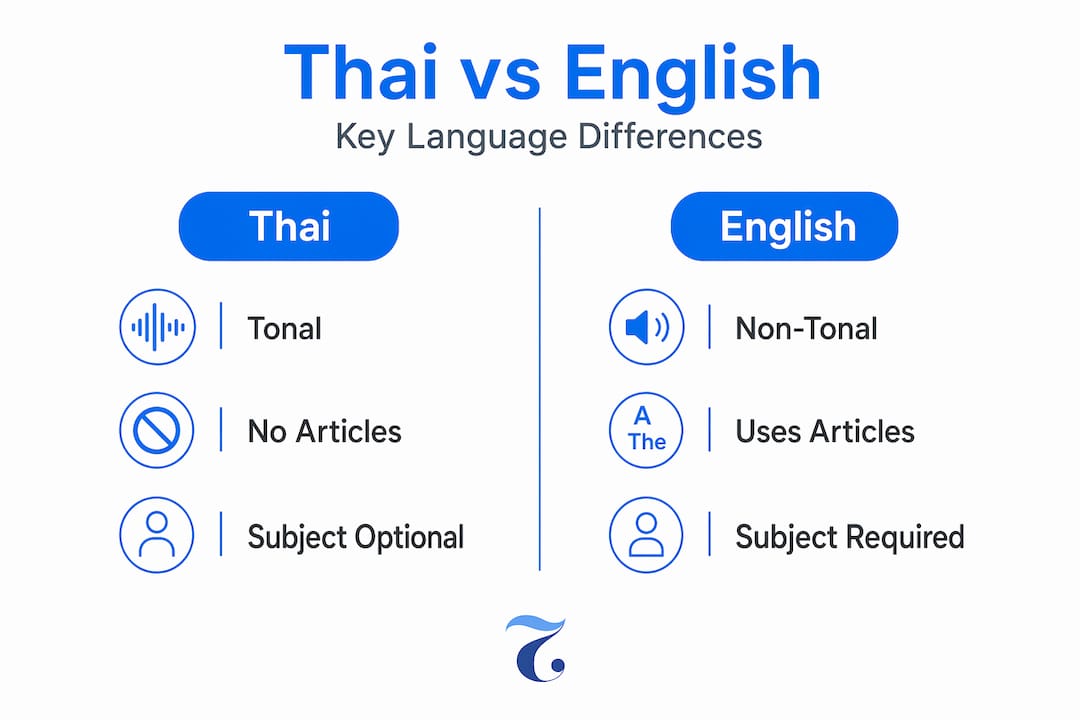
Thai operates as a high-context language, which is the opposite of English’s relatively low-context style. English values explicitness. You state the subject, state the verb, state the object. Ambiguity is generally considered poor communication. Thai allows and even expects listeners to infer meaning from context, relationship, and shared understanding.
Key structural contrasts:
- Subject omission: Thai regularly drops the subject entirely. “Going to eat now” is a complete sentence because context tells both parties who is eating.
- Adjective placement: In Thai, adjectives follow the noun they describe. “A red car” becomes “car red.” Adverbs similarly follow the verb they modify, not precede it.
- Particles do social work: Sentence-final particles like krap, ka, na, and la signal tone of voice, politeness, and speaker attitude. Removing them makes speech sound cold or blunt.
- No tense markers built into verbs: Thai uses time words like “yesterday” or “tomorrow” to establish when something happened. The verb itself does not change.
| Sentence element | Thai approach | English approach |
|---|---|---|
| Subject | Often omitted | Usually required |
| Tense | Time words, no conjugation | Verb form changes |
| Adjective position | Follows noun | Precedes noun |
| Politeness markers | Sentence-final particles | Word choice and tone |
Understanding Thai sentence structure from the beginning prevents the habit of mentally translating English sentences into Thai word-by-word, which produces awkward speech that native speakers struggle to follow.
Applying Thai language knowledge for effective communication and integration
With a clear understanding of linguistic and cultural differences, we turn to how you actually apply this knowledge.
Knowing that Thai is tonal, contextual, and socially encoded is one thing. Adjusting your communication behavior to match is another. Here is how to make that shift:
- Prioritize spoken Thai for daily tasks. Ordering food, asking for directions, and navigating markets all become dramatically easier with even basic Thai. Locals respond differently when you try.
- Avoid public corrections. Correcting someone publicly in Thai culture causes sia naa, or “loss of face,” a concept that carries far more social weight than embarrassment does in Western contexts. If you correct a Thai speaker’s English in front of others, the interaction often ends there.
- Build your listening ear separately from speaking. Thai radio, TV dramas, and podcasts train your ear to catch the tonal and contextual signals that textbooks cannot replicate.
- Study social context alongside vocabulary. Learn not just what to say but who you are when you say it. Your age relative to the other person, your professional role, and your gender all affect word choice in ways English simply does not require.
Pro Tip: Use polite particles (krap for men, ka for women) at the end of every sentence while you are still learning. Even if your grammar is rough, this single habit signals respect and dramatically improves how Thai speakers respond to you.
Why mastering the cultural context is as crucial as language rules
Here is an uncomfortable truth that most language learning programs skip over: you can memorize Thai grammar perfectly and still fail at Thai communication. Not struggle. Fail.
The reason is that Thai language and Thai social behavior are not separate systems. They are the same system. The way you choose a pronoun is a social act. The way you soften a request with na at the end of a sentence is a relationship signal. Grammar and culture do not run in parallel. They run together.
Foreigners who learn Thai grammar without internalizing the hierarchical social norms that language encodes face persistent barriers in both professional and personal settings. They are technically correct but socially tone-deaf. And in Thailand, social tone-deafness is a real professional liability. A business meeting where you use overly casual pronouns with a senior executive, or where you push back directly when a Thai colleague gives an indirect “no,” can quietly end a working relationship.
What actually works is treating the language and the culture as one subject. When you study why Phi softens a request, you are not just learning a vocabulary word. You are learning that Thai relationships are built on acknowledged hierarchy, not flattened equality. When you learn that Thais rarely say “no” directly, you are learning that the language itself is built to preserve relationships by avoiding confrontation.
This is where cultural fluency insights become as important as any grammar lesson. The learners who progress fastest at Thai Explorer are not necessarily those with the strongest linguistic backgrounds. They are the ones who approach Thai culture with genuine curiosity and humility, who observe before they speak and who ask about the why behind the words.
Patience is not just a virtue in this process. It is a practical tool. Rushing toward fluency without cultural grounding produces confident mistakes. Taking time to understand the social logic behind Thai language choices produces communication that actually lands.
Explore Thai language courses tailored for adults in Singapore
Knowing the differences between Thai and English is the starting point. Building real fluency takes structured practice with people who understand both languages and both cultures.

At Thai Explorer, located directly above Tanjong Pagar MRT, our Thai language courses in Singapore are built for adult learners at every level, from complete beginners to those preparing for professional or business use. Whether you prefer the focus of private Thai lessons or the flexibility of an online Thai course via Zoom, every class integrates cultural context alongside language skills. Our native Thai instructors are bilingual in Thai and English, so explanations land clearly. You learn to communicate, not just conjugate.
Frequently asked questions
Is English widely spoken outside Bangkok in Thailand?
English proficiency is generally low outside Bangkok and major tourist areas, making basic Thai essential for everyday communication in provincial towns and rural settings.
What makes Thai pronouns more complex than English pronouns?
Thai has numerous pronouns that shift based on gender, age, and social distance, unlike English’s small fixed set, reflecting Thailand’s deeply hierarchical social culture directly through language.
Why is listening comprehension so challenging in Thai?
Thai frequently omits subjects and pronouns and relies on context to carry meaning, which makes identifying who is doing what in a conversation genuinely difficult for learners beyond the beginner stage.
How important is cultural understanding when learning Thai?
Cultural knowledge, especially around social hierarchy and face-saving behavior, is as important as grammar for effective communication, since Thai language and social conduct are inseparable systems.