
TL;DR:
- Learning Thai script first enhances pronunciation accuracy and long-term fluency more effectively than relying on romanization.
- Consistent daily practice, combined with native audio, script recognition, and structured feedback, accelerates language mastery.
Thai looks intimidating at first glance. The script curves in ways that seem impossible to decode, the five tones make every syllable feel like a gamble, and romanization charts leave you sounding like a robot. But knowing how to learn Thai correctly from the start changes everything. Whether you’re heading to Bangkok for business, building deeper connections through travel, or simply want to engage with Thai culture on a real level, this guide gives you a clear, adult-focused roadmap. No fluff. No shortcuts that waste your time.
Table of Contents
- Key takeaways
- How to learn Thai: what you need before you start
- Mastering Thai script: the foundation that changes everything
- Building vocabulary, pronunciation, and real conversation skills
- Common mistakes that slow Thai learners down
- Tracking your progress and building toward fluency
- My honest take on what it really takes
- Ready to take Thai from study to conversation?
- FAQ
Key takeaways
| Point | Details |
|---|---|
| Script before romanization | Learning Thai script first accelerates pronunciation accuracy and long-term fluency far more than phonetic workarounds. |
| Tones are non-negotiable | Thai has five tones that change word meaning entirely; tone practice must start on day one, not later. |
| Grammar is your friend | Thai has no verb conjugations, gender, or plurals, making sentence structure easier than most European languages. |
| Daily consistency beats intensity | Short, daily sessions using spaced repetition tools outperform long weekend cramming sessions for vocabulary retention. |
| Structured feedback matters | Self-study has limits; a qualified instructor catches tone errors and pronunciation habits before they become permanent. |
How to learn Thai: what you need before you start
The single most common mistake new learners make is diving into apps or phrasebooks without any preparation framework. Before your first lesson or study session, get the right materials and the right mindset together.
On the materials side, you need at minimum: a Thai consonant and vowel chart, a good audio resource that uses native speakers, a flashcard system (physical or digital), and a notebook dedicated entirely to script practice. For digital tools, Anki and Memrise are the most practical options for building vocabulary through spaced repetition. A Thai keyboard on your phone is also worth setting up early so you can type in script, not just read it.
Here is a quick checklist for learning Thai that actually works at the beginner stage:
- Thai script chart with consonant classes marked
- Anki deck with audio for pronunciation
- Dedicated notebook for writing practice
- Thai keyboard installed on your device
- Access to native-speaker audio content (podcasts, YouTube channels, or structured lessons)
- A structured course or qualified instructor for corrective feedback
Pro Tip: Install an OCR (optical character recognition) app on your phone before your first week ends. Pointing your camera at Thai text in menus, signs, or packaging and getting instant transliterations creates daily immersion without needing to be in Thailand.
Mindset matters as much as materials. Online language learning research consistently shows that learners who commit to 20 to 30 minutes of daily practice outperform those who do sporadic marathon sessions. Consistency is the actual method.
| Tool | Best For | Limitation |
|---|---|---|
| Anki | Vocabulary retention via spaced repetition | Requires self-discipline to build quality decks |
| Memrise | Beginner vocabulary with native audio | Less flexible for custom content |
| YouTube (Thai channels) | Listening comprehension and culture | Unstructured without a learning plan |
| Structured course | Speaking, tones, script, and feedback | Requires scheduling commitment |
| OCR apps | Real-world reading practice | Cannot explain grammar or meaning |
Mastering Thai script: the foundation that changes everything
Here is the truth most beginner guides bury in a footnote: ignoring Thai script leads learners to develop flat, robotic pronunciation that native speakers struggle to understand. Romanization cannot capture tone length or vowel quality accurately. The script can.
Thai script is an abugida, which means consonants carry an inherent vowel sound and other vowels are added as markers. What makes it feel overwhelming at first is the spatial layout. Vowels orbit consonants in four zones: above, below, before, and after the consonant. Once you recognize this pattern, what looked like a wall of shapes becomes a predictable grid.
Pro Tip: Treat the consonant as the center of a compass. North is above, south is below, west is before, east is after. When you learn a new vowel, immediately place it on your mental compass. This spatial trick cuts reading time dramatically in the first month.
Thai has 44 consonants organized into three tone classes: mid, low, and high. These classes directly determine the tone of any syllable, which means learning consonant classes is not a grammar exercise. It is a pronunciation exercise. The five Thai tones (mid, low, falling, high, and rising) are determined by the consonant class combined with any tone marks present.
| Consonant class | Tone marks affect | Default tone (no mark) |
|---|---|---|
| Mid class | All four tone marks | Mid tone |
| Low class | Two tone marks | Mid tone |
| High class | Two tone marks | Rising tone |
The grammar side of Thai is genuinely straightforward. Thai sentence structure follows Subject-Verb-Object order with no verb conjugations, no grammatical gender, and no plural forms. You say the same word for “cat” whether you mean one or twenty. Context and number words handle the rest. This makes building basic sentences faster than most learners expect.
Common script mistakes to avoid:
- Skipping consonant class memorization and trying to guess tones by sound alone
- Treating all vowels as following the consonant, when many appear before or above it
- Confusing visually similar consonants (there are several pairs that look nearly identical)
- Rushing past script to get to “real” Thai phrases before the foundation is solid
Building vocabulary, pronunciation, and real conversation skills
Once you can read basic script, the learning curve shifts from visual decoding to sound production. This is where spaced repetition software becomes your most consistent practice partner. Anki decks with audio files let you hear the correct tone, see the script, and test your recall in the same session.
Tone mastery takes deliberate practice. The method that works fastest is drilling minimal pairs: words that are identical except for tone. “Maa” (มา) means “to come” on a mid tone but means “horse” (ม้า) on a rising tone. Practicing these pairs until the difference is automatic trains your ear and your mouth at the same time.
For listening comprehension, Thai TV series and YouTube channels aimed at Thai audiences are better than material made for learners. Learner-facing audio is often slowed down and over-enunciated. Real content reflects actual speech rhythm, which is what you will encounter in conversation.
Daily practice tips that actually move the needle:
- Record yourself reading a Thai sentence, then play it back and compare to a native audio source
- Type in Thai script on your phone for at least five minutes each day (messaging apps work fine)
- Learn ten new words each day using Anki, always with audio attached
- Practice one new sentence pattern each day and use it in at least three different contexts
- Watch five minutes of Thai content with Thai subtitles (not English) to train visual-audio connection
Pro Tip: When you first practice speaking, slow your delivery down to about 60 percent of normal speed. This gives your brain time to self-monitor tone production. Native speakers will still understand you. What they won’t understand is a rushed attempt at the wrong tone.
AI conversation partners have become a practical tool for learners who do not yet have speaking partners. They offer immediate feedback and are available at any hour. The limitation is accent authenticity, but for drilling sentence patterns and basic tone awareness, they fill a real gap between study sessions and real conversations.

Common mistakes that slow Thai learners down
Plateaus feel personal, but they almost always have structural causes. The most common one is a split between reading ability and speaking ability that develops when learners study vocabulary without tying it to script. They recognize words visually but cannot produce them because they have not internalized the tone class of the consonant starting that word.
Another common pattern is avoiding the harder material by cycling through beginner content indefinitely. Apps can reinforce this because they reward completion of easy modules. If your listening comprehension has not improved in four weeks, you are probably not challenging yourself enough with natural Thai content.
Common errors and how to correct them:
- Tone confusion: Go back to consonant class drills, not tone marks alone. The class determines the baseline.
- Script overwhelm: Narrow your focus to one consonant class per week instead of trying to memorize all 44 at once.
- Speaking plateau: Seek structured feedback from a qualified instructor. Self-monitoring has limits, especially for tones.
- Romanization dependence: Delete romanization references from your flashcards. Force yourself to work with script and audio only.
- Motivation drop: Set a specific, external goal. Booking a trip, registering for a proficiency test, or joining a conversation group creates accountability.
Thai language proficiency directly affects how well foreign residents integrate socially and professionally in Thailand. That is not just motivation. It is practical reality. Learners who connect their study to concrete outcomes sustain effort longer than those who learn without a clear reason.
Tracking your progress and building toward fluency
Self-assessment is a skill most learners skip, and it costs them. Without honest benchmarking, you cannot know whether you are actually improving or just getting more comfortable with the same level of competency.
Daily reading and listening practice solidifies comprehension faster when you also track what you understand. Keep a simple log: date, content you consumed, percentage you estimated you understood. Watching the same type of content weekly and noting whether comprehension improves tells you more than any app progress bar.
External validation matters too. The CU-TFL (Chulalongkorn University Proficiency Test of Thai as a Foreign Language) gives learners a standardized benchmark for reading, writing, listening, and speaking. Even preparing for a test without sitting it forces structured review that self-study often lacks.
| Milestone | Expected skills | Timeframe (consistent daily study) |
|---|---|---|
| Beginner | Read basic script, greet and introduce yourself | 1 to 2 months |
| Elementary | Handle travel situations, order food, ask directions | 3 to 4 months |
| Intermediate | Discuss work, preferences, and current events | 6 to 12 months |
| Upper-intermediate | Follow fast native speech, hold business conversations | 12 to 18 months |
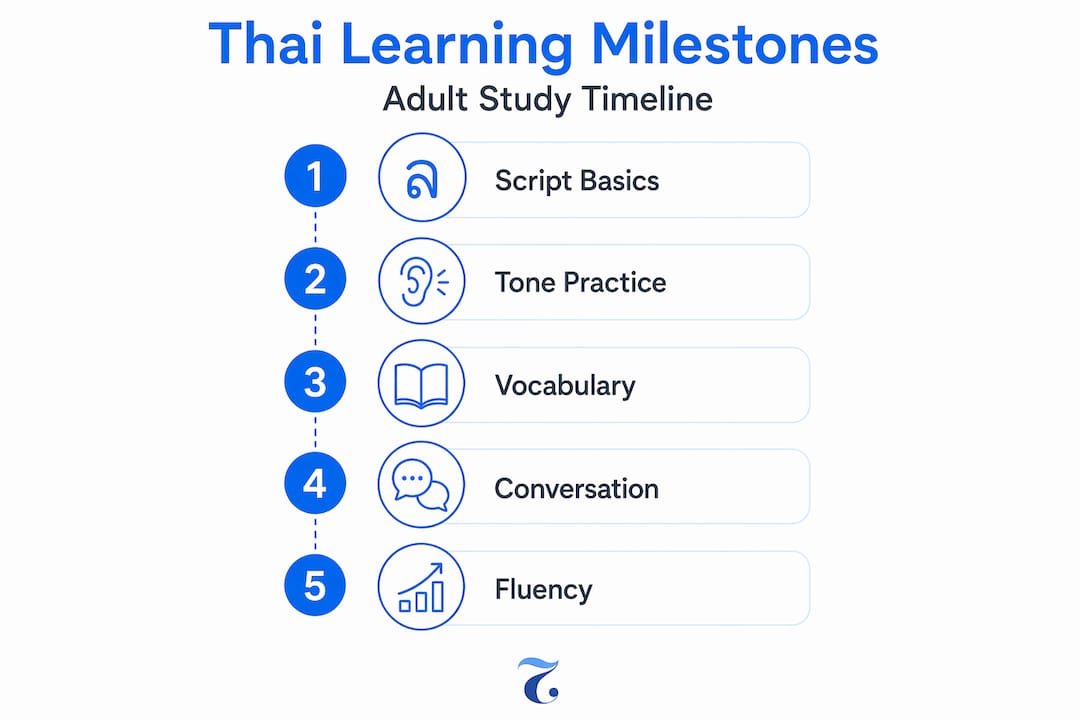
Joining a Thai language exchange group or local Thai cultural community adds real-world practice that no app can replicate. For Singapore-based learners, Thai cultural associations and community events offer regular conversation exposure with native speakers. Look for Thai learning programs that combine structured lessons with cultural context, because language without culture produces textbook speakers who miss the nuance that fluency actually requires.
My honest take on what it really takes
I have seen many learners attempt Thai and stall at the same two walls: the script and the tones. And I have watched just as many push through both by doing something counterintuitive. They slowed down before they sped up. In my experience, the learners who skip script memorization because it feels hard in week two are the same ones complaining a year later that their speaking “sounds off.” The script is not a detour. It is the road.
What I have found genuinely underrated is the connection between reading and listening. When I started reading Thai text alongside audio, the tones clicked in a way that drills alone never produced. Seeing the consonant class on the page while hearing the tone in real time creates a feedback loop that sticks. I recommend every adult learner find a qualified instructor for at least the first month, not to replace self-study but to catch errors early. Correcting a tonal habit at week two takes an afternoon. Correcting it at month six takes months.
Cultural integration is real too. Deep social integration and Thai proficiency are directly linked. You do not need to become fluent to start experiencing that shift. Even functional Thai in a market or a meeting creates a different kind of connection that English simply cannot.
— Paul
Ready to take Thai from study to conversation?
Thai Explorer offers structured adult Thai courses in Singapore designed exactly for learners who want to move beyond basics and into real communication. Whether you are preparing for travel, deepening cultural connections, or need to handle professional situations in Thai, the programs at Thai Explorer are built for that outcome.
Classes are conducted by qualified native Thai instructors who are bilingual in Thai and English, keeping explanations clear while keeping the learning authentically Thai. Flexible options include group classes, private Thai lessons, and online Zoom courses for learners who need to fit study around a busy schedule. Corporate training is also available for teams. Thai Explorer is located at 10 Anson Road, #22-07, International Plaza, Singapore 079903, directly above Tanjong Pagar MRT. Explore the full range of Thai language courses and find the format that fits your life.
FAQ
What is the best way to learn Thai as a complete beginner?
Start with the Thai script and consonant classes before using any romanization. Pair daily script practice with audio from native speakers, and use spaced repetition tools like Anki for vocabulary from the first week.
How long does it take to reach conversational Thai?
Most adult learners who study consistently for 20 to 30 minutes daily reach basic conversational ability within three to four months, and comfortable intermediate conversation within 12 months.
Can I learn Thai online effectively?
Yes. Online Thai courses through platforms like Zoom allow structured lessons with qualified instructors and are particularly effective when combined with daily self-study using audio and script practice tools.
Do I really need to learn the Thai script?
Yes. Romanization neglects tones and vowel length, leading to pronunciation that native speakers find difficult to understand. The script is the clearest path to accurate, natural Thai.
Is Thai grammar difficult for English speakers?
Thai grammar is actually one of the easier aspects of the language. There are no verb conjugations, no grammatical gender, and no plural forms. Sentence structure follows a simple Subject-Verb-Object pattern that English speakers adapt to quickly.