
TL;DR:
- Thai reading is often hindered by applying English habits to a phonetic, tonal, and pattern-driven script with no word separation. Mastering consonant classes, tone rules, and chunking techniques enables learners to recognize script within weeks and read more confidently. Focusing on functional markers, visualization, and integrated listening practice accelerates comprehension and fluency in Thai.
Thai reading trips up most learners not because the script is random, but because they apply English reading habits to a system built on entirely different logic. Explaining Thai reading strategies properly means starting with that misconception and dismantling it. Thai script is phonetically consistent, pattern-driven, and deeply tied to tone. Once you understand how it is structured and adopt the right cognitive approach, basic script recognition typically comes within 3 to 4 weeks of focused practice. The strategies in this guide move you from frustrated beginner to confident, fluent reader.
Table of Contents
- Key takeaways
- What makes Thai script different from English
- Chunking and contextual pattern recognition
- Mastering Thai tones for reading accuracy
- Building vocabulary and comprehension through strategic practice
- Handling advanced challenges and sustaining progress
- My honest take on learning to read Thai
- Take your Thai reading further with Thai Explorer
- FAQ
Key takeaways
| Point | Details |
|---|---|
| Drop English reading habits | Thai script follows phonetic and tonal logic; applying English strategies actively slows your progress. |
| Learn vowel placement zones | Vowels sit in four positions around consonants; recognizing this visual pattern unlocks faster decoding. |
| Use chunking, not word-by-word reading | Processing Thai in phrase-sized chunks and tracking functional markers dramatically improves comprehension speed. |
| Tone class mastery is non-negotiable | Consonant class determines tone; drilling this relationship is the single biggest lever for reading accuracy. |
| Graded materials build real fluency | Story-based apps and graded readers build vocabulary and reading confidence faster than isolated drills. |
What makes Thai script different from English
Before any strategy makes sense, you need a clear picture of what you are actually working with. Thai is not just English with different letters. It is a fundamentally different reading system, and applying English strategies to it is one of the most common and costly mistakes adult learners make.
Here is what sets Thai script apart:
- No spaces between words. Thai uses scriptio continua, meaning words run together in a continuous stream. Your job as a reader is to identify word boundaries from context, consonant clusters, and pattern recognition. There is no visual gap to guide you.
- Vowels orbit consonants. Thai vowels are placed in four zones around each consonant: before (เ), after (า), above (ิ), and below (ุ). This creates a visual “compass” effect that you read in a non-linear direction.
- 44 consonants and 32 vowel forms. That number sounds daunting, but each symbol maps to a predictable sound. The system is phonetically consistent once you internalize the patterns.
- Tone is built into the script. Unlike English where tone is optional emphasis, Thai tone marks and consonant classes determine meaning. The same syllable spoken in five different tones can mean five completely different things.
- Consonant classes drive everything. Thai consonants are grouped into High, Mid, and Low classes. The class of the leading consonant in a syllable directly determines its default tone, before any tone mark is applied.
Pro Tip: Before you attempt to read full sentences, spend one focused week learning the three consonant classes and their default tones. This single investment pays dividends across every other reading strategy.
The shift in mindset you need here is significant. Approach Thai as a new operating system, not a foreign skin over an English one. The Thai alphabet structure has its own internal logic, and once you start operating within that logic, reading becomes far more intuitive.

Chunking and contextual pattern recognition
This is where effective Thai reading strategies diverge most sharply from how English speakers instinctively read. Most learners try to decode every word sequentially and immediately assign a fixed meaning to it. Thai does not reward that approach.
Processing Thai in chunks and recognizing directional markers improves comprehension by allowing your brain to wait until the sentence end to confirm meaning. Think of it less like reading a list and more like tracking a moving train. You follow the direction, not just each individual car.
Here is how to build chunking as a practical skill:
- Identify functional markers first. Words like พอ (as soon as), มา (toward the speaker), ไป (away from the speaker), กลับ (back/return), ได้ (ability or completion), and ก็ (then/also) do not carry fixed meanings. They signal sentence direction and grammatical flow. Spotting them early orients you within the sentence structure.
- Group words into logical phrases. Rather than decoding one word at a time, train your eyes to span 3 to 5 characters and process them as a single unit of meaning. This mirrors how fluent Thai readers process text.
- Delay committing to a fixed meaning. Allowing meaning to form progressively rather than locking in a translation at each word prevents the cognitive bottleneck that freezes most intermediate learners mid-sentence.
- Practice with real sentences, not isolated vocabulary. Write out a short Thai sentence, circle every functional marker you can identify, and then work out the phrase groups between them. This active annotation builds pattern recognition faster than passive reading.
Pro Tip: When you encounter a functional marker like ได้ in a sentence, pause and ask: is this expressing ability (can) or completion (successfully did)? Context before the marker almost always tells you. Training this question instinct is the core of advanced Thai reading comprehension.
The payoff from chunking is significant. Learners who stop reacting to individual words and instead follow sentence flow report noticeably faster reading speeds and fewer comprehension breakdowns within weeks of consistent practice.
Mastering Thai tones for reading accuracy
Tone mastery is not just a speaking skill. It is a reading skill. When you read Thai aloud or silently process it, your brain needs to assign the correct tone to each syllable automatically. If that assignment is wrong, the word you “hear” in your head is wrong, and comprehension suffers.
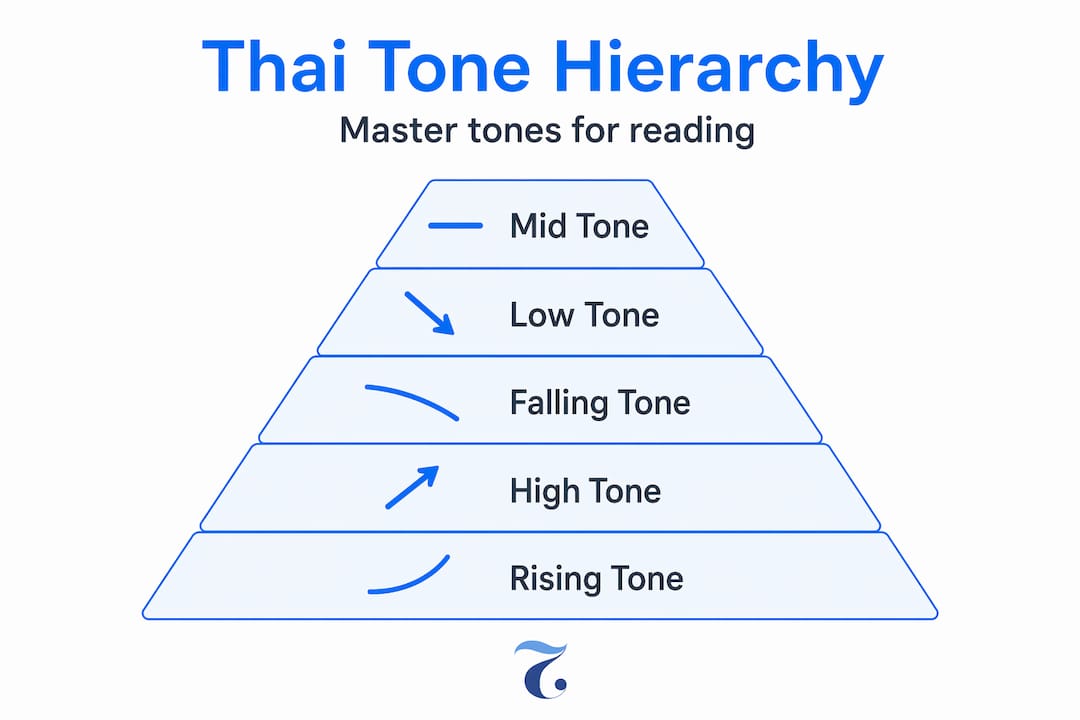
Thai has five tones: mid, low, falling, high, and rising. The tone of any syllable is determined first by its consonant class and then modified by any tone mark present. Here is a quick reference:
| Consonant class | Default tone (no tone mark) | Effect of mai ek (่) | Effect of mai tho (้) |
|---|---|---|---|
| Mid class | Mid | Low | Falling |
| High class | Rising | Low | Falling |
| Low class | Mid | Falling | High |
Understanding this table is not just academic. It is a practical decoding tool. When you see an unfamiliar word, you can work out its approximate tone from this pattern alone.
Strategies for internalizing tones through reading practice:
- Listen while you read. Use native audio paired with the written text. Apps and graded readers that include audio let you train the sound-symbol relationship simultaneously. Repetitive tone drills with native audio are proven to improve tone identification faster than silent reading alone.
- Group consonants by class and drill the defaults. Write out 10 Mid class consonants, 10 High class, and 10 Low class. Drill the default tone for each class daily until the association is automatic.
- Read known words for tone confirmation. Take a word you already know how to say, find it in written form, identify its consonant class, and confirm your knowledge of its class matches. This reverse engineering deepens the pattern.
- Watch for tone mark changes that shift meaning. The word กาว (glue) and ก่าว are related in script but different in meaning once a tone mark shifts the sound. Spotting these pairs in your reading practice sharpens your precision.
A common pitfall is ignoring tone entirely during early reading practice because it feels overwhelming. That shortcut creates a habit of tonal blindness that is genuinely hard to undo later. Build tone awareness from the first week. Your reading comprehension will be measurably stronger for it.
Building vocabulary and comprehension through strategic practice
Raw knowledge of the script and tones is the foundation. The structure on top of that foundation is built through consistent, strategic reading practice with the right materials.
The most effective approach combines multiple input channels working together:
- Start with graded readers. Story-based materials written at your current proficiency level let you practice word recognition and sentence flow without constant dictionary interruption. Graded stories with native audio improve both reading confidence and vocabulary growth more effectively than studying word lists.
- Use spaced repetition for vocabulary. Tools like Anki let you build a personal deck of Thai words you encounter in reading. Reviewing them at spaced intervals moves vocabulary from short-term recognition to automatic recall.
- Visualize meaning as you read. Rather than translating each Thai word into English, try to picture the concept directly. A sentence about eating at a market should trigger a mental image, not a chain of English translations. This visualization habit accelerates genuine fluency.
- Integrate reading with speaking and listening. Read a short passage, then listen to it read by a native speaker, then attempt to read it aloud yourself. This three-step loop builds the connection between script, sound, and meaning that defines truly fluent reading. For a structured approach to this integration, the practical step-by-step guide from Thai Explorer is worth bookmarking.
Improving Thai reading skills is not about studying harder in isolation. It is about creating feedback loops between the written script and real spoken Thai so that each reinforces the other.
Handling advanced challenges and sustaining progress
Most learners plateau not because they stop learning, but because they stop noticing what they are actually getting wrong. At the intermediate and advanced stages, maintaining progress requires a shift in how you diagnose and address your own gaps.
Complex sentence structures in Thai often involve embedded clauses and chains of functional markers. When you hit a sentence that does not parse easily, the instinct is to look up every unknown word. A better first move is to locate the functional markers, identify the verb phrase, and infer the general direction of meaning. Unknown vocabulary within a coherent grammatical frame is far easier to guess accurately.
Avoid the perfectionism trap. Learners who refuse to move forward until every character is certain read slowly, lose the sentence flow, and actually comprehend less. Pattern recognition, not perfect decoding, is what fluent readers do. Shift your goal from “translate every word” to “understand the sentence’s intent.”
Pro Tip: Set a regular “fluency reading” session where you read a passage at a challenging level without stopping to look anything up. After one full read-through, note what you understood and what you missed. This trains reading stamina and cultural inference simultaneously, two skills that classroom vocabulary drills do not build.
Cultural context also matters for comprehension. Thai text, especially in business or formal registers, uses vocabulary and sentence structures that reflect social hierarchy and politeness levels. Building cultural awareness alongside your reading comprehension skills is not optional. It is part of reading Thai accurately.
My honest take on learning to read Thai
I have worked with Thai language learners across all levels, and the single most consistent thing I have observed is this: the learners who break through to genuine reading fluency are the ones who stopped trying to control every piece of meaning and started trusting the sentence as a whole unit.
Word-by-word reading in Thai is not just slow. It actively prevents comprehension. The moment you train yourself to track functional markers and let meaning accumulate toward the end of a sentence, everything gets easier. That shift feels counterintuitive at first, especially for analytically minded adults who want certainty at every step. But Thai is a language built around flow, not checkpoints.
The other thing I find underestimated is the role of patience with tones. Most learners want to move past tones quickly and get to “real” reading. But tones are not a separate topic you finish and set aside. They are woven through every character you will ever read. The learners I have seen make the fastest progress are those who keep tone class review as a regular part of their practice, even at the intermediate level.
Thai reading is a dynamic, living skill. You do not master it once. You refine it continuously. That mindset shift, from checking boxes to building fluency, is what separates learners who plateau from those who keep growing.
— Paul
Take your Thai reading further with Thai Explorer
If the strategies in this article resonate with you, the next step is putting them into practice with structured guidance from qualified instructors. Thai Explorer offers adult Thai language courses in Singapore designed specifically for learners who want to build real reading, speaking, and comprehension skills, not just memorize vocabulary.

Lessons are taught by bilingual native Thai instructors who can explain the tonal and script mechanics in English clearly. Whether you prefer group classes, private sessions, or online Thai courses via Zoom, Thai Explorer has a format that fits your schedule. The curriculum covers reading, writing, speaking, and listening in a way that connects each skill to the others, exactly the integrated approach this article recommends. Explore the full range of Thai language courses and find the right level to start from. Thai Explorer is located right above Tanjong Pagar MRT at 10 Anson Road, #22-07, International Plaza, Singapore 079903.
FAQ
What is the fastest way to start reading Thai?
Focus on learning the Thai consonant classes and their default tones first, before memorizing every character. Most learners recognize basic script within 3 to 4 weeks of consistent daily practice using this structured approach.
Why is Thai reading so hard for English speakers?
Thai uses scriptio continua with no spaces between words, vowels that orbit consonants in four positions, and tones that change meaning entirely. English reading habits do not transfer, so adopting Thai-specific strategies is the key shift.
What are functional markers in Thai and why do they matter?
Functional markers like พอ, มา, ไป, and ได้ signal grammatical direction rather than carrying fixed meanings. Recognizing these markers helps you track sentence flow instead of getting stuck on individual words.
How do I improve Thai reading comprehension quickly?
Combine graded reading materials with native audio, practice identifying functional markers, and use spaced repetition for vocabulary. Integrating reading with listening and speaking accelerates comprehension faster than any single-skill drill.
Do I need to master all 44 Thai consonants before I can read?
No. Start with the consonant classes and high-frequency characters, then build from there. Chunking strategies and pattern recognition work effectively even when your character knowledge is still developing, as long as you understand the tonal logic of the script.