TL;DR:
- Effective advanced Thai preparation requires integrating structured study, active listening, and cultural knowledge into a consistent routine.
- Practicing speaking early, shadowing native audio, and processing language in phrase chunks help improve fluency beyond memorization.
Effective preparation for advanced Thai lessons means far more than reviewing vocabulary lists before class. Learners who reach true fluency combine structured study techniques, targeted listening practice, and cultural knowledge into a single, consistent routine. The CU-TFL (Chulalongkorn University Proficiency Test of Thai as a Foreign Language) standard recognizes four skill areas: speaking, listening, reading, and writing. Preparing across all four, not just one, separates learners who plateau from those who keep improving. This guide gives you the exact methods to walk into your next advanced lesson ready to perform.
How to prepare for advanced Thai lessons: core skills and mindset
The single biggest mistake advanced learners make is treating Thai like a translation exercise. Word-by-word processing slows comprehension and kills natural conversation. The shift you need is from memorizing vocabulary to processing language in functional units.
Speaking early builds retrieval skills that memorization alone cannot develop. You do not need perfect accuracy before opening your mouth. Waiting until you feel “ready” delays the very practice that creates readiness. Speak in class, speak with language partners, and speak to yourself when reviewing new phrases.
Active listening is the second pillar. Train yourself to listen for sentence direction, not just individual words. Thai functional markers like พอ, มา, and ได้ signal sentence outcomes in real time, telling you where a thought is heading before it finishes. Recognizing these markers changes how fast you understand native speakers.
- Speak out loud during every study session, not just in class
- Listen to Thai audio daily, even for 10 minutes, to build tonal intuition
- Notice functional markers in sentences and practice predicting what comes next
- Shift your goal from “knowing words” to “processing meaning in real time”
Pro Tip: Record yourself answering a question in Thai before each lesson. Play it back once. You will catch pronunciation habits your ear ignores during live speech.
Which study materials best support advanced Thai preparation?

Structured courses combined with private tutoring give advanced learners the most direct path to accurate pronunciation and natural phrasing. A qualified instructor hears exactly where your tone breaks down and corrects it on the spot. Self-study alone rarely catches these errors because you cannot hear what you cannot yet distinguish.
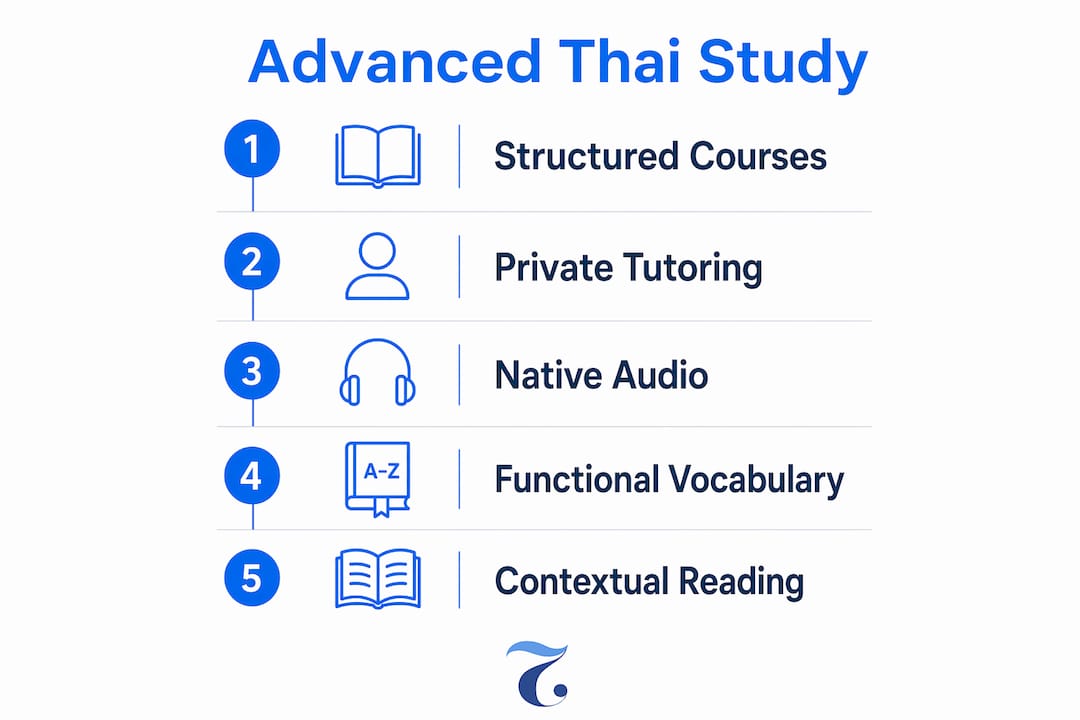
For listening practice, choose native audio that emphasizes natural rhythm over slow, textbook-paced speech. Podcasts, Thai television news, and unscripted conversations all work well. The goal is to expose your ear to the speed and tonal variation of real speech. Daily listening to native Thai makes tone recognition more intuitive over time, not just more familiar.
Vocabulary selection matters as much as volume. Focusing on high-frequency functional patterns produces faster active use than trying to memorize large word lists. Build your vocabulary around the topics you actually discuss: business, travel, daily life, or professional contexts. Pair new words with the sentence patterns they appear in, not just their definitions.
| Study material type | Best use for advanced learners |
|---|---|
| Structured group classes | Consistent grammar progression and peer interaction |
| Private tutoring sessions | Targeted tone correction and personalized feedback |
| Native audio with shadowing | Tone and rhythm internalization |
| Functional vocabulary drills | High-frequency patterns for real conversations |
| Thai reading practice | Reinforces sentence structure and expands vocabulary |
For reading, adult learners benefit most from texts that match their spoken level. Thai news articles, short stories, and professional emails all build reading fluency without requiring a separate study track. The Thai reading strategies guide at Thai Explorer offers a practical framework for adult learners at this stage.
Pro Tip: Build a vocabulary list of 20 functional phrases per week, not 20 isolated words. Phrases give you context, grammar, and pronunciation in one unit.
How do tone shadowing and chunking improve Thai fluency?
Tone shadowing is the practice of listening to a native speaker and repeating their speech simultaneously, matching their rhythm, pitch, and pace as closely as possible. The mouth learns tonal reflexes through auditory imitation, not by studying tone rules on a chart. This distinction matters because Thai has five tones, and the difference between them is physical muscle memory, not intellectual knowledge.
Chunking means grouping words into meaningful phrases and processing them as single units. Advanced learners who think in phrase chunks rather than individual words show faster comprehension and more natural speech rhythm. A phrase like “ไปกินข้าวกันไหม” (shall we go eat?) is one chunk, not five separate words to decode.
- Choose a 30-second clip of native Thai speech at natural speed.
- Listen to the full clip once without stopping.
- Shadow the clip out loud, matching tone and rhythm as closely as you can.
- Record your attempt on your phone.
- Compare your recording directly to the original.
- Identify the two or three tones that differ most and repeat those phrases.
- Do this three times per week, rotating between different speakers and topics.
Recording and comparing your speech weekly against native audio creates a feedback loop that classroom practice alone cannot replicate. You hear your own errors from the outside, which is the only way to correct them reliably.
The plateau most advanced learners hit comes from processing Thai word by word. The fix is deliberate chunking practice. Take sentences from your lessons and drill them as complete units. Use the Thai listening practice guide to find exercises built around this approach.
How does cultural understanding strengthen your Thai lesson preparation?
Cultural fluency is not a bonus skill. It is a prerequisite for advanced Thai communication. Understanding Thai politeness norms and concepts like “kreng jai” prevents misunderstandings that no grammar rule can fix. Kreng jai, the tendency to avoid causing discomfort to others, shapes how Thai speakers phrase requests, disagreements, and refusals. Knowing this changes how you interpret what people say and how you respond.
Real-life practice with language partners accelerates cultural fluency faster than textbooks. Find a Thai conversation partner and practice situational exchanges: ordering food, negotiating politely, or discussing work. These scenarios expose you to pragmatic language use that classroom drills rarely replicate.
“Language is the road map of a culture. It tells you where its people come from and where they are going.” Applying this to Thai means that every phrase you learn carries a cultural assumption. Advanced learners who study those assumptions speak Thai that feels natural, not just grammatically correct.
- Watch Thai films and television with Thai subtitles, not English ones
- Attend Thai cultural events in Singapore to hear natural speech in social contexts
- Practice polite speech registers with your instructor before using them in real conversations
- Use daily Thai practice strategies to build immersive habits without traveling to Thailand
Balancing structured lessons with spontaneous practice is the final piece. Your lessons give you the framework. Real-life use gives you the flexibility. Structured progression combined with real-life speaking practice produces steady, measurable gains at the advanced level.
Key Takeaways
Preparing for advanced Thai lessons requires combining structured study, tone shadowing, chunking practice, and cultural fluency into one consistent routine.
| Point | Details |
|---|---|
| Speak before you feel ready | Early speaking builds retrieval skills that memorization cannot develop. |
| Use chunking, not word-by-word processing | Processing Thai in phrase units improves comprehension speed and natural rhythm. |
| Shadow native audio weekly | Tonal reflexes come from auditory imitation, not from studying tone charts. |
| Prioritize functional vocabulary | High-frequency patterns in context produce faster active use than large word lists. |
| Study cultural norms alongside language | Understanding concepts like kreng jai prevents miscommunication at the advanced level. |
What I’ve learned from watching advanced learners break through
The learners I’ve seen make the fastest progress share one habit: they speak before they are comfortable. Every advanced Thai learner I’ve worked with who waited for “perfect preparation” before speaking out loud hit a wall. The ones who spoke early, made mistakes, and kept going built real fluency.
Tone shadowing changed everything for me personally. I spent months studying tone rules and could recite them accurately. My actual speech was still flat and often wrong. The week I started shadowing native audio daily, my tones shifted in ways that months of rule study had not produced. The mouth needs repetition, not explanation.
The cultural piece surprises most learners. You can have strong grammar and a wide vocabulary and still sound off in Thai conversation. Learning why Thai speakers phrase things the way they do, the social logic behind the language, makes your speech land correctly. Combine that with consistent adult Thai learning strategies and the progress compounds quickly.
My honest advice: do not wait until you finish one more lesson or learn one more grammar point. Start the shadowing practice today. Record yourself this week. The feedback you get from your own recordings will teach you more than any single lesson.
— Paul
Thai Explorer’s advanced Thai courses for serious learners
Thai Explorer offers structured Thai courses in Singapore designed specifically for adult learners aiming at conversational and business fluency. Lessons are taught by qualified native Thai instructors who are bilingual in Thai and English, so you get precise tone correction and cultural context in every session.
The curriculum aligns with the CU-TFL standard, covering speaking, listening, reading, and writing in a progression that builds real-world communication skills. Group classes, private Thai lessons, and online Zoom sessions are all available, giving you the flexibility to study on your schedule. Thai Explorer is located right above Tanjong Pagar MRT at 10 Anson Road, #22-07, International Plaza, Singapore 079903. Explore the full range of Thai language courses and find the right fit for your level.
FAQ
What skills should I have before starting advanced Thai lessons?
Advanced Thai lessons require a working foundation in Thai tones, basic sentence structure, and functional vocabulary. Learners who can hold simple conversations and recognize common functional markers are well positioned to advance.
How do I improve my Thai tones at an advanced level?
Shadowing native audio and recording yourself weekly is the most effective method. The mouth builds tonal reflexes through imitation, not through studying tone rules on a chart.
How long does it take to reach advanced Thai fluency?
The timeline varies by study intensity and practice frequency. Learners who combine structured lessons with daily listening and real-life speaking practice consistently progress faster than those who study in class alone.
Why do advanced Thai learners plateau?
Most plateaus happen because learners continue processing Thai word by word instead of in phrase chunks. Shifting to sentence-level processing and chunking practice breaks this pattern.
How does cultural knowledge help with advanced Thai?
Cultural concepts like kreng jai shape how Thai speakers phrase requests and responses. Understanding these norms prevents miscommunication that grammar study alone cannot address.