
TL;DR:
- Aligning Thai courses with CU-TFL ensures teaching activities, assessments, and outcomes reach standardized proficiency levels. This coherence improves learner confidence, course quality, and preparation for official tests. Regular review and active instructor judgment maintain effective alignment across different teaching formats.
Aligning Thai language courses with CU-TFL, the Chulalongkorn University Proficiency Test of Thai as a Foreign Language, means synchronizing learning goals, instructional methods, and assessments to meet a nationally recognized standard for non-native speakers. This practice, known in educational design as constructive alignment, gives educators a clear framework for building courses that produce measurable results. When you understand why align courses with CU-TFL matters, you stop designing lessons in isolation and start building a coherent system where every activity, every lesson, and every test serves the same goal. Thai Explorer applies this principle across its adult Thai language programs in Singapore, ensuring learners at every level progress with purpose and confidence.
Why align courses with CU-TFL in the first place?
CU-TFL alignment is the practice of connecting course learning outcomes, teaching activities, and assessments directly to the proficiency levels and skill domains defined by the CU-TFL framework. The framework covers four communication domains: listening, speaking, reading, and writing. Each domain maps to specific proficiency levels, giving educators a concrete target rather than a vague instructional goal.
Constructive alignment significantly improves student learning by coherently linking these three course components. That coherence means a student preparing for a CU-TFL listening task will practice the exact type of listening comprehension the test requires, not a loosely related activity that feels relevant but misses the mark.
The importance of CU-TFL integration goes beyond test preparation. It creates a shared language between instructors, administrators, and learners about what proficiency actually looks like at each stage. Without that shared language, course quality becomes subjective and inconsistent across instructors or cohorts.

What does aligning courses with CU-TFL involve?
Effective CU-TFL course alignment rests on three connected layers: learning outcomes, teaching activities, and assessments. Each layer must reflect the same CU-TFL proficiency target. When one layer drifts, the whole course loses coherence.
Here is what each layer requires in practice:
- Learning outcomes: Write outcomes that specify the CU-TFL skill domain and proficiency level. “Learners will identify the main idea in a spoken Thai passage at intermediate level” is measurable. “Learners will improve their Thai” is not.
- Teaching activities: Design activities that practice the exact cognitive and linguistic skills the CU-TFL assessment will test. Role plays, dictation tasks, and structured reading exercises each map to specific CU-TFL domains.
- Assessments: Build assessments that directly measure CU-TFL skills. A writing task should mirror the format and difficulty of the CU-TFL writing component at the target level.
- Proficiency mapping: Use CU-TFL level descriptors to anchor your course objectives. This prevents the common mistake of teaching at one level while assessing at another.
Course goals must support institutional mission, and outcome hierarchies are essential for effective alignment. That means your individual lesson goals should connect upward to course goals, which connect to program goals, which connect to the institution’s broader educational mission.
Pro Tip: Map each lesson objective to a specific CU-TFL skill domain before you write a single activity. This single step prevents the most common alignment errors before they happen.
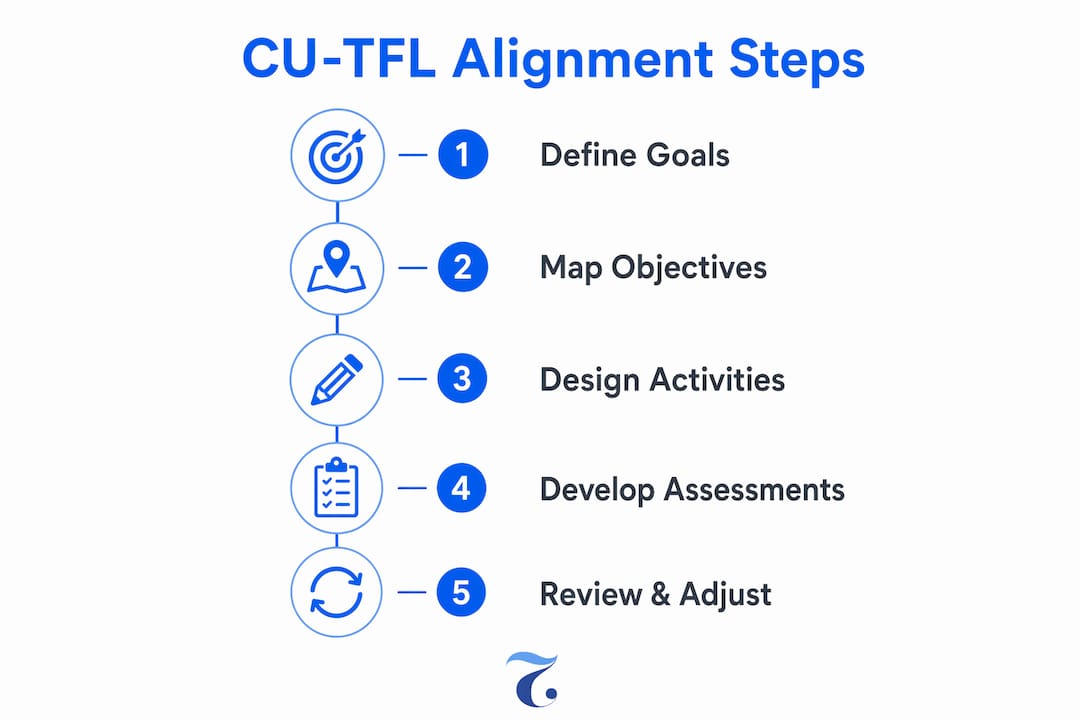
Understanding language standards in learning helps educators see how this hierarchy functions across an entire program, not just within a single course.
What are the benefits of aligning Thai courses with CU-TFL standards?
The advantages of CU-TFL aligned courses are concrete and measurable. Well-aligned courses reduce student confusion and anxiety, increase motivation, and improve quality review scores. That outcome matters because confused learners disengage, and disengaged learners drop out.
The benefits of course alignment extend across four areas:
- Clarity for learners: Students know exactly what they are learning, why it matters, and how they will be evaluated. That transparency builds confidence and reduces the anxiety that often accompanies language testing.
- Consistent course quality: When every instructor follows the same CU-TFL aligned framework, course quality does not depend on individual teaching style. Administrators can review and audit courses against a clear standard.
- Easier certification preparation: A course already aligned with CU-TFL skill domains prepares learners for the test as a natural outcome of the course, not as a last-minute add-on.
- Higher learner success rates: Strong alignment means students always know what they are learning and how they will be evaluated. That predictability directly improves performance.
Misalignment leads to disconnection between activities and assessments, lowering course quality and student results. The inverse is equally true: tight alignment raises both. For adult learners in conversational or business Thai programs, this difference shows up in real-world communication confidence, not just test scores.
Structured Thai courses built on this principle produce learners who can transfer skills from the classroom to professional and social settings.
What common challenges and misconceptions exist in CU-TFL course alignment?
The biggest misconception about CU-TFL alignment is that it is a checklist exercise. Educators sometimes label a course as “CU-TFL aligned” after reviewing a syllabus against a framework document, without checking whether the actual cognitive demands of activities and assessments match the stated outcomes. That is alignment in name only.
Alignment requires active, informed teacher judgment backed by sound pedagogy, not just a framework review. Misuse of alignment frameworks undermines professional accountability and, more critically, student learning. An educator who claims CU-TFL alignment without evidence-based decisions is making a promise the course cannot keep.
Common pitfalls include:
- Cognitive level mismatch: Teaching recognition-level vocabulary but assessing production-level writing. The learner practiced the wrong skill.
- Content drift: Activities that are culturally engaging but disconnected from CU-TFL skill domains. Enjoyable lessons are not automatically aligned lessons.
- Assessment difficulty gaps: Mismatch between teaching level and assessment difficulty is a major cause of student frustration and dropouts. Students feel misled when the test is harder than anything they practiced.
Pro Tip: After designing each assessment, trace it back to a specific teaching activity. If you cannot find a direct match, the course has an alignment gap that needs fixing before the course runs.
Superficial alignment claims also harm institutional credibility. Administrators who approve courses based on stated alignment without verifying the evidence expose their programs to poor learner outcomes and weak quality reviews.
How can educators effectively align their courses with CU-TFL?
Building a genuinely aligned course requires a top-down design process. Start with the CU-TFL proficiency level your course targets, then work backward through assessments, activities, and finally individual lessons. This backward design approach prevents the common mistake of building lessons first and retrofitting alignment claims later.
Follow these steps to align courses effectively:
- Identify the target CU-TFL level and skill domains. Specify which of the four domains (listening, speaking, reading, writing) the course addresses and at which proficiency level.
- Write measurable learning outcomes. Using SMART and taxonomic frameworks helps define effective learning outcomes. Each outcome should name a skill, a context, and a performance standard.
- Design assessments before activities. Build assessments that directly mirror CU-TFL task formats. Then design activities that prepare learners for those exact tasks.
- Map every activity to an outcome. Activities should practice the same skills assessed; otherwise, students feel misled. Remove any activity that does not connect to a stated outcome.
- Review alignment at regular intervals. Course content drifts over time as instructors adapt materials. Schedule a formal alignment review at the end of each cohort.
The table below shows how each course design element maps to a CU-TFL skill domain:
| Course element | CU-TFL skill domain | Example task |
|---|---|---|
| Listening activity | Listening | Identify main idea in a recorded Thai dialogue |
| Speaking practice | Speaking | Role play a business introduction in Thai |
| Reading exercise | Reading | Extract key information from a Thai news excerpt |
| Writing task | Writing | Compose a short formal email in Thai |
| Summative assessment | All four domains | Timed mixed-skills test mirroring CU-TFL format |
Constructive alignment strengthens course design in both online and face-to-face contexts. That flexibility matters for programs offering Zoom-based or corporate Thai training, where the delivery format changes but the alignment standard does not.
Effective classroom activities that map directly to CU-TFL skill domains give learners consistent practice regardless of whether the lesson happens in a physical classroom or a virtual one.
Key Takeaways
Aligning Thai language courses with CU-TFL requires linking learning outcomes, teaching activities, and assessments to the same proficiency standard, producing measurable gains in learner clarity, confidence, and course quality.
| Point | Details |
|---|---|
| Define alignment precisely | Connect outcomes, activities, and assessments to specific CU-TFL skill domains and proficiency levels. |
| Use backward design | Start with the target CU-TFL level, design assessments first, then build activities to match. |
| Avoid superficial alignment | Verify that cognitive demands in activities and assessments actually match, not just topic labels. |
| Review courses regularly | Schedule formal alignment checks after each cohort to catch content drift early. |
| Alignment benefits all stakeholders | Learners gain clarity and confidence; administrators gain consistent, auditable course quality. |
What I have learned from watching CU-TFL alignment work in practice
The educators who get CU-TFL alignment right share one habit: they treat the framework as a design tool, not a compliance document. I have seen courses that listed CU-TFL objectives on every slide but still left learners unprepared for the actual test. The problem was never the framework. The problem was that no one checked whether the activities and assessments were doing the same job as the stated outcomes.
What actually changes learner outcomes is the moment an instructor stops asking “does this activity feel relevant?” and starts asking “does this activity practice the exact skill the assessment will measure?” That shift in question changes everything about how a lesson is built.
Institutional benefits follow naturally from that discipline. When every course in a program applies the same alignment standard, administrators can compare cohorts, identify weak points, and make evidence-based decisions about curriculum changes. That is quality assurance that actually works, not just documentation that looks good in a review.
The ongoing challenge is maintaining alignment rigor when teaching contexts shift, as they do in corporate training, online delivery, and intensive formats. The solution is not a more detailed checklist. It is educators who understand the principle well enough to apply it in any context. That understanding comes from professional development that treats alignment as a skill, not a procedure.
— Paul
Thai Explorer’s CU-TFL aligned Thai courses in Singapore
Thai Explorer designs its adult Thai language courses around the CU-TFL framework, ensuring that every lesson, activity, and assessment connects to a recognized proficiency standard. Whether you are building a corporate Thai training program or reviewing an existing curriculum, the course structure at Thai Explorer gives you a clear model of what genuine CU-TFL alignment looks like in practice.
Courses are available in group, private, and online formats, all taught by qualified native Thai instructors who are bilingual in Thai and English. The school is located above Tanjong Pagar MRT at 10 Anson Road, #22-07, International Plaza, Singapore 079903. Explore the full range of CU-TFL aligned courses or review the detailed Thai language course options to find the right fit for your program or learners.
FAQ
What is CU-TFL alignment in a Thai language course?
CU-TFL alignment means designing a course so that its learning outcomes, teaching activities, and assessments all target the same proficiency levels and skill domains defined by the Chulalongkorn University Proficiency Test of Thai as a Foreign Language. The result is a course where every element serves the same measurable goal.
How does course alignment improve learner outcomes?
Well-aligned courses reduce student confusion and anxiety by ensuring learners know what they are practicing and why. That clarity increases motivation and directly improves performance on CU-TFL assessments.
What is “alignment in name only” and why does it matter?
“Alignment in name only” occurs when a course labels its objectives as CU-TFL aligned but the actual cognitive demands of activities and assessments do not match. This mismatch causes student frustration and is a leading cause of dropout in language programs.
How often should educators review CU-TFL course alignment?
A formal alignment review after each cohort is the minimum standard. Instructors adapt materials over time, and content drift can quietly break the connection between outcomes, activities, and assessments without anyone noticing until learner results decline.
Can CU-TFL alignment work for online and corporate Thai training?
Yes. Constructive alignment works equally well in online and face-to-face delivery formats. The skill domains and proficiency targets remain the same; only the delivery tools change.