
TL;DR:
- Effective group language classes depend heavily on deliberate structure and active participation from learners. Structured turn-taking, peer interaction, and guided tasks significantly increase speaking engagement and confidence development. Combining group classes with independent study yields the best results, especially when classes incorporate scaffolding and clear speaking frameworks.
Signing up for a group language class and expecting fluency to follow naturally is one of the most common assumptions adult learners make. The role of group classes in language learning is real and well-documented, but the benefits don’t arrive automatically. They depend almost entirely on how the class is designed and how actively you participate. This article breaks down the social, cognitive, and structural factors that determine whether group classes accelerate your progress or quietly waste your time.
Table of Contents
- Key takeaways
- The role of group classes in language learning
- Why structure matters more than group size
- Group classes vs. other learning methods
- How to get more from every group class
- My honest take on group classes
- Learn Thai in Singapore with structured group classes
- FAQ
Key takeaways
| Point | Details |
|---|---|
| Structure drives participation | Group classes only boost speaking skills when deliberate turn-taking frameworks are in place. |
| Social interaction builds confidence | Peer support in group settings reduces anxiety and motivates consistent practice. |
| Scaffolding helps lower-proficiency learners | Pre-scripted prompts and guided roles especially benefit learners who are newer to a language. |
| Combined methods outperform any single approach | Pairing group classes with individual study produces stronger pragmatic competence than either alone. |
| Active participation is your responsibility | Choosing the right class matters, but showing up ready to speak and engage matters more. |
The role of group classes in language learning
Group learning is fundamentally social. When you sit in a room or join a live Zoom session with six other learners working through the same material, something happens that a textbook or app simply cannot replicate: you are accountable to other people. That social pressure, when channeled well, produces real motivation.
Peer interaction in groups facilitates cooperative learning, exposes you to diverse perspectives, and reduces the isolation that often causes solo learners to quit. You hear a classmate use a phrase you hadn’t considered. You laugh at a shared mistake. You build relationships with people at the same stage of the process as you.
The benefits go beyond morale. Group classes create conditions for authentic communication practice that private lessons and apps cannot fully simulate. Speaking to a peer who is also learning carries different social stakes than speaking to a teacher. That slightly uncomfortable, low-pressure, real-time exchange is where fluency begins to form.
Formats that deliberately engineer speaking turns amplify these benefits. Techniques like Think-Pair-Share, where you first think independently about a prompt, discuss with one partner, then share with the group, create structured speaking moments for every learner in the room. Assigned roles, such as asking questions, summarizing, or responding, work the same way. They make sure quieter learners speak and more dominant speakers listen.
Some effective approaches for building genuine community in group classes include:
- Regular pair rotations so you practice with different speaking styles each session
- Short structured tasks before open discussion to reduce anxiety and prepare ideas
- Peer feedback moments where learners respond to each other, not just the teacher
- Cultural exchange prompts that encourage personal storytelling alongside grammar practice
Pro Tip: If your group class doesn’t give you a specific speaking task in the first ten minutes, you’re probably in a lecture-style session dressed up as group learning. Real group classes get you talking early.
Why structure matters more than group size
Here is the part most learners don’t expect. Putting people in a group does not automatically generate participation. Speaking participation rose dramatically only after structured turn-taking strategies were applied, jumping from roughly 20 to 25 percent to over 65 to 70 percent. That is not a small improvement. It is the difference between a passive and an active class.
This finding matters because many language programs market their group format as inherently interactive without actually building in the mechanics that make interaction happen. The result is a class where three or four confident learners dominate, while the rest absorb passively. If you’ve been in that environment, you already know how little speaking practice you actually get.
The research on dynamic assessment models adds another layer to this. Studies on interventionist versus interactionist teaching models show that:
- Interventionist models use pre-scripted prompts and guided mediation to move learners through progressively harder tasks with structured support at each step.
- Interactionist models rely on natural conversation and responsive feedback, which works well for higher-proficiency learners but can leave beginners lost.
- Lower-proficiency learners benefit significantly more from the interventionist approach because it reduces cognitive overload and keeps anxiety manageable.
- Higher-proficiency learners can self-direct more freely, but still benefit from some scaffolding at the edges of their current ability.
“A balance between free interaction and structured mediation is critical, especially for lower-proficiency or anxiety-prone learners.” — Research on dynamic assessment models
The practical implication for you as a learner is clear. Before enrolling in any group class, ask how speaking time is distributed. Ask whether the teacher uses roles, pair activities, or structured prompts. A well-designed class will have clear answers. An unstructured one won’t.
Truly interactive lessons are built on exactly these frameworks, where every learner gets consistent speaking time rather than waiting passively for the teacher to call on them.
Group classes vs. other learning methods
Understanding where group classes fit in the broader picture of language learning helps you use them more strategically. The comparison is not about which method wins. It’s about knowing what each one does well.
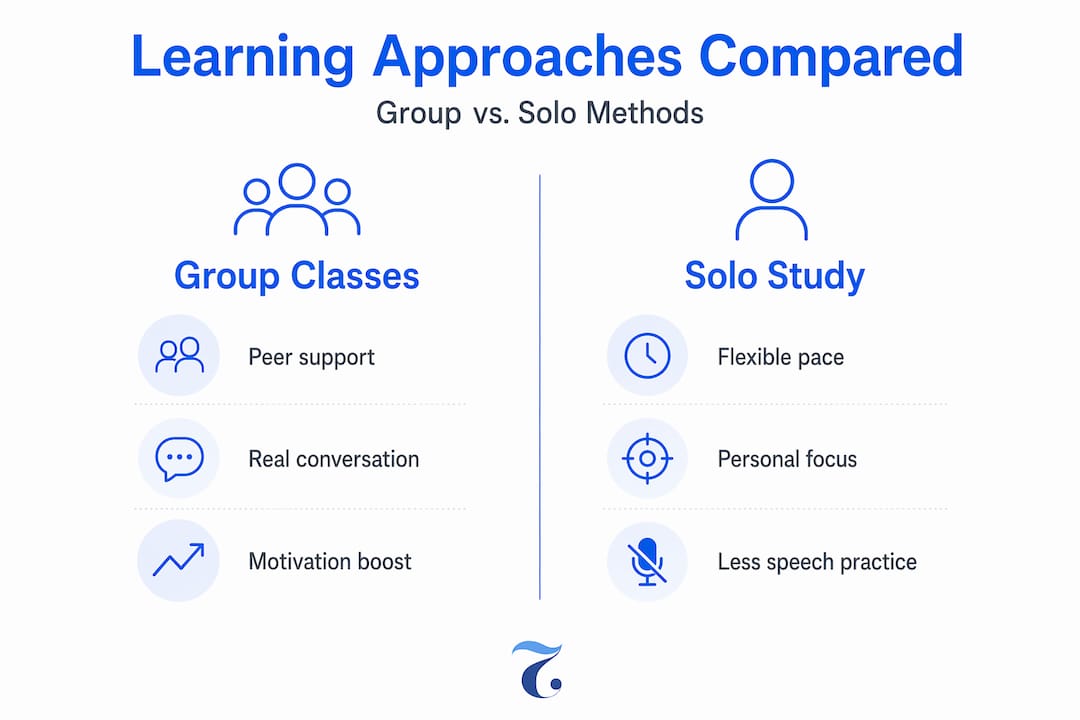
Research comparing classroom-only, app-only, and combined learning found no significant differences in vocabulary, grammar, or communicative competence between beginners after one semester. However, the combined group showed stronger pragmatic competence, meaning the ability to use language appropriately in social contexts. That’s the advantage that sits at the heart of group learning: real people, real social cues, real context.
| Learning method | Key strength | Key limitation |
|---|---|---|
| Group classes | Social interaction, peer motivation, real-time conversation practice | Less individual attention; pacing is set for the group |
| Private lessons | Personalized feedback, flexible pacing, focused on your weak points | No peer interaction; less exposure to varied communication styles |
| App-based learning | Available anytime, low-pressure repetition, good for vocabulary | No speaking accountability; limited real-world conversational practice |
| Combined (group + solo) | Strongest pragmatic competence; reinforces classroom learning through independent review | Requires more time commitment and self-discipline |
The verdict from the data is that group classes are not superior in every category. They are superior in social learning and motivation. Private lessons are superior for targeted skill correction. Apps are superior for consistent daily review.

Pro Tip: Think of your language learning like a workout plan. Group classes are the team sport that keeps you showing up. Solo study is the gym session that fixes your technique. You need both.
For learners exploring different formats of Thai language learning, understanding this distinction helps you build a practice that actually sticks rather than relying on one format to do everything.
How to get more from every group class
Knowing the theory is one thing. Applying it session by session is another. These strategies separate learners who plateau after a few months from those who keep building.
- Choose classes with a proven structure. Look for programs that mention pair work, role assignments, or structured speaking tasks in their course descriptions. Vague descriptions like “conversational atmosphere” are a red flag.
- Speak first, correct later. Fluency is built through volume of output, not perfection. Use class time to produce language, even imperfectly. Save grammar review for your self-study sessions.
- Take notes on peers, not just the teacher. When a classmate uses an expression naturally, write it down. Peer language modeling is one of the most underused resources in group classes.
- Use the community outside class hours. Group chats, shared study sessions, and peer conversation practice extend your learning well beyond the formal lesson time.
- Combine class with a daily app or flashcard habit. As the research shows, combining group and solo practice produces stronger results than either approach alone, particularly for real-world language use.
Pro Tip: After every group class, write two sentences in your target language summarizing what you discussed. This takes three minutes and dramatically improves retention of the vocabulary you used in conversation.
Finding the right Thai language class means looking beyond the price or schedule to evaluate how much structured speaking time you’ll actually get per session.
My honest take on group classes
I’ve watched hundreds of adult learners go through group language programs, and the pattern is remarkably consistent. The ones who thrive aren’t necessarily the most talented. They’re the ones who understand what a group class is actually for and use it accordingly.
What I’ve found frustrating over the years is the marketing around group classes. Programs advertise “dynamic group interaction” when what they actually offer is a teacher talking at a small audience. I’ve sat in on sessions where one learner asked questions for thirty minutes while five others listened. That’s a one-on-one lesson with witnesses.
The research backs up what I’ve observed firsthand. Equitable speaking frameworks are what separate effective group classes from expensive passive listening. When a class uses Think-Pair-Share, assigned roles, or structured pair rotations, every learner gets speaking time. When it doesn’t, participation defaults to whoever is most comfortable speaking in public.
What genuinely surprises new learners is how much anxiety reduction happens in a well-run small group. Knowing that everyone at the table is also struggling to conjugate correctly creates a kind of permission to try and fail. That permission is where confidence grows. I’ve seen learners who couldn’t string two sentences together in a private lesson suddenly open up in a group of four people at the same level.
My honest advice: don’t evaluate group classes by how comfortable they feel in week one. Evaluate them by whether you are speaking more in week six than you were in week two.
— Paul
Learn Thai in Singapore with structured group classes

At Thai Explorer, group Thai language classes are designed around exactly the principles this article covers. Small group live sessions keep class sizes manageable so every learner gets real speaking time. Instructors are native Thai speakers who are bilingual in Thai and English, which means explanations are clear and cultural context is built into every lesson.
Whether your goal is conversational Thai for travel, professional communication, or building genuine fluency, the curriculum is structured to move you forward at each stage. Online group classes run via Zoom, making them accessible from anywhere in Singapore without sacrificing the live interaction that makes group learning work.
Explore the full range of options on the Thai Explorer course page or browse specific Thai language courses designed for adult learners at all proficiency levels.
FAQ
What is the main benefit of group classes for language learning?
Group classes provide social interaction and peer motivation that solo study cannot replicate, which builds confidence and reduces isolation in adult language learners.
Do group classes or private lessons produce better results?
Neither is universally superior. Combined approaches produce stronger pragmatic competence, while private lessons offer more targeted feedback and group classes build communication fluency through peer interaction.
How do structured techniques improve group language classes?
Research shows that applying turn-taking frameworks like Think-Pair-Share increased speaking participation from 20 to over 65 percent, making structured techniques far more effective than unguided group conversation.
Are group classes suitable for beginner language learners?
Yes, particularly when the class uses pre-scripted prompts and guided tasks. Lower-proficiency learners benefit more from structured mediation that reduces anxiety and provides clear language models.
How can I tell if a group class is well-designed before enrolling?
Ask whether the course includes structured pair activities, assigned speaking roles, or deliberate turn-taking strategies. A well-run class will describe these specifics. Vague descriptions of “group conversation” usually mean unstructured sessions where dominant speakers take most of the floor time.