
TL;DR:
- Thai language skills provide a competitive edge by enhancing internal coordination, client relationships, and regional communication in Thailand. Bilingual professionals earn significantly higher salaries and demonstrate cultural competence vital for leadership and trust-building. Practical, focused learning of workplace Thai accelerates career advancement without requiring native-like fluency.
Professionals working across Southeast Asia often assume English fluency is enough to get ahead. It rarely is. Understanding how Thai language boosts career prospects requires looking past the surface of multinational job descriptions and into the actual hiring preferences of Thai employers, the dynamics of client relationships, and the salary data that consistently rewards bilingual workers. Thai proficiency is not just a cultural nicety. It is a measurable professional asset that separates candidates who get shortlisted from those who get hired, promoted, and trusted with regional responsibilities.
Table of Contents
- Key takeaways
- How Thai language boosts career competitiveness in Thailand
- The salary and promotion case for Thai language skills
- Practical Thai skills that move the career needle
- Cross-cultural fluency and relationship building
- My perspective: what Thai actually opened for me
- Take your career further with Thai Explorer
- FAQ
Key takeaways
| Point | Details |
|---|---|
| Thai gives you a hiring edge | Employers in Thailand actively favor candidates who combine technical skills with functional Thai for coordination and client roles. |
| Bilingual workers earn significantly more | Studies show bilingual professionals earn an average of $9,353 more per year than monolingual peers. |
| Functional fluency beats perfect fluency | Mastering high-frequency workplace phrases delivers faster career returns than waiting until you speak like a native. |
| Cultural competence is part of language | Understanding concepts like “kreng jai” and face-saving directly impacts negotiation outcomes and team trust. |
| Structured learning accelerates results | Aligned courses targeting conversational and business Thai get you to workplace-ready proficiency faster than self-study. |
How Thai language boosts career competitiveness in Thailand
Most foreign professionals entering the Thailand job market treat Thai as optional. That assumption costs them. According to current foreign professional hiring data, Thai language skills combined with local business culture familiarity meaningfully differentiate candidates in a competitive market where many applicants share similar technical backgrounds.
The advantage shows up in practical ways. Roles involving internal team coordination, vendor management, or local client interaction often require at least functional Thai. A regional sales manager who can hold a basic meeting in Thai, follow side conversations, or send a politely worded email in the local language removes friction that a purely English-speaking peer cannot. That frictionless quality is exactly what Thai employers pay attention to during hiring decisions.
Multinational companies operating in Bangkok or Chiang Mai also value regional language competence. Here is why that matters for your positioning:
- Internal credibility: Speaking Thai signals to local staff that you are invested in the team, not just passing through on an expat assignment.
- Client retention: Local clients are far more likely to continue working with someone who makes the effort to communicate in their language, even at a basic level.
- Faster onboarding: You spend less time waiting for translations during internal meetings and start contributing to decisions sooner.
- Access to the informal network: Hallway conversations, lunch discussions, and after-work social exchanges happen in Thai. You either participate or you miss them.
The strongest career prospects for foreign professionals in Thailand combine native English, regional exposure, and Thai language ability. When you have all three, you are not competing with other foreigners. You are competing with local talent, and you bring something local talent usually cannot: bilingual communication across both ASEAN and Western business contexts.
Pro Tip: When updating your resume for Thailand-based roles, do not just list “Basic Thai” under skills. Add a line in your cover letter describing a specific work scenario where you used Thai, such as coordinating with a local supplier or presenting to a Thai-speaking team. Concrete evidence matters far more than a language label.
The salary and promotion case for Thai language skills
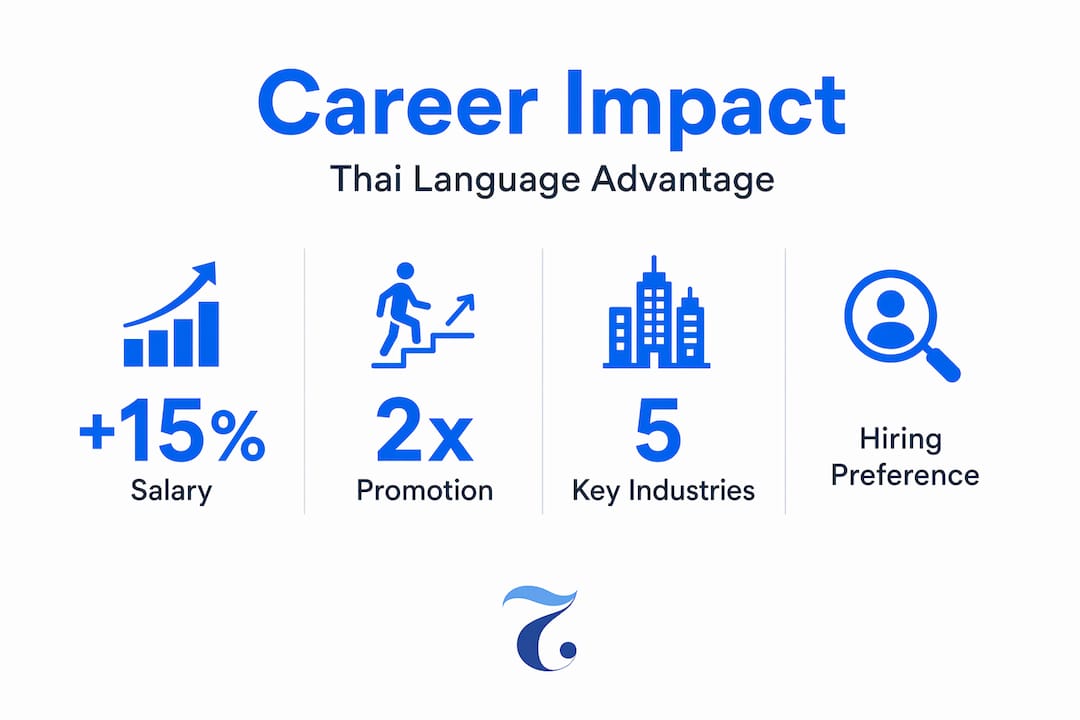
The financial argument for learning Thai is backed by data, not just anecdote. Bilingual workers globally earn an average of $9,353 more per year than their monolingual peers, with language pay premiums ranging from 3.3% to 19.4% depending on country and industry. That range is wide because context matters. In markets where a second language is rare or strategically important, the premium climbs toward the upper end.
Thailand qualifies as that kind of market for professionals working in logistics, tourism, real estate, financial services, and manufacturing. These sectors employ large local workforces, deal with Thai-speaking clients, and regularly miss out on efficiency because of communication gaps between management and operations.

| Industry | Why Thai fluency matters | Career impact |
|---|---|---|
| Financial services | Client trust and regulatory communication | Faster promotion to relationship manager roles |
| Logistics and supply chain | Vendor coordination and local team management | Reduced operational errors, stronger team performance |
| Hospitality and tourism | Guest experience and staff leadership | Priority for general manager tracks |
| Real estate | Negotiation and legal documentation | Access to deals unavailable to English-only agents |
| Corporate HR and training | Employee relations and policy communication | Stronger internal influence and executive visibility |
Beyond salary, language skills signal mental flexibility and communication competence that senior hiring managers associate with leadership potential. When a candidate can shift registers between English-language board reporting and Thai-language team briefings, they demonstrate the kind of cognitive agility that distinguishes a functional contributor from a future executive.
“Language mastery signals commitment and long-term market engagement, differentiating professionals from transient competitors relying on English alone.”
That distinction matters in Thailand’s business culture, where relationships and perceived dedication heavily influence who gets promoted into senior roles.
Practical Thai skills that move the career needle
Here is a counterintuitive truth about career advancement through Thai: you do not need to be fluent. You need to be functional. The gap between functional and fluent is where most people waste time, chasing perfection when practical proficiency is what employers actually reward.
Functional workplace Thai focuses on a defined set of high-frequency scenarios. These include:
- Meeting participation: Following agenda items, acknowledging contributions, and politely redirecting discussion when needed.
- Email and messaging: Drafting professional Thai messages that are appropriately formal without requiring a native speaker to review them.
- Client coordination: Managing expectations, confirming timelines, and thanking contacts in ways that respect Thai social norms.
- Negotiation openings: Using Thai to establish rapport before switching to English for technical detail, which signals respect and earns goodwill early.
- Workplace small talk: Commenting on food, holidays, or team achievements in Thai, which builds relationships faster than any formal introduction.
Employers assess language ability based on its relevance to specific job interactions, not standardized test scores. A logistics coordinator who can flawlessly discuss delivery schedules in Thai is more valuable than a candidate who scored higher on a vocabulary exam but freezes in a real conversation.
Understanding culturally specific concepts also matters. “Kreng jai” describes the Thai tendency to avoid burdening others with direct requests or negative feedback. Knowing this concept prevents negotiation breakdowns and helps you read situations where a Thai colleague says “yes” but means “I am uncomfortable disagreeing.” You can find resources on Thai communication in work contexts that cover exactly these kinds of practical phrases and cultural frameworks.
Pro Tip: Build a personal glossary of 30 to 50 high-priority workplace phrases tailored to your specific industry. Review them before important meetings. This targeted approach gives you faster, more visible results than working through a generic language textbook from page one.
Cross-cultural fluency and relationship building
Language is the entry point. Culture is what makes relationships last. In Thai professional settings, the two are inseparable, and understanding both is where the real career impact of Thai fluency shows up.
Thai business culture operates around several core principles that directly affect how you are perceived as a colleague, manager, or partner:
- Face preservation (“Naa”): Public criticism, even when well-intentioned, damages relationships and trust. Speaking Thai allows you to navigate sensitive feedback in ways that protect everyone’s dignity.
- Sanuk (enjoyment): Thai workplaces value a positive, enjoyable atmosphere. Engaging in Thai humor or showing appreciation in local terms signals that you understand and respect this value.
- Hierarchy and respect: Knowing how to address senior colleagues properly in Thai, using the correct particles and titles, demonstrates cultural intelligence that English-only speakers cannot replicate.
- Informal relationship building: Sharing a meal, chatting about the weekend, or acknowledging personal milestones in Thai creates bonds that translate directly into professional loyalty and cooperation.
Speaking Thai improves team cohesion and measurably reduces staff turnover by building closer management-to-employee relationships. This is especially relevant if you manage local teams, where the gap between a manager who “shows up and gives instructions” and one who genuinely connects with staff can determine whether your whole team performs or quietly disengages.
There is also a competitive intelligence dimension. Language proficiency gives access to informal market intelligence that monolingual professionals simply never hear. Side conversations at industry events, off-the-record comments from suppliers, and candid feedback from local staff all happen in Thai. Understanding them gives you a view of the market that competitors working only in English never get.
Employers in Thailand consistently prefer candidates who can reduce coordination friction through language. That preference shows up in hiring, promotion decisions, and the kinds of projects you get assigned. For more on building cultural fluency alongside language skills, Thai Explorer’s guide to cultural fluency in Thai is a solid starting point. You can also explore official Thai language certifications if you want documented proof of proficiency to include on your resume.
My perspective: what Thai actually opened for me
I spent years working across Southeast Asia under the comfortable assumption that English plus a good translator was enough. It worked, until it didn’t. I watched colleagues with Thai language skills get pulled into the room for conversations I was never invited to. Not because of seniority. Because they could be trusted to navigate those conversations without a cultural misfire.
What changed things for me was focusing on functional Thai rather than chasing perfect fluency. I built a working vocabulary around the twenty or thirty situations that came up repeatedly in my role. Within a few months, I was following enough of a client conversation to catch when the mood shifted, even if I couldn’t catch every word. That alone changed how I was perceived. It changed what I was trusted with.
The unexpected doors Thai opened weren’t the ones I predicted. Better negotiation outcomes were obvious. What surprised me was the informal access: suppliers who told me things they wouldn’t say through a translator, local staff who flagged problems early because they felt heard, and senior Thai executives who treated me as a peer rather than a well-meaning outsider.
My honest advice is this: don’t wait until you feel “ready.” Start with the phrases that matter most for your current job and build from there. The learning curve feels steep at first, but the professional returns start appearing far earlier than most people expect.
— Paul
Take your career further with Thai Explorer
If you’re serious about using Thai language for professional growth, the right structured learning environment makes all the difference between slow frustration and real progress.
Thai Explorer, located at 10 Anson Road, #22-07, International Plaza, Singapore 079903 (right above Tanjong Pagar MRT), offers adult Thai courses built specifically for conversational and business use. Whether you’re a professional preparing for a role in Thailand, a manager working with Thai-speaking teams, or a business developer building local relationships, the curriculum is designed around practical communication, not textbook memorization. Courses are available as group classes, private lessons, and online Zoom sessions, giving you flexibility around your existing work schedule. Corporate training programs are also available for teams. Native Thai instructors who are bilingual in Thai and English teach every class, so you always have clear explanations when you need them. Browse the full range of Thai language courses or explore business and conversational Thai programs tailored to your professional goals.
FAQ
Does learning Thai actually improve job prospects?
Yes. Foreign professionals with Thai skills are actively preferred by Thai employers for roles involving internal coordination and client interaction, giving bilingual candidates a clear advantage in the hiring process.
How much Thai do you need to speak for career benefits?
Functional conversational proficiency is enough to see meaningful career returns. Employers value practical communication ability in workplace scenarios far more than near-native fluency or formal test scores.
Can speaking Thai lead to higher pay?
Research shows bilingual professionals earn an average of $9,353 more per year than monolingual peers, with pay premiums reaching up to 19.4% depending on the industry and market context.
Which industries benefit most from Thai language skills?
Financial services, logistics, hospitality, real estate, and corporate HR roles all show strong career advancement benefits for professionals who combine technical expertise with Thai language ability in Thailand’s job market.
How long does it take to reach workplace-ready Thai proficiency?
With structured, focused instruction targeting workplace scenarios, most adult learners reach functional conversational Thai within six to twelve months of consistent study, especially when using a curriculum aligned to real business communication needs.