
TL;DR:
- Immersive language learning involves using the target language as the primary communication medium, emphasizing meaningful exposure over translation. It promotes natural acquisition through contextualized input, output, and interaction, achievable without traveling abroad by leveraging technology and social practice. Research confirms that sustained immersive methods improve long-term retention, speaking confidence, and fluency when combined with structured feedback and consistent effort.
Immersive language learning is defined as the practice of using the target language as your primary communication medium, replacing translation and grammar drills with direct, contextualized engagement. Rather than studying a language as a subject, you live inside it. This approach draws on Stephen Krashen’s Input Hypothesis, which holds that acquisition happens naturally when learners receive comprehensible input slightly above their current level, known as i+1. Tools like Anki for spaced repetition, the IMMERSE VR platform for virtual conversation practice, and structured programs aligned with standards like the CU-TFL (Chulalongkorn University Proficiency Test of Thai as a Foreign Language) all apply these principles to accelerate natural skill acquisition.
What is immersive language learning and how does it work?
Immersive language learning works by replacing isolated drills with meaningful, contextualized exposure. Instead of memorizing verb conjugations in a vacuum, you encounter grammar patterns through real communication. Comprehensible input at the i+1 level means the content is challenging enough to stretch your understanding but not so difficult that it causes confusion. This balance is what drives acquisition rather than rote memorization.

The mechanism behind effective immersion involves three interlocking processes: input, output, and interaction. Input means receiving the language through listening and reading. Output means producing it through speaking and writing. Interaction means negotiating meaning in real time with another person or a realistic simulation. Programs combining input with output demands produce fuller language competence than those relying on passive exposure alone.
Guided immersion environments use realistic scenarios to make this process concrete. Role-based communication tasks set in contexts like a doctor’s office, a conference room, or a market stall force learners to deploy vocabulary and grammar purposefully. This is fundamentally different from a textbook exercise asking you to fill in the blank. The stakes feel real, and that sense of purpose accelerates retention.
- Comprehensible input (i+1): Content just above your current level, supported by visual cues and context
- Active output: Speaking and writing tasks that force you to produce, not just recognize, the language
- Meaningful interaction: Real-time communication with instructors, peers, or virtual interlocutors
- Implicit acquisition: Forming internal language rules through exposure rather than explicit instruction
- Feedback loops: Corrections and coaching that close accuracy gaps without interrupting communication flow
Pro Tip: When consuming target-language media, choose content where you understand roughly 70 to 80 percent of the vocabulary. Below that threshold, frustration replaces acquisition.
Can you experience immersion without traveling abroad?
Immersion without living abroad is entirely achievable through sustained, repeated, and meaningful exposure structured around your daily life. The key word is “meaningful.” Passively watching foreign films while scrolling your phone is not immersion. Watching them with full attention, pausing to repeat phrases, and then discussing the plot in the target language with a conversation partner is.
The most effective location-independent immersion strategies combine multiple channels simultaneously. A learner studying Thai in Singapore, for example, can consume Thai podcasts during their commute, practice speaking with a native instructor twice a week, use Anki to reinforce vocabulary with spaced repetition, and join a Thai cultural community group for authentic social interaction. Each channel reinforces the others, creating the density of exposure that immersion requires.
Technology has made this more accessible than ever. VR platforms like IMMERSE place learners inside simulated environments where live social interaction in VR promotes conversational practice, boosting vocabulary retention and confidence. A Purdue University study found that VR role-play classes improved speaking skills by 24% through authentic, task-based scenarios and peer collaboration. That is a measurable outcome from a technology that requires no plane ticket.
Here is a practical sequence for building an immersion habit at home:
- Set a daily minimum exposure time. Thirty minutes of focused target-language engagement beats two hours of passive background noise.
- Choose one primary input source. A Thai-language YouTube channel, a podcast, or a structured online course gives your brain a consistent linguistic environment.
- Schedule speaking practice at least twice a week. Output is where acquisition becomes fluency. Without it, comprehension improves but production stalls.
- Use SRS tools like Anki for vocabulary. Spaced repetition keeps high-frequency words active in memory without requiring hours of review.
- Track comprehension, not just time. If you understand more of your input source this week than last week, immersion is working.
Pro Tip: Pair your daily Thai practice with a specific real-world goal, such as ordering food, discussing your work, or navigating a trip to Bangkok. Goal-anchored immersion builds vocabulary that actually sticks.
What are the proven benefits and limitations of immersive language learning?
The advantages of immersive language learning are well-documented, but the picture is more nuanced than most enthusiasts admit. A 2026 systematic review confirmed that VR immersion consistently improves long-term vocabulary retention, though immediate post-test effects vary. This matters because learners often judge a method by how they feel right after a lesson, not by what they retain three months later. Immersion pays dividends over time, not overnight.
The long-term retention benefit is tied to how immersion encodes information. Encountering a word in a meaningful context, using it in a conversation, and then hearing it again in a different scenario creates multiple memory traces. Isolated vocabulary drills create one. The depth of processing is simply not comparable.
“Immersion-only experiences improve comprehension but can leave accuracy and speaking gaps unless paired with output practice and feedback.” — Mikey Does Language Glossary
That quote captures the central limitation honestly. Learners who consume enormous amounts of target-language content without ever being corrected tend to fossilize errors. They become fluent in their mistakes. Structured feedback from a qualified instructor, particularly a native Thai teacher who can identify and correct patterns in real time, is what separates high-level immersion from well-intentioned but inefficient self-study.
| Benefit | Evidence |
|---|---|
| Long-term vocabulary retention | 2026 systematic review confirms VR immersion improves durable memory outcomes |
| Faster fluency development | Contextualized exposure builds comprehension speed more effectively than drills |
| Improved speaking confidence | Purdue University VR study recorded a 24% improvement in speaking skills |
| Implicit grammar acquisition | Learners internalize rules through exposure, reducing cognitive load during speech |
| Limitation: accuracy gaps | Output-only immersion without feedback allows errors to become habitual |
| Limitation: context dependency | VR effectiveness depends heavily on interaction design and learner skill level |
The impact of immersive language experience is strongest when technology, human interaction, and structured feedback operate together. No single element is sufficient on its own.
How does immersive learning compare with traditional language methods?
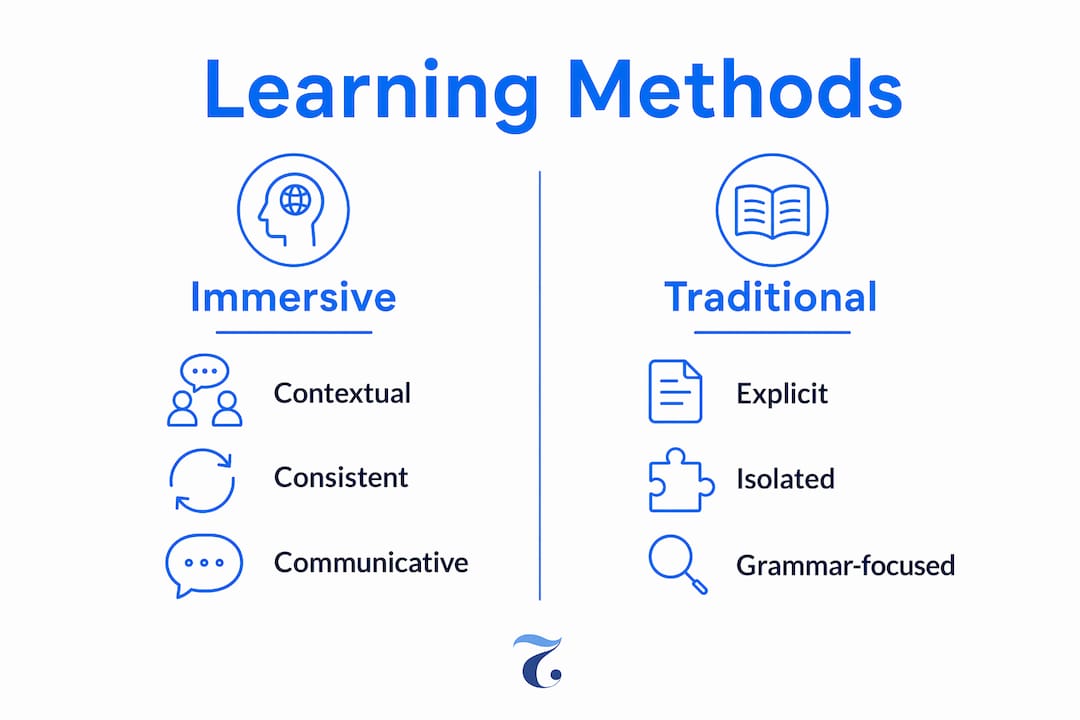
Traditional language learning centers on explicit instruction: grammar rules explained in your native language, vocabulary lists memorized out of context, and translation exercises that keep the target language at arm’s length. This approach produces learners who can pass written tests but freeze when a native speaker talks at natural speed. The gap between classroom performance and real-world communication is the defining failure of grammar-translation methods.
Immersion emphasizes implicit acquisition through repeated exposure and contextual understanding. Learners actively form hypotheses about how the language works by understanding messages, then refine those hypotheses through trial and error. This mirrors how children acquire their first language, and it produces the same result: language that feels automatic rather than calculated.
| Feature | Immersive learning | Traditional learning |
|---|---|---|
| Primary medium | Target language throughout | Native language explanations |
| Grammar instruction | Implicit, through exposure | Explicit rules and drills |
| Vocabulary acquisition | Contextual, multi-exposure | Isolated lists and translation |
| Speaking practice | Central and frequent | Supplementary, often delayed |
| Error correction | Real-time, communicative | Post-exercise, written |
| Fluency outcome | Higher for real-world use | Higher for formal written tests |
The advantages of immersive language learning over traditional methods are most visible at the intermediate and advanced levels. Beginners sometimes benefit from explicit instruction to build a basic framework. But once that foundation exists, continued reliance on grammar-translation actively slows progress. The learner who switches to immersion at the intermediate stage typically accelerates faster than one who stays in a grammar-focused course.
Understanding what language immersion is at a conceptual level helps learners make smarter decisions about which methods to combine and when to make the switch.
How can adult learners apply immersive techniques effectively in 2026?
Adult learners face a specific challenge that children do not: a busy schedule with limited time for sustained exposure. The solution is not to find more hours but to make existing hours count more. Quality input slightly above your current level, scaffolded with visual cues and context, drives acquisition far more efficiently than massive exposure to content you barely understand.
Start by auditing your current learning activities. If you spend most of your study time reviewing grammar rules or translating sentences, you are investing in the wrong activities. Shift the balance toward listening to authentic speech, speaking with native instructors, and reading texts written for native speakers rather than learners.
- Choose tools that match your goal. Business Thai requires different vocabulary and register than conversational Thai. Your immersion sources should reflect your actual use case.
- Use IMMERSE VR or similar platforms for speaking practice when a human conversation partner is unavailable. The sensory and social features of VR activate the same memory encoding processes as real interaction.
- Build cultural knowledge alongside language. Cultural fluency accelerates language acquisition because it gives you the context to interpret what you hear correctly.
- Schedule feedback sessions regularly. A qualified instructor reviewing your output every one to two weeks catches fossilizing errors before they become permanent habits.
- Measure progress with delayed tests. Because VR and immersive methods show stronger effects on long-term retention than immediate recall, test yourself two to four weeks after a learning session for an accurate picture of what you have actually acquired.
Pro Tip: For workplace or business Thai, simulate real professional scenarios in your practice sessions. Practicing how to introduce yourself in a meeting or negotiate terms in Thai builds the exact vocabulary and confidence you need, faster than any generic course.
Key takeaways
Immersive language learning outperforms traditional methods because it builds fluency through contextualized use, not memorization, and its benefits compound significantly over time when input, output, and feedback work together.
| Point | Details |
|---|---|
| Core definition | Immersion uses the target language as the communication medium, not a subject to study. |
| The i+1 principle | Input slightly above your current level, with context support, drives natural acquisition. |
| Output is non-negotiable | Comprehension improves without speaking practice, but fluency and accuracy do not. |
| Long-term retention wins | Immersive VR and contextual learning show strongest results weeks after exposure, not immediately. |
| Location independence | Sustained, meaningful exposure through media, VR, and native instructors replicates abroad-level immersion. |
Why I think most learners underestimate what immersion actually demands
After years of observing how adult learners progress, the pattern I see most often is this: someone discovers immersion, commits to it enthusiastically for three weeks, then concludes it is not working because their speaking has not improved. The problem is not the method. The problem is the timeline and the missing output component.
Immersion builds comprehension first. Speaking confidence follows, but only if you are actually speaking. The learners I have seen make the fastest progress are not the ones consuming the most content. They are the ones who combine consistent input with regular, corrected speaking practice and who measure their progress over months rather than weeks.
Technology like IMMERSE VR is genuinely exciting, and the Purdue University data on speaking improvement is hard to argue with. But I would caution against treating any platform as a substitute for human interaction. International connections and social practice remain the most powerful accelerators of fluency I have observed, because they introduce the unpredictability and emotional stakes that make language stick.
The future of immersive learning is not VR replacing classrooms. It is VR, qualified instructors, authentic media, and structured feedback operating as a system. Learners who understand this and build that system deliberately will outperform those chasing any single method.
— Paul
Experience immersive Thai learning with Thai Explorer
Thai Explorer brings immersive language learning principles into every lesson, combining native Thai instructors, cultural context, and real-world communication tasks designed for adult learners in Singapore. Whether your goal is conversational confidence, business Thai, or preparation for travel, the curriculum is built around the same i+1 input and output principles that the research consistently validates. Lessons are available as group classes, private sessions, and online Zoom courses, giving you the flexibility to build genuine immersion into your schedule. Explore the full range of Thai language courses and find the format that fits your learning goals.
FAQ
What is immersive language learning in simple terms?
Immersive language learning is the practice of using the target language as your primary communication tool rather than studying it through translation or grammar rules. The goal is natural acquisition through meaningful exposure and real interaction.
How does immersive learning differ from a standard language course?
Standard courses teach language as a subject using your native language for explanation. Immersive learning places you inside the target language from the start, building comprehension and fluency through contextualized use rather than explicit instruction.
Do I need to travel abroad for language immersion to work?
No. Sustained, meaningful exposure through native instructors, authentic media, VR platforms, and conversation practice replicates the conditions of abroad immersion without requiring travel.
How long does it take to see results from immersive language learning?
Comprehension improvements typically appear within weeks, but fluency gains are most visible after several months. Research on VR immersion confirms that delayed post-tests show stronger results than immediate assessments, so patience is part of the method.
What is the biggest mistake learners make with immersion?
Relying entirely on passive input without speaking practice. Immersion builds comprehension effectively, but fluency and accuracy require regular output with corrective feedback from a qualified instructor.