
TL;DR:
- Cultural context is essential for true language comprehension, as it influences tone and social meaning. Without it, even fluent speakers risk miscommunicating or offending based on social cues and norms. Integrating cultural understanding from the start enhances retention, confidence, and authentic communication skills.
Cultural context is the social framework that gives language its real meaning, and without it, even grammatically perfect speech fails to communicate. Learners who study vocabulary and grammar alone often hit a wall when they encounter real conversations. They say the right words but miss the tone, the implied meaning, or the social expectation behind them. This is why cultural context matters in language learning at every stage, from your first lesson to advanced fluency. Language and culture are inseparable; culture encodes the social rules that determine how, when, and why people say what they say.
Why cultural context matters in language learning: meaning beyond grammar
Language carries layers of meaning that grammar rules cannot explain. Tone, social status, indirect requests, and idiomatic expressions all depend on cultural knowledge to decode correctly. When learners ignore these layers, they experience what linguists call pragmatic failure. This is not a grammar mistake. It is a communication breakdown caused by missing the cultural logic behind a phrase.
High-context cultures, such as Thai, Japanese, and many Arab cultures, rely heavily on implied meaning, shared social understanding, and nonverbal cues. Low-context cultures, such as those in Germany or the United States, tend to communicate more directly and explicitly. Communication patterns differ significantly between these two frameworks, and learners who are unaware of this distinction regularly misread tone and intent.
Consider a practical example. In Thai culture, a direct refusal is often considered impolite. A native speaker might say “maybe” or give a vague, non-committal response to signal “no.” A learner who only knows the literal meaning of the words will walk away thinking the answer was “possibly yes.” That misunderstanding does not come from poor vocabulary. It comes from missing the cultural script.
Cultural norms also shape how compliments, apologies, and requests are expressed. In some cultures, accepting a compliment directly is normal. In others, deflecting it is the polite response. Learners who apply their home culture’s rules to a new language will consistently produce speech that sounds off, even when every word is technically correct.
- Indirect speech acts: Requests phrased as questions or statements rather than commands are common in high-context cultures and require cultural decoding.
- Politeness hierarchies: Many Asian languages, including Thai, use different vocabulary and particles depending on the social rank of the person you are addressing.
- Figurative expressions: Idioms like “it’s raining cats and dogs” carry zero literal meaning. Cultural familiarity is the only way to understand them.
- Social rituals: Greetings, farewells, and small talk follow cultural scripts that vary widely across languages.
Pro Tip: When you encounter a phrase that confuses you in context, do not just look up the words. Look up the social situation. Ask a native speaker what the phrase signals about the relationship between the speakers.
How cultural insight accelerates retention and learner confidence
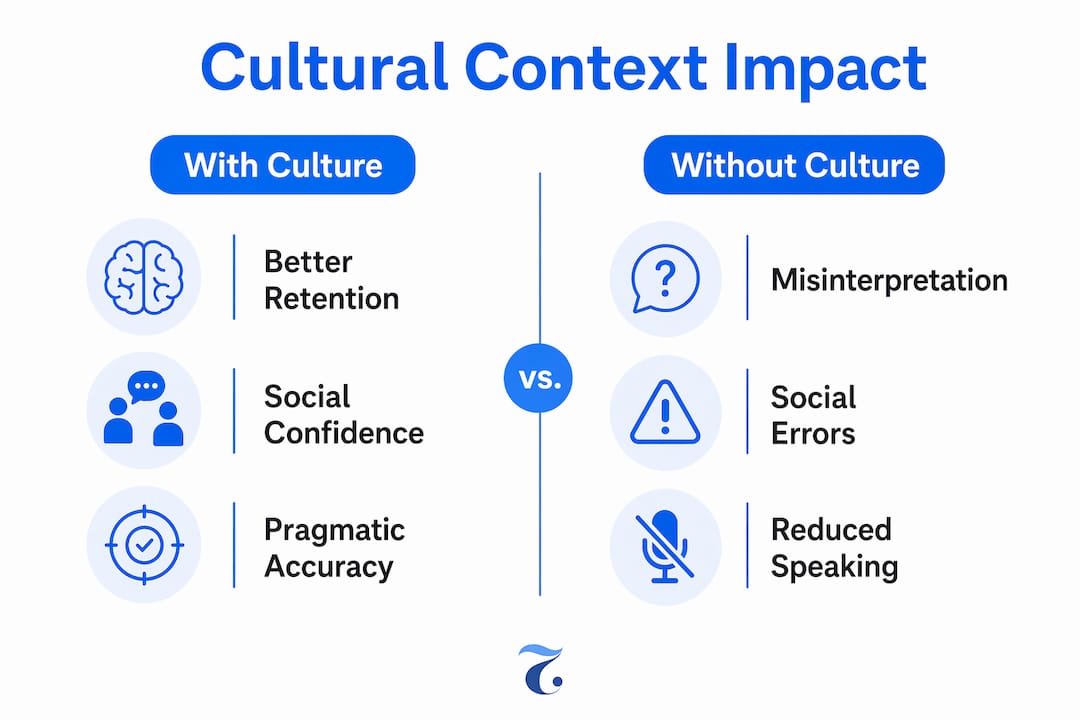
Connecting language to real social situations strengthens memory in ways that rote memorization cannot. Phrases learned with social context are remembered longer and used more confidently than phrases drilled in isolation. The brain stores language more effectively when it is attached to emotion, purpose, and human interaction.

Successful learners treat a new language as a system of cultural codes rather than a set of rules to memorize. This shift in mindset creates stronger memory connections because every word carries a social story. When you learn the Thai word for “thank you” alongside the cultural context of when and how to use it, including the appropriate gesture and level of formality, you are building a complete social memory, not just a vocabulary entry.
Cultural engagement also raises motivation. Learners who understand the culture behind a language find the material more interesting and personally relevant. They are more likely to practice, more willing to make mistakes, and more eager to interact with native speakers.
“Authentic cultural materials and immersion enhance language learning by connecting words to social purpose and emotion. Learners who engage with real cultural content develop both linguistic skill and the social confidence to use it.”
The practical steps that accelerate culturally grounded learning include:
- Watch authentic media. Films, TV shows, and social media content in the target language expose you to real speech patterns, humor, and social norms that textbooks rarely capture.
- Study social scenarios, not just sentences. Learn how to order food, apologize, or ask for help within the cultural context of those situations, not just the vocabulary.
- Interact with native speakers early. Even brief conversations force you to apply cultural knowledge in real time, which builds both skill and confidence faster than solo study.
- Reflect on cultural differences actively. After each interaction, note what surprised you. Those surprises are the gaps in your cultural knowledge that need attention.
Cultural confidence directly affects how often learners speak. Learners who feel uncertain about social appropriateness tend to stay quiet. Those who understand the cultural rules participate more, and participation is what drives fluency.
What challenges arise when cultural understanding is missing?
Advanced learners frequently struggle with interpreting culturally embedded pragmatic cues despite strong grammar skills. A study of 52 university students found significant gaps in recognizing indirect speech acts and figurative expressions. Strong grammar did not protect these learners from misunderstanding. This finding shows that cultural competence is a separate skill that requires deliberate teaching.
Without cultural knowledge, learners may speak grammatically correct but socially inappropriate language/01%3A_The_Study_and_Practice_of_Intercultural_Communication/1.07%3A_Verbal_Communication) due to differing politeness and hierarchy norms. Experts note that social awkwardness and unintended offense frequently arise from missing social scripts, not from vocabulary errors. This is a critical distinction for educators.
| Challenge | Root cause | Teaching solution |
|---|---|---|
| Misreading indirect refusals | High-context communication norms | Roleplay scenarios with native speaker feedback |
| Inappropriate formality level | Unfamiliarity with social hierarchy | Teach register and honorifics in context |
| Misunderstanding idioms | Literal translation habit | Use authentic texts and discuss figurative meaning |
| Offending without intent | Different politeness scripts | Analyze real conversations for cultural cues |
Educators play a direct role in closing these gaps. Integrating culture from the start builds learner confidence and helps learners interpret the social use of language. Treating culture as an add-on unit taught at the end of a course is a structural mistake. Cultural awareness belongs in lesson one.
Practical teaching methods that work include:
- Authentic materials: Use real newspaper articles, social media posts, films, and podcasts rather than textbook dialogues written to avoid complexity.
- Roleplay with cultural scenarios: Simulate real situations like negotiating, apologizing, or making requests, and debrief on what cultural rules applied.
- Native speaker input: Regular exposure to native speakers, whether in class or through media, gives learners access to cultural tone and teaching strategies that no textbook can fully replicate.
- Explicit discussion of social scripts: Name the cultural rules directly. Tell learners why a phrase is used, not just what it means.
Pro Tip: Build a “cultural notebook” alongside your vocabulary list. For every new phrase, write one sentence about the social situation where it is used. This habit rewires how you store and retrieve language.
How does language evolve with culture, and why does it matter?
Language does not stay still. Slang, idioms, and social norms shift over time, and those shifts change meaning. Relying on static textbooks without pairing them with real-time cultural exposure creates a gap between what learners study and how people actually speak. A phrase that was polite in one decade can carry a completely different connotation a generation later.
This is especially relevant for learners of Thai, where social values, generational language shifts, and digital culture all influence everyday speech. Younger Thai speakers use vocabulary and expressions that differ noticeably from formal written Thai or older textbook examples. Learners who only study from structured materials miss this living layer of the language.
Staying culturally current requires active habits:
- Follow native speakers on social media platforms to observe informal, real-time language use.
- Watch current Thai films, series, and YouTube content to track how speech patterns evolve.
- Engage with intercultural communication skills that go beyond vocabulary, including reading social cues and adapting register in real time.
- Revisit and update your cultural knowledge regularly, especially before travel or professional interactions.
Modern language learning apps and media enable social and cultural engagement that supports learner motivation and intercultural connection. Technology makes it easier than ever to stay current, but only if learners use it for cultural exposure, not just grammar drills.
Key Takeaways
Cultural context is the single most important factor separating grammatically correct speech from genuinely effective communication in any language.
| Point | Details |
|---|---|
| Culture shapes meaning | Grammar alone cannot decode tone, indirect speech, or social appropriateness in real conversations. |
| Context accelerates retention | Phrases learned with social context are remembered longer and applied more confidently than drilled vocabulary. |
| Pragmatic failure is real | Advanced learners still misread cultural cues; cultural competence requires deliberate teaching from lesson one. |
| Language evolves with culture | Static textbooks become outdated; pair structured learning with authentic media and native speaker interaction. |
| Educators are cultural guides | Integrating culture from the start, not as an add-on, builds learner confidence and practical fluency. |
The skill most language courses still undervalue
I have watched learners spend years studying Thai grammar and still freeze in a real conversation. Not because they lacked vocabulary. Because they did not know what to do with silence, how to read a polite deflection, or when to use a more formal register. Grammar gave them the tools. Culture was the instruction manual they never received.
Intercultural agility matters more than grammatical perfection in real conversations. I believe this completely. The learners I have seen succeed fastest are not the ones who memorized the most words. They are the ones who paid attention to how people behaved, what made native speakers laugh or go quiet, and what the unspoken rules of the room were.
The uncomfortable truth is that most language courses still treat culture as decoration. A lesson on Thai festivals here, a note about the wai greeting there. That is not cultural integration. That is cultural tourism. Real cultural learning means understanding why a Thai speaker might phrase a disagreement as a question, or why silence in a conversation is not awkward but respectful.
My advice to learners is this: treat every cultural observation as a language lesson. And my advice to educators is equally direct. You are not just a language instructor. You are a cultural guide. The moment you accept that role, your teaching changes fundamentally, and so do your learners’ results.
— Paul
Thai Explorer: where language and culture are taught together
Thai Explorer teaches Thai as a living language, not a set of rules to memorize. Every course at Thai Explorer combines structured language instruction with the cultural insights that make real communication possible.

Lessons are taught by qualified native Thai instructors who are bilingual in Thai and English, so you get both linguistic accuracy and cultural depth in every class. The curriculum is aligned with the CU-TFL (Chulalongkorn University Proficiency Test of Thai as a Foreign Language) standard, covering speaking, listening, reading, and writing in culturally grounded contexts. Whether you prefer group sessions, private Thai lessons, or online classes via Zoom, Thai Explorer offers a format that fits your schedule and learning goals. Browse the full range of Thai language courses and find the right starting point for your level.
FAQ
What is cultural context in language learning?
Cultural context is the social framework of norms, values, and communication rules that shapes how language is used and interpreted. Without it, learners can produce grammatically correct speech that is still socially inappropriate or misunderstood.
Why do advanced learners still struggle with cultural cues?
A study of 52 university students found that even advanced learners have significant gaps in recognizing indirect speech acts and figurative expressions. Cultural competence is a separate skill from grammar and requires deliberate, ongoing practice.
What is pragmatic failure?
Pragmatic failure occurs when a speaker uses language that is grammatically correct but culturally inappropriate, causing miscommunication or unintended offense. It typically results from applying one culture’s social scripts to another language.
How can educators integrate culture into language teaching?
Educators should introduce cultural context from the first lesson rather than treating it as a separate unit. Authentic materials, roleplay scenarios, and regular native speaker interaction are the most effective methods for building pragmatic awareness.
Does language change with culture over time?
Language evolves alongside cultural trends, generational shifts, and social values, making static textbooks an incomplete resource. Learners should pair structured study with current media, social platforms, and real-world interaction to stay current.