
TL;DR:
- Mastering Thai newspaper reading involves script mastery, structural understanding, and active comprehension techniques. Consistent practice with headlines, leads, and articles, combined with tools like dictionaries and flashcards, accelerates learning and builds confidence. Applying methods like SQ4R and pairing reading with cultural context significantly improves comprehension and retention.
Step by step reading Thai newspapers is a skill any adult learner can build with the right method and consistent practice. Thai newspapers use the same 44 consonants, vowels, and tone marks you find in every Thai text, so your existing script knowledge transfers directly to news content. Research on effective Thai reading instruction points to three core pillars: mastering the Thai alphabet, understanding how news articles are structured, and applying active reading techniques like the SQ4R method and Content and Language Integrated Learning (CLIL). This guide walks you through each stage in plain terms so you can open a Thai newspaper and actually make sense of it.
What prerequisites and tools do you need before reading Thai newspapers?
Solid preparation separates learners who progress from those who stall. Before you attempt a full Thai news article, you need two things: script confidence and a small toolkit of resources.
Script readiness
The Thai alphabet has 44 consonants organized into three tone classes: mid, high, and low. Memorizing consonants by tone class is faster than grouping them visually, because tone class directly controls how a syllable sounds. Most dedicated learners master all 44 consonants in 2–4 weeks with 15–20 minutes of daily practice. That timeline is realistic. It means you can be functionally ready to attempt simple headlines within a month.
Beyond consonants, you need to recognize common vowel forms and the five tone marks. Thai vowels wrap around consonants in four directions: above, below, before, and after. Practicing Thai writing exercises that isolate vowel placement builds the visual pattern recognition newspapers demand.
Essential tools for Thai newspaper reading
| Tool | Purpose | Best for |
|---|---|---|
| Thai dictionary app (e.g., Longdo Dict) | Look up unfamiliar words instantly | Vocabulary gaps |
| Digital Thai newspaper (e.g., Matichon, Khaosod) | Authentic reading material | Daily practice |
| Thai grammar reference | Clarify sentence structure | Syntax confusion |
| Flashcard app (e.g., Anki) | Reinforce new vocabulary | Retention |
| Bilingual glossary | Cross-reference news terms | Topic-specific words |
- Start with digital newspapers so you can copy and paste words into a dictionary.
- Bookmark a Thai news site with short articles. Khaosod and Matichon both publish brief daily news items.
- Keep a vocabulary notebook organized by topic: politics, economy, culture.
Pro Tip: Group your new vocabulary by the newspaper section where you found it. Words from the economy section cluster together naturally, which makes them easier to recall the next time you read a financial headline.
How do you decode Thai newspaper articles step by step?
Thai newspaper articles follow a predictable structure. Every article contains a headline, a lead paragraph, and a body. That structure is your roadmap.
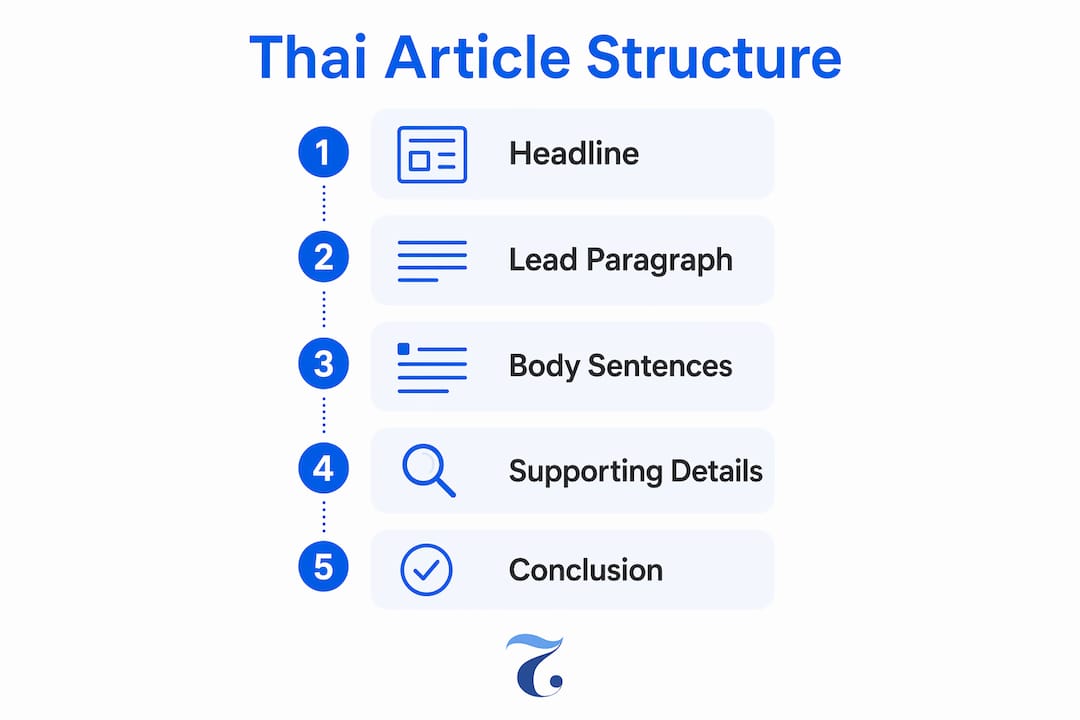
Step 1: Start with the headline
The headline is your first target. It is short, uses high-frequency vocabulary, and tells you the topic immediately. Read it slowly. Identify the main noun and the main verb. Do not worry about every particle yet. Your goal at this stage is to answer one question: what is this article about?

Step 2: Read the lead paragraph
The lead paragraph answers Who, What, Where, When, Why, and How. Decoding the headline and lead gives you enough information to understand the core news event. This is a critical insight for beginners. You do not need to finish the article to grasp the story. Stopping at the lead and confirming your understanding before moving on prevents the discouragement that kills reading habits.
Step 3: Work through the body sentence by sentence
The body expands on the lead with quotes, context, and detail. Approach it one sentence at a time. Identify the subject, then the verb, then the object. Thai sentences often place time expressions and location phrases before the main clause, so scan for those first.
| Reading stage | Focus area | Key question to answer |
|---|---|---|
| Headline | Main topic and key noun | What is this about? |
| Lead paragraph | Who, What, Where, When, Why, How | What happened and to whom? |
| Body sentences | Subject, verb, object, context | What details support the main point? |
| Functional words | Particles, conjunctions, connectors | How do ideas connect? |
- Underline words you do not recognize. Look them up after finishing the sentence, not mid-sentence.
- Note repeated words. High-frequency words in one article often appear in the next.
- Read the headline again after finishing the article. Your comprehension of it will sharpen noticeably.
Pro Tip: Write the headline in your notebook and translate it before reading the article. Then check your translation after you finish. This one habit builds headline vocabulary faster than any word list.
What active reading practices boost Thai reading comprehension?
Active reading means doing something with the text, not just scanning it. Passive reading builds familiarity. Active reading builds comprehension. The difference shows up quickly when you try to recall what you read an hour later.
The SQ4R method applies directly to Thai newspaper reading. SQ4R stands for Survey, Question, Read, Recite, Record, and Review. Research shows that SQ4R applied to Thai reading pushed learners past an 80% comprehension benchmark. That result is significant because 80% comprehension is the threshold where reading stops feeling like decoding and starts feeling like understanding.
Here is how to apply SQ4R to a Thai news article:
- Survey. Skim the headline, lead, and any subheadings. Form a mental picture of the topic before reading a single full sentence.
- Question. Write down two or three questions you expect the article to answer. “Who made this decision?” or “Where did this happen?” works well.
- Read. Work through the article section by section, sentence by sentence. Do not skip functional words.
- Recite. Close the article and say aloud what you understood. Use Thai if you can. Use English if you must.
- Record. Write down five new words and the sentence where you found them. Context is what makes vocabulary stick.
- Review. Re-read the article two days later. Notice how much more you catch on the second pass.
Alongside SQ4R, self-translation before checking an official translation trains your brain to work independently. Translate a paragraph on your own first. Then compare your version to a published translation. The gaps you find are your exact learning targets.
Content and Language Integrated Learning, known as CLIL, adds another layer. CLIL improves both Thai reading skills and cultural understanding at a statistically significant level. Practically, this means pairing your newspaper reading with background knowledge about Thai culture, politics, or current events. When you understand the cultural context of a story, unfamiliar vocabulary becomes easier to guess from context.
- Read aloud for at least five minutes per session. Hearing the words reinforces tone and rhythm.
- Summarize each article in three sentences after finishing it.
- Use your Thai reading comprehension practice log to track which article types give you the most trouble.
Pro Tip: Pick one recurring topic in Thai news, such as tourism or the economy, and read every article you find on that topic for two weeks. Repeated exposure to the same vocabulary cluster accelerates recognition far faster than reading across random topics.
What common challenges do learners face when reading Thai newspapers?
Every learner hits the same walls. Knowing what they are before you hit them means you recover faster.
Tone class confusion. Thai has five tones, and the tone of a syllable changes its meaning entirely. Consonant tone class plus tone mark determines the tone. Learners who memorize consonants without grouping them by tone class struggle more with this. Reorganize your consonant study by mid, high, and low class if you have not already.
Skipping functional words. Reading slowly and attending to small functional words is the single most cited advice from Thai reading experts. Particles like แล้ว (already), ก็ (also/then), and ด้วย (also/with) change the meaning of a sentence significantly. Skipping them causes misreads that compound across a paragraph.
Getting lost in long body text. Long articles feel discouraging when you are still building fluency. The fix is simple: stop at the lead. Confirm you understood the core event. Then decide whether the body is worth the effort for that session. Some days, one well-understood lead paragraph is a better outcome than a half-understood full article.
Vocabulary gaps in specialized topics. Political and legal reporting uses formal vocabulary that rarely appears in conversation. Build a topic-specific word list for the sections you read most. Ten new words per session, drawn from real articles, compounds quickly.
- Use the avoid common Thai mistakes framework to audit your reading errors weekly.
- If a sentence makes no sense after two reads, parse it word by word and look up every unfamiliar item.
- Track your error types. Tone errors, vocabulary gaps, and grammar misreads each need a different fix.
Pro Tip: When a sentence confuses you, remove all the particles and read just the content words. If the core meaning becomes clear, the particles are your study target for that session. This isolates the exact problem instead of leaving you stuck on the whole sentence.
Key Takeaways
Reading Thai newspapers step by step requires script mastery, a structured approach to article parts, and active comprehension techniques applied consistently over time.
| Point | Details |
|---|---|
| Master the alphabet first | Learn all 44 consonants grouped by tone class before attempting news articles. |
| Start with headlines and leads | Decoding the headline and lead gives you the full news event without needing the body. |
| Apply SQ4R to every article | SQ4R pushed Thai learners past 80% comprehension in research trials. |
| Attend to functional words | Small particles change sentence meaning; skipping them causes compounding errors. |
| Pair reading with cultural context | CLIL-based practice improves both reading skill and cultural literacy simultaneously. |
What I’ve learned from watching adults tackle Thai newspapers
The learners who make the fastest progress share one habit: they treat the newspaper as a daily ritual, not an occasional challenge. They open the same section every morning, even when they only have ten minutes. Consistency beats intensity every time with a script-based language like Thai.
The advice I give most often is to resist the urge to understand everything. Thai newspapers are written for native readers with decades of vocabulary exposure. You are not supposed to understand every word yet. What you are supposed to do is extract the main point from the headline and lead, confirm it, and move on. That small win, repeated daily, builds the confidence that keeps learners going past the six-week mark where most people quit.
Cultural immersion matters more than most learners expect. When you know that a Thai headline about “the cabinet” refers to the Council of Ministers, or that a story about “the three southern provinces” has specific political weight, your comprehension jumps without any new vocabulary. Pairing your reading with cultural fluency work is not optional. It is the multiplier.
Reading speed will come. Accuracy has to come first. Slow, careful reading that builds correct habits is worth far more than fast reading that reinforces errors. Give yourself permission to be slow. The speed follows.
— Paul
Thai Explorer can help you read Thai with confidence
Thai Explorer offers structured Thai language courses for adult learners in Singapore who want practical, real-world reading skills. Lessons are taught by qualified native Thai instructors who are bilingual in Thai and English, so you get clear explanations of exactly the grammar and vocabulary points that trip up newspaper readers.

Whether you prefer group classes, private sessions, or online learning via Zoom, Thai Explorer’s curriculum builds the reading comprehension and cultural knowledge you need to work through authentic Thai content. The program is aligned with the CU-TFL (Chulalongkorn University Proficiency Test of Thai as a Foreign Language) standards, giving your progress a recognized benchmark. Explore the full range of Thai language courses and find the format that fits your schedule and goals.
FAQ
How long does it take to read Thai newspapers as a beginner?
Most learners reach functional headline and lead comprehension within 2–3 months of consistent daily practice. Full article comprehension develops over 6–12 months depending on vocabulary exposure and study frequency.
What is the best Thai newspaper for learners?
Digital editions of Khaosod and Matichon work well for learners because their articles are accessible online, allowing you to copy words into a dictionary instantly. Start with shorter news briefs before attempting long feature articles.
What does the SQ4R method do for Thai reading?
SQ4R is a six-step reading process: Survey, Question, Read, Recite, Record, and Review. Research shows it pushes Thai reading comprehension past the 80% benchmark, making it one of the most evidence-backed methods for adult learners.
Why do functional words matter so much in Thai?
Thai particles and connectors carry grammatical meaning that English expresses through word order. Ignoring small function words leads to misreads that compound across a paragraph, turning a manageable sentence into a confusing block of text.
Should I translate Thai articles myself before checking a translation?
Yes. Self-translation before reviewing an official version forces your brain to engage with sentence structure actively. The gaps between your translation and the correct one become your most targeted study material.