
TL;DR:
- Listening is essential for language acquisition because it provides the foundation for developing vocabulary and grammar skills. Active listening strategies and tailored support enable learners to improve comprehension more effectively than passive exposure.
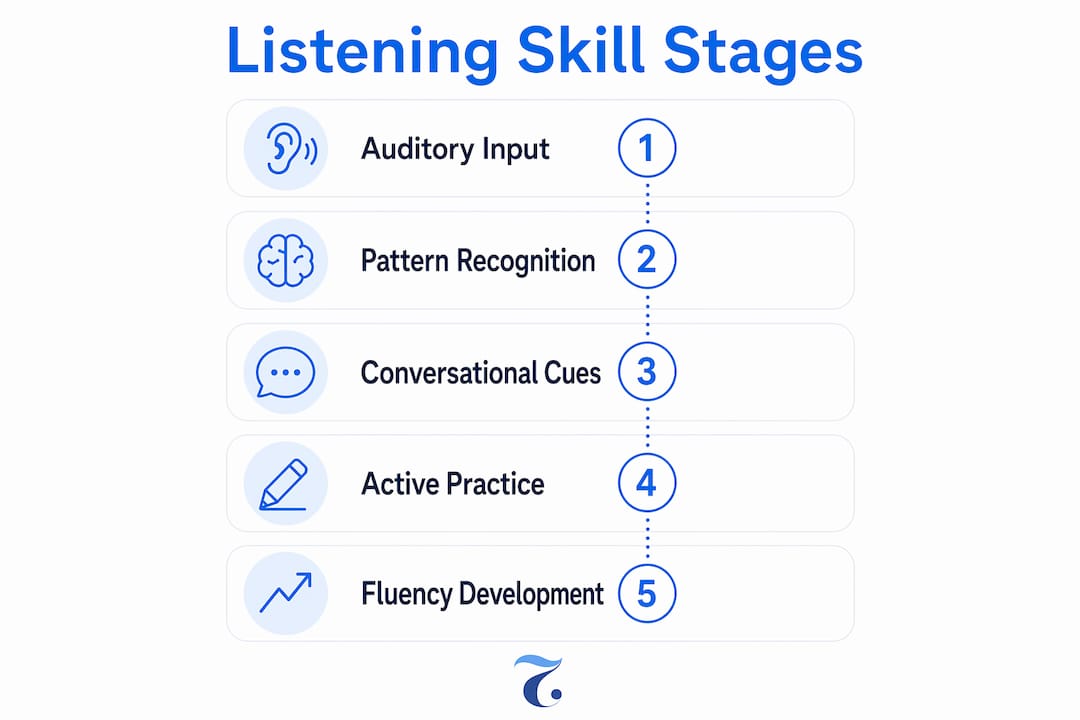
Listening is defined as the primary channel through which language learners receive and process linguistic input, making it the foundation of all language acquisition. The role of listening skills in language acquisition is not secondary to speaking or reading. It comes first. Stephen Krashen’s Input Hypothesis establishes that learners acquire language by understanding input that is slightly beyond their current level, a process that depends entirely on listening. Without strong auditory comprehension, vocabulary, syntax, and pragmatic skills cannot develop naturally. Every fluent speaker you have ever met built that fluency on a base of thousands of hours of listening before they ever spoke with confidence.
How do listening skills contribute to language fluency?
Listening comprehension is not a passive act. It requires the brain to simultaneously decode sounds, match them to known vocabulary, parse grammatical structures, and infer meaning from context. Researchers describe this as a combination of bottom-up processing, where you decode individual sounds and words, and top-down processing, where you use background knowledge and context to fill in gaps. Both processes work together in real time during every conversation.
Three specific auditory functions drive this process:
- Phonetic blueprinting: The brain maps new sounds to internal sound templates, which is how learners begin to distinguish similar phonemes in a foreign language.
- Speech segmentation: Learners learn to identify where one word ends and another begins in a continuous stream of speech, a skill that takes significant exposure to develop.
- Prosodic awareness: Recognizing rhythm, stress, and intonation patterns helps learners understand emotion, emphasis, and conversational intent beyond the literal words.
The foundation of fluency rests on auditory input, which enables learners to implicitly map linguistic structures during a silent period before they begin speaking. This silent period is not wasted time. It is when the brain builds the internal models that speaking will later draw from.
Listening also develops sensitivity to tone and real-time conversational cues. A learner who has heard thousands of hours of Thai, for example, will recognize hesitation, politeness markers, and emotional register long before they can explain those features grammatically. That intuitive understanding is what separates a textbook learner from a fluent communicator.

Pro Tip: Record yourself listening to a short audio clip, then write down what you understood. Replay it and note what you missed. This simple exercise builds metacognitive awareness of your own listening gaps faster than passive listening alone.
What strategies improve listening comprehension in language learning?
Learners who approach listening strategically outperform those who rely on passive exposure alone. Strategy instruction falls into two categories: metacognitive and cognitive.
Metacognitive strategies involve thinking about your own listening process:
- Planning: Before listening, activate background knowledge and predict what vocabulary or topics might appear.
- Monitoring: During listening, notice when comprehension breaks down and identify whether the gap is a vocabulary problem, a speed problem, or a pronunciation problem.
- Evaluating: After listening, assess how well you understood and what you would do differently next time.
Cognitive strategies are more task-focused:
- Inferencing: Use context clues, tone, and surrounding words to guess the meaning of unfamiliar terms.
- Note-taking: Write key words or phrases during listening to reduce the cognitive burden of holding everything in working memory.
- Summarizing: After a listening task, restate the main points in your own words to consolidate comprehension.
A 12-week intervention with young EFL learners showed significant comprehension gains through explicit scaffolding of these strategies. The gains were not just in test scores. Learners showed increased self-regulation and motivation during listening tasks. Explicit strategy instruction works because it gives learners a mental framework to apply when comprehension fails, rather than simply giving up or guessing randomly.
The impact of strategy instruction does vary by proficiency level and learning context. Adult learners with some prior exposure to a language tend to benefit most from monitoring and inferencing strategies, while beginners benefit more from planning and prediction before a listening task.
Pro Tip: Before your next Thai listening session, spend two minutes predicting the vocabulary you expect to hear based on the topic. This primes your brain to recognize words faster and reduces the cognitive load during actual listening.
How does auditory processing affect second language acquisition?
Individual differences in auditory processing create real variation in how quickly learners acquire a second language. Two abilities matter most: auditory statistical learning and pitch acuity.
Auditory statistical learning is the brain’s ability to detect patterns in speech over time. Learners with strong statistical learning pick up grammar rules and vocabulary patterns faster because their brains are better at extracting regularities from the input they hear. Pitch statistical learning, specifically, predicts grammar proficiency more strongly than pitch acuity alone. This distinction matters for tonal languages like Thai, where pitch carries grammatical meaning.
| Auditory ability | What it measures | Impact on language learning |
|---|---|---|
| Auditory statistical learning | Pattern detection in speech over time | Predicts vocabulary and grammar acquisition speed |
| Pitch statistical learning | Detection of pitch patterns and sequences | Strongly predicts morphosyntactic proficiency |
| Pitch acuity | Sensitivity to individual pitch differences | Supports tone recognition but less predictive of grammar |
Learners with weaker auditory statistical learning are not at a permanent disadvantage. Research shows these learners benefit more from targeted interventions than learners with stronger baseline abilities. That means tailored support, such as slowed audio, repeated exposure, and explicit pattern instruction, can close the gap meaningfully. Educators who recognize individual auditory differences can design instruction that meets learners where they are rather than applying a one-size approach.
What instructional methods improve listening skills most effectively?
The most effective listening instruction combines multimedia input with explicit metacognitive strategy guidance. Neither element works as well alone.
An experimental study of university learners found that audio-only input reduced cognitive load and promoted more effective strategy use compared to video input. This is a counterintuitive finding. Many learners assume that video is always better because it adds visual context. Audio-only input forces the brain to work harder at extracting meaning from sound alone, which builds the core listening skill more directly.
Effective classroom and self-study techniques include:
- Podcasts and audio programs: Choose content slightly above your current level and listen multiple times, first for gist and then for detail.
- Guided reflection tasks: After listening, answer specific comprehension questions before checking a transcript. This builds the habit of extracting meaning without a written crutch.
- Shadowing: Repeat what you hear immediately after hearing it, matching rhythm and intonation. This builds prosodic awareness and pronunciation simultaneously.
- Dictation exercises: Write what you hear word for word. This forces precise attention to sounds and reveals exactly where your phonetic blueprinting breaks down.
Multimodal input, such as video with audio, requires explicit scaffolding to be effective. Without guided reflection, learners tend to rely on visual cues and translation rather than building genuine listening comprehension. Recent studies indicate that real-time comprehension can actually suffer when learners overrely on translation instead of developing strategic listening habits. The Thai listening practice guide from Thai Explorer offers structured approaches specifically designed for adult learners working through these challenges.
For learners studying a tonal language like Thai, accent training resources that focus on listening in accent development can complement classroom instruction by targeting the specific auditory discrimination skills that tonal languages demand.
Is poor listening comprehension an attention problem?
Poor listening comprehension is a language skill gap, not an attention problem. This distinction is one of the most important and most misunderstood points in language education.
A learner can be fully focused, motivated, and attentive and still fail to understand spoken language. The reason is almost always a gap in vocabulary, syntax knowledge, or background knowledge, not a failure of concentration. Listening comprehension depends on vocabulary knowledge, syntax understanding, background knowledge, and inferencing skills working together. When any one of those components is weak, comprehension breaks down regardless of how hard the learner is trying to pay attention.
Longitudinal research shows that listening comprehension explains up to 36% of variance in reading comprehension by eighth grade, outpacing word recognition as a predictor of overall language ability. This finding applies directly to adult second language learners. As proficiency grows, listening comprehension becomes the dominant driver of overall language performance.
Poor listening comprehension is almost always a language knowledge problem. Learners who struggle to understand spoken input typically have vocabulary or syntax gaps, not attention deficits. Targeting those gaps directly, through vocabulary instruction, background knowledge building, and inferencing practice, produces faster gains than any attention-focused intervention.
Educators can use a simple diagnostic technique called the read-aloud test. Read a passage aloud to a learner and ask comprehension questions. If they understand the passage when it is read to them but not when they read it themselves, the issue is decoding. If they still struggle when it is read aloud, the issue is listening comprehension, which points to vocabulary or syntax gaps that need direct instruction.
Pro Tip: If you consistently miss meaning in spoken Thai despite paying close attention, audit your vocabulary first. Build a list of the 500 most common Thai words and test yourself on them. Gaps in that core vocabulary explain most adult listening comprehension failures.
Key Takeaways
Listening is the primary input channel for language acquisition, and developing it deliberately through strategy instruction and targeted practice produces faster, more durable fluency gains than passive exposure alone.
| Point | Details |
|---|---|
| Listening comes first | Auditory input precedes and enables speaking, reading, and writing development. |
| Strategies accelerate gains | Metacognitive strategies like planning, monitoring, and evaluating improve comprehension measurably. |
| Auditory processing varies | Pitch statistical learning predicts grammar proficiency; tailored support helps weaker processors catch up. |
| Audio-only input builds skill | Audio without video reduces cognitive load and forces deeper listening engagement. |
| Comprehension gaps are language gaps | Poor listening comprehension reflects vocabulary or syntax deficits, not attention problems. |
Why I think most adult learners underinvest in listening
Adult learners consistently underestimate how much listening practice they actually need. The pattern I see repeatedly is learners who spend most of their study time on grammar rules and vocabulary flashcards, then wonder why they cannot understand native speakers in conversation. The answer is almost always that they have not logged enough hours of real listening input.
The uncomfortable truth is that listening feels passive, so learners do not count it as serious study. But deliberate listening, with active monitoring and post-task reflection, is cognitively demanding work. It builds the internal sound models that make everything else in language learning faster. Learners who prioritize active learning approaches that integrate listening from day one consistently outperform those who treat listening as a supplementary activity.
The other mistake I see is treating all listening as equal. Listening to background music in Thai while cooking does not build the same skills as focused listening to a podcast with a comprehension task attached. Authentic audio materials, combined with guided strategy instruction, produce the best results. Balancing that listening practice with speaking and reading creates a feedback loop where each skill reinforces the others. The learners who progress fastest are the ones who treat listening as the anchor skill, not the afterthought.
— Paul
Thai Explorer’s approach to listening in adult Thai courses
Thai Explorer builds listening comprehension into every stage of its adult Thai courses, because fluency without strong listening is not real fluency.

Courses at Thai Explorer use multimedia audio materials, structured listening tasks, and native Thai instructors who model authentic speech patterns from the first lesson. The curriculum aligns with the CU-TFL standard, which means listening skills are assessed and developed alongside speaking, reading, and writing in a balanced way. Whether you prefer group classes, private lessons, or online Zoom sessions, the instruction keeps listening at the center of your progress. Thai Explorer’s courses are designed for adult learners in Singapore pursuing Thai for travel, work, or personal connection. Explore the full course range and find the format that fits your schedule and goals.
FAQ
What is the role of listening in language acquisition?
Listening provides the primary auditory input that enables learners to develop vocabulary, grammar, and fluency. Stephen Krashen’s Input Hypothesis identifies comprehensible auditory input as the starting point for all language acquisition.
How does active listening differ from passive listening in language learning?
Active listening involves deliberate strategies like prediction, monitoring, and post-task reflection, while passive listening is incidental exposure without focused engagement. Active listening produces measurably greater comprehension gains.
Why do learners struggle with listening comprehension even when they pay attention?
Poor comprehension despite focused attention almost always reflects gaps in vocabulary or syntax knowledge, not attention deficits. Targeting those language gaps directly produces faster improvement than attention-focused strategies.
Does audio-only input help more than video for language learners?
Audio-only input reduces cognitive load and promotes stronger listening strategy use compared to video input. Video requires explicit scaffolding to prevent learners from relying on visual cues instead of building genuine auditory comprehension.
How does pitch statistical learning affect Thai language acquisition?
Pitch statistical learning, the brain’s ability to detect pitch patterns over time, predicts morphosyntactic proficiency in tonal languages like Thai. Learners with weaker pitch statistical learning benefit most from targeted auditory training.