
Most people assume learning Thai in Singapore means showing up every Tuesday and Thursday at 7pm, no exceptions. That assumption stops a lot of people before they even start. The truth is, flexible Thai courses have changed the game entirely, giving you real control over when, where, and how fast you learn. Whether you’re a shift worker, a frequent traveler to Bangkok, or a professional building new skills, there’s a format designed around your life. This guide breaks down exactly what flexible Thai courses look like, who they work best for, what types exist in Singapore, and how to pick the one that fits your goals.
Table of Contents
- Flexible Thai courses: What sets them apart
- Who benefits most from flexible Thai courses
- Types of flexible Thai courses available in Singapore
- How to choose the right flexible Thai course for your goals
- The reality: What most guides miss about flexible Thai courses
- Ready to start? Explore flexible Thai courses in Singapore
- Frequently asked questions
Key Takeaways
| Point | Details |
|---|---|
| Flexible formats explained | Flexible Thai courses allow you to learn at your own pace, location, and schedule. |
| Best fit for busy lifestyles | These courses help professionals, travelers, and hobbyists balance learning with everyday life. |
| Practical course selection | Assess your language goals and try demo lessons to discover the best flexible option for you. |
| Support and subsidies matter | Top-rated schools offer community, good teachers |
Flexible Thai courses: What sets them apart
A flexible Thai course is not just one with a convenient time slot. True flexibility covers three dimensions: schedule, format, and pacing. A genuinely flexible program lets you choose when you attend, whether you learn in person or online, and how quickly you move through the material.
Traditional classroom Thai courses run on fixed terms. You join a cohort, follow a set syllabus, and keep pace with the group regardless of how fast or slow you absorb the language. Miss a class? You fall behind. That model works for some people, but it breaks down fast for anyone with an unpredictable schedule.
Flexible courses flip that structure. Here’s what they typically offer:
- Multiple weekly time slots so you can pick sessions around work or family
- Hybrid learning combining face-to-face and online lessons in the same course
- Self-paced modules that let you revisit grammar or vocabulary at your own speed
- Level-based entry so you join at your actual proficiency, not the start of a fixed term
- Make-up class options or recorded sessions for lessons you can’t attend live
The difference matters. In a rigid course, the curriculum drives you. In a flexible one, your goals drive the curriculum. Thai learning options in Singapore now range from fully online to hybrid to intensive private sessions, which means you can genuinely build a learning plan that fits your life.
One thing to watch for: flexibility in scheduling doesn’t automatically mean flexibility in quality. Look for programs with qualified native instructors, structured syllabi, and clear learning outcomes. Private Thai lessons are a strong example of this balance, offering one-on-one attention with a curriculum tailored to your specific goals.
“The best flexible courses don’t just move the clock around. They personalize the entire learning experience, from vocabulary focus to cultural context.”
Student feedback on platforms like TrustIndex highlights effective progress and engaging teachers as the top markers of a quality flexible course.
Pro Tip: Before enrolling, ask the school specifically how they handle missed classes and whether lessons can be rescheduled. This one question separates genuinely flexible programs from those that just advertise the word.
Who benefits most from flexible Thai courses
Not every learner needs flexibility for the same reason. Understanding your own situation helps you choose the right program and commit to it.
Shift workers and irregular schedules. If your work hours rotate weekly, a fixed Tuesday evening class is useless. Flexible courses with multiple weekly slots or on-demand online access solve this directly.

Frequent travelers to Thailand. If you visit Bangkok or Chiang Mai regularly for work or leisure, you need conversational Thai fast. You don’t have six months to follow a slow-moving group class. A self-paced or private format gets you functional faster.
Professionals adding a career skill. Thai language skills open doors in sectors like trade, logistics, tourism, and regional business. Professionals often need structured learning but can’t commit to rigid class times. Flexible formats let them progress without disrupting their work calendar.
Students and young adults. School and university schedules are unpredictable. Flexible courses accommodate exam periods, holidays, and part-time jobs without forcing you to drop out of a cohort.
Personal enrichment learners. Some people learn Thai because they love the culture, the food, or Thai drama series. These learners benefit from flexible pacing because motivation is personal, not deadline-driven.
Here’s a quick comparison to clarify the tradeoffs:
| Learner type | Fixed course | Flexible course |
|---|---|---|
| Shift worker | Poor fit | Strong fit |
| Business traveler | Moderate fit | Strong fit |
| Absolute beginner | Good fit | Strong fit |
| Self-motivated adult | Good fit | Excellent fit |
| Group learner | Excellent fit | Moderate fit |
Hybrid options and central locations are increasingly recognized as essential for learners balancing travel and professional ambitions. Being near a major MRT station, for example, removes one more logistical barrier.
If you’re unsure whether a flexible format suits you, trial Thai lessons are the smartest way to test the waters before committing to a full course. You’ll get a real feel for the teaching style, pace, and format in a single session.
It’s also worth understanding learning Thai timelines before you choose a format. Knowing roughly how long fluency takes helps you set realistic expectations and pick a course intensity that matches your timeline.
Types of flexible Thai courses available in Singapore
Once you know you want flexibility, the next question is which format actually fits your lifestyle. There are four main types to consider.
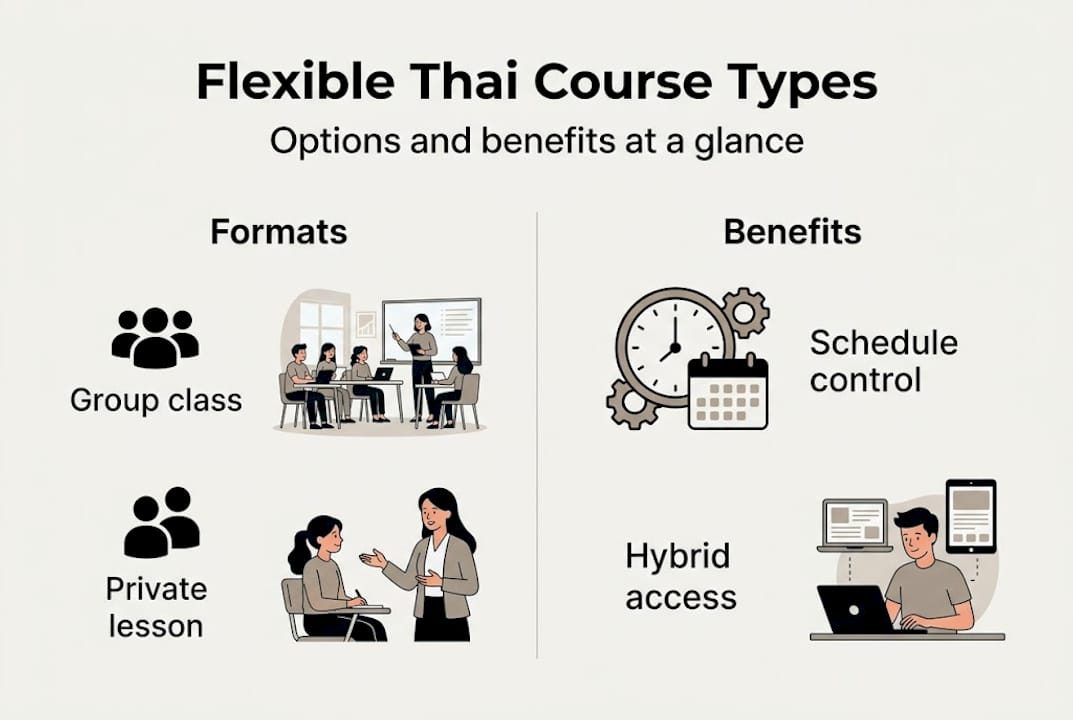
- Group classes with flexible scheduling. These run with small cohorts but offer multiple weekly session options. You get peer interaction and a social learning environment while still choosing your preferred time slot. Best for learners who stay motivated through group energy.
- Private lessons. One instructor, one student. The schedule, pace, and curriculum all revolve around you. This is the most flexible format available and also the fastest route to progress for most adult learners. Ideal for professionals and travelers with specific goals.
- Online Thai courses. Fully remote, often with live video sessions and supplementary recorded content. You can attend from home, a café, or a hotel room in Bangkok. Online Thai courses suit learners who travel frequently or prefer studying from a fixed home environment.
- Hybrid courses. A mix of in-person and online sessions within the same program. You attend face-to-face when you can and switch to online when you can’t. Lingo, inlingua, and Stanford are among providers offering hybrid flexible options in Singapore, reflecting how mainstream this format has become.
Here’s a format comparison at a glance:
| Format | Schedule flexibility | Pace control | Social interaction | Cost range |
|---|---|---|---|---|
| Group class | Moderate | Low | High | Lower |
| Private lesson | High | High | None | Higher |
| Online course | High | Moderate | Low | Moderate |
| Hybrid | High | Moderate | Moderate | Moderate |
Pro Tip: Don’t choose a format based on price alone. A cheaper group class that doesn’t fit your schedule will cost you more in wasted time and lost motivation than a slightly pricier private or hybrid option that you actually complete.
How to choose the right flexible Thai course for your goals
Choosing a course without a clear goal is like booking a flight without a destination. Here’s a practical step-by-step approach.
- Define your Thai language objective. Are you learning to navigate Bangkok markets, hold business meetings, watch Thai dramas without subtitles, or pass a formal proficiency test? Each goal points to a different course type and intensity.
- Audit your weekly schedule honestly. How many hours per week can you realistically commit? Two hours? Five? This determines whether a group class, private lesson, or self-paced online format makes sense.
- Compare course structures, not just prices. Look at syllabus depth, instructor qualifications, class sizes, and what happens when you miss a session.
- Book a trial lesson first. Don’t commit to a full term without testing the teaching style and format.
A useful checklist when comparing flexible Thai courses:
- Are instructors native Thai speakers with formal teaching qualifications?
- Does the curriculum align with recognized standards like CU-TFL?
- Can you switch between online and in-person attendance?
- What’s the maximum class size for group sessions?
- Is there a clear progression path from beginner to advanced?
Personalized, engaging instruction consistently shows up in student reviews as the factor that drives real progress and reduces learning stress. That’s not a coincidence. Teacher quality and course structure matter far more than schedule alone.
Browse the full Thai course selection to compare levels and formats side by side. And if you want to maintain momentum between lessons, building a habit of practising Thai daily makes a measurable difference in how fast you progress.
Pro Tip: Set a specific milestone before you enroll. Something like “I want to order food and ask for directions in Thai within three months.” Concrete goals keep you accountable and help your instructor tailor lessons to what actually matters to you.
The reality: What most guides miss about flexible Thai courses
Here’s something most course comparison articles won’t tell you: flexibility alone does not make you fluent. We’ve seen learners sign up for the most adaptable, self-paced, always-available programs and make almost no progress after six months. Why? Because without structure and accountability, flexibility becomes an excuse to skip.
The learners who succeed in flexible formats share one trait. They treat their Thai lessons like fixed appointments, even when the schedule technically allows them to reschedule. They show up consistently, communicate openly with their instructors, and stay connected to a community of fellow learners.
Isolation is the silent killer of self-paced language learning. When you study alone with no feedback loop, small errors compound into bad habits. This is why teacher engagement and peer interaction matter even in flexible formats. A good instructor doesn’t just deliver content. They notice when your tones are off, when you’re avoiding certain structures, and when you need encouragement to push past a plateau.
For learners motivated by real-world use, connecting language learning to actual travel plans accelerates progress dramatically. Resources like Thai for travelers bridge the gap between classroom Thai and the language you’ll actually use in Thailand. The best flexible programs build that bridge intentionally, not as an afterthought.
Ready to start? Explore flexible Thai courses in Singapore
Thai Explorer offers structured, flexible Thai courses designed for real life in Singapore. Whether you’re a complete beginner or picking up where you left off, there’s a format that fits your schedule and your goals.
Browse the full range of flexible Thai course options including group, private, and online formats, all taught by qualified native instructors. If you want a personalized experience from day one, private Thai lessons give you the fastest, most tailored path to fluency. Located directly above Tanjong Pagar MRT, Thai Explorer makes it easy to fit learning into your daily commute.
Frequently asked questions
What makes a Thai course truly flexible?
A genuinely flexible Thai course combines adaptable scheduling, hybrid formats that mix in-person and online attendance, and personalized pacing. Hybrid and flexible options are widely recommended for Singaporeans managing diverse personal and professional commitments.
How do I know which flexible Thai course is right for my travel or business goals?
Look for courses with customizable modules and instructors experienced in practical, real-world Thai communication. Trial lessons and tailored modules consistently receive praise for helping learners assess fit before committing to a full course.
Do flexible Thai courses work for absolute beginners?
Absolutely. Most flexible programs are built to accommodate beginners and adapt the progression speed to your comfort level. Effective progress across beginner levels is a common theme in student reviews of quality flexible Thai courses.