TL;DR:
- Memorizing Thai words alone does not ensure effective communication, as pronunciation and politeness are essential.
- Focusing on core vocabulary within practical scenarios enhances real-world understanding, especially for travelers and learners in Singapore.
- Mastering tones and polite language early is crucial for meaningful interactions, making targeted, context-based practice the most effective approach.
Memorizing a list of Thai words is not the same as actually communicating in Thai. Many learners arrive in Bangkok armed with vocabulary flashcards, only to find that a mispronounced tone turns “rice” into “white” or a missing polite particle makes a perfectly friendly sentence sound abrupt. The truth is that Thai vocabulary works as a system, not a collection of isolated words. This guide breaks down what you actually need to know, from the most practical word categories to the pronunciation rules and politeness conventions that make your vocabulary come alive in real conversations.
Table of Contents
- Why knowing essential Thai vocabulary matters
- What makes Thai vocabulary ‘essential’: Categories and benchmarks
- Pronunciation, tones, and polite language: The must-know nuances
- Strategies to learn and apply Thai vocabulary in Singapore
- Applying Thai vocabulary essentials: Real-life scenarios
- The uncomfortable truth about mastering Thai vocabulary essentials
- Next steps: Learn and apply Thai vocabulary essentials in Singapore
- Frequently asked questions
Key Takeaways
| Point | Details |
|---|---|
| Core vocabulary first | Mastering 100-500 key words and phrases unlocks basic Thai communication for travel, culture, and work. |
| Context and politeness matter | Understanding tones, pronunciation, and gendered polite endings is essential for real-world use. |
| Scenario-based learning | Grouping vocabulary by practical context accelerates retention and confidence. |
| Flexible strategies | Singaporeans benefit from online resources and adaptable frameworks that match real-life needs. |
| Real-life exposure boosts mastery | Applying vocabulary in authentic situations and relaxed settings raises motivation and effectiveness. |
Why knowing essential Thai vocabulary matters
Language learning has a clear pattern: a small core vocabulary, used well, unlocks a surprisingly large portion of everyday communication. For Thai, that principle is especially powerful. Whether you are visiting Chiang Mai for a week, living in Bangkok for a year, or managing business relationships with Thai partners from Singapore, knowing the right words in the right context opens doors that a phrasebook alone cannot.
Consider the difference between pointing at a menu and saying “an née kráp” (this one, please) versus confidently ordering a specific dish, asking about spice levels, and thanking the server with a warm “khàawp khun kráp.” The second interaction builds trust, earns smiles, and deepens your experience of Thai culture. The same logic applies to asking for directions, navigating emergencies, or greeting a Thai colleague for the first time.
For Singaporean learners specifically, Thai is an accessible target language. The Singaporean ear is already trained to handle tonal nuances from Mandarin and regional dialects, and exposure to Thai food, culture, and tourism makes the language feel familiar and motivating. Thai phrases for travelers organized by real-life scenarios give you immediate wins that keep you moving forward.
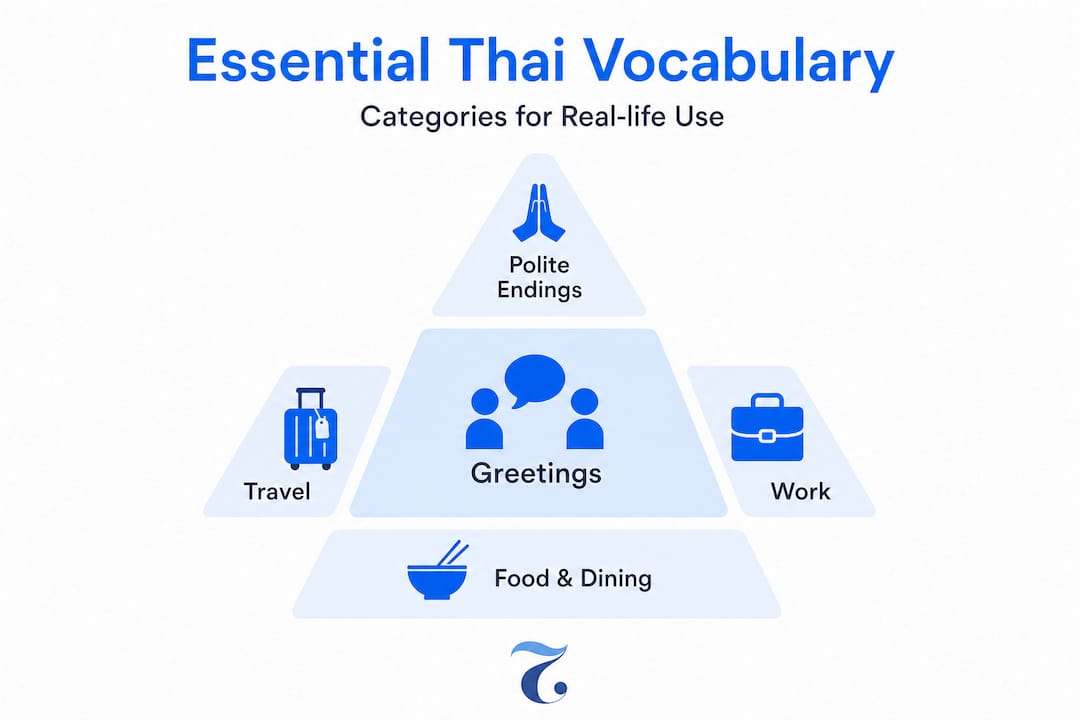
The key vocabulary categories every beginner should target include:
- Greetings and social phrases (sawàtdii, khàawp khun, khǒo thôot)
- Directions and transportation (left, right, straight, BTS station, taxi)
- Food and ordering (spicy, no spice, vegetarian, bill please)
- Shopping and numbers (how much, too expensive, discount)
- Emergency phrases (help, hospital, police, I’m lost)
“Knowing even 100 core Thai phrases can transform a trip from frustrating to genuinely rewarding. Locals notice and appreciate the effort immediately.”
Learning Thai greetings and politeness early is not just about being polite. It sets the tone for every interaction and signals cultural respect, which Thai people value deeply.
What makes Thai vocabulary ‘essential’: Categories and benchmarks
Not all vocabulary is created equal. The question is not how many words you can learn but which words will give you the most return on your time. Core phrases benchmarks show that essential Thai vocabulary for travel, cultural immersion, and professional purposes centers on 100 to 500 core words and phrases categorized by greetings, directions, shopping, food, transportation, and emergencies.
Research into Thai vocabulary acquisition provides useful benchmarks. Empirical studies on Thai vocabulary show that A1 level learners need roughly 100 to 500 words covering greetings, numbers, and basic sentences, while university students learning Thai as a foreign language demonstrate an average vocabulary size of around 4,490 out of 14,000 words, or about 26.54%. That gap is significant and explains why structured, prioritized learning matters far more than casual exposure.
Two broad approaches exist for organizing your vocabulary study:
| Approach | Best for | Focus | Example categories |
|---|---|---|---|
| Scenario grouping | Travelers, beginners | Immediate practical use | Food, transport, emergencies |
| High-frequency word lists | Long-term learners | Broad comprehension | Common verbs, nouns, particles |
| Business/professional focus | Work purposes | Formal registers | Titles, meeting phrases, email openers |
| Full immersion | Cultural integration | Reading, speaking, writing | All categories plus script |
Essential phrases for travelers are grouped for travel safety, cultural integration, and work professionalism, confirming that context-first organization outperforms random memorization for most learners.
For beginners, scenario grouping is almost always the smarter starting point. If you know why you are learning Thai, you can prioritize accordingly. A business traveler visiting Bangkok quarterly needs meeting room language, polite titles, and negotiation phrases. A backpacker heading to Pai for two weeks needs food orders, guesthouse vocabulary, and emergency phrases.
Understanding Thai grammar basics early helps because Thai sentences follow a subject-verb-object pattern without verb conjugations, making new vocabulary faster to slot into real sentences.
Pro Tip: Before you start memorizing any Thai word list, write down your top three reasons for learning Thai and let those goals dictate which scenario group you tackle first. This single step dramatically reduces wasted study time.
Visit the Thai Explorer blog for regularly updated vocabulary tips organized by level and purpose.
Pronunciation, tones, and polite language: The must-know nuances
Here is where many learners lose confidence. Thai is a tonal language with five distinct tones, and the tone you use on a word can completely change its meaning. This is not a minor detail you can skip and fix later. It is central to being understood.
The five tones in Thai are:
- Mid tone (flat, neutral): The default tone for many common words
- Low tone (slightly below mid): Marked with a specific consonant class
- Falling tone (starts high, drops): Common in emotional or emphatic speech
- High tone (above mid, slight rise then fall): Appears in many everyday words
- Rising tone (starts low, rises): Often sounds like a questioning inflection
The classic example is the word “khao.” Depending on your tone, it can mean rice, white, or to enter. Tone changes in Thai are not edge cases; they represent how the language fundamentally operates, and gendered politeness is equally mandatory for cultural respect. A wrong tone in the wrong context can be confusing, amusing to locals, or occasionally awkward.
The good news is that context rescues you more often than you might expect. Tones in tourist contexts are crucial, but context does help foreigners get their meaning across even with imperfect tones, especially in tourist-heavy areas. Locals are generally patient and will try to understand you.
Beyond tones, politeness particles are non-negotiable in Thai. Male speakers end sentences with “kráp” and female speakers use “kâ” or “khâ.” These small additions signal respect and cultural awareness immediately. Dropping them in a business setting or when speaking to older Thais is a significant social misstep, even if your vocabulary is otherwise excellent.
Professional situations introduce additional layers. Thai culture places strong emphasis on age and status hierarchies. Knowing the difference between “khun” (a neutral, respectful title similar to Mr. or Ms.) and more formal honorifics becomes important in workplace settings. The vocabulary for a meeting with a senior executive differs noticeably from the vocabulary for casual conversation with a colleague your own age.
“Politeness in Thai is not optional decoration. It is structural. Every sentence you speak communicates not just information but your relationship to the person you are speaking with.”
For Singaporean learners pursuing Thai pronunciation mastery, working with a native speaker from the start builds far better tone habits than self-study alone. Studying essential polite Thai phrases early also gives you the social framework that makes all your other vocabulary work harder.
Pro Tip: Always attach the polite ending “kráp” or “kâ” to every sentence when speaking to strangers, regardless of how informal the situation feels. It costs you nothing and signals respect that opens every conversation more warmly.

Strategies to learn and apply Thai vocabulary in Singapore
Learning Thai in Singapore comes with specific advantages and challenges. On the plus side, you have a multilingual community, regular flights to Thailand, Thai restaurants everywhere to practice ordering, and a strong culture of structured language learning. The challenge is finding resources that match your specific goals.
A practical learning framework for Singapore-based learners might look like this:
- Spoken focus first: For travelers and short-term purposes, prioritize listening and speaking before tackling the Thai script. Script is optional for short trips but becomes important for full immersion or professional literacy.
- Spaced repetition apps: Tools like Anki allow you to build custom Thai vocabulary decks grouped by your chosen scenarios. Review frequency automatically adjusts based on what you remember.
- Language exchange partners: Singapore has a substantial Thai community. Connecting with native Thai speakers for informal practice sessions is one of the most effective and underused strategies.
- Themed study sessions: Dedicate one session to food vocabulary, the next to transportation, and the next to greetings. Thematic focus builds richer word associations than random lists.
Expat experiences in Thailand consistently highlight that tones and politeness are non-negotiable nuances, even for people who have lived in the country for years. Getting comfortable with them early saves you from developing bad habits that become harder to unlearn later.
| Learning goal | Recommended method | Script needed? | Time to basic fluency |
|---|---|---|---|
| Short-trip travel | Spoken phrases, apps | No | 2 to 4 weeks |
| Cultural immersion | Classes with native speaker | Recommended | 3 to 6 months |
| Professional use | Structured course, business Thai | Yes | 6 to 12 months |
| Full fluency | Formal curriculum with exams | Yes | 2 to 3 years |
Learning Thai online strategies have become increasingly viable, especially with live instructor-led classes that allow real-time tone correction, something recorded content simply cannot replicate. For learners interested in writing Thai script, building that skill alongside spoken practice creates a much stronger foundation than tackling them separately.
Pro Tip: Incorporate real-life Thai contexts into your study routine from day one. Order from a Thai restaurant in Thai, label household objects with Thai sticky notes, or watch Thai dramas with subtitles. The emotional connection to real contexts dramatically improves vocabulary retention compared to dry flashcard drilling.
If you want to study Thai online in Singapore, structured classes with native instructors remain the most efficient path to accurate tones and authentic usage.
Applying Thai vocabulary essentials: Real-life scenarios
Vocabulary only becomes truly useful when you test it in real situations. Here is how your essential Thai word bank plays out across three key scenarios.
Travel scenario: You arrive at Suvarnabhumi Airport and need a taxi to your hotel. You say “bpai hôtel [name] kráp, tâo ràai kráp?” (Going to hotel [name] please, how much?). The driver quotes a price. You know enough to say “phaeng bpai” (too expensive) and negotiate. That exchange, built on maybe 20 vocabulary items, saves you money and starts your trip with confidence.
Cultural scenario: You visit a temple and meet an older Thai woman near the entrance. A simple “sawàtdii kráp” with a small wai (the traditional greeting gesture) immediately earns warmth and respect. Knowing phrases like “sǔay mâak” (very beautiful) about the temple and “khàawp khun mâak kráp” (thank you very much) for any help offered turns a tourist visit into a genuine human connection.
Professional scenario: Your Thai business partner greets you before a meeting. You respond with “yin dii thîi dâai rúujàk kráp” (pleased to meet you) and use “khun” followed by their first name throughout the conversation. These small vocabulary choices signal that you understand Thai professional norms. Research on motivation in language learning consistently shows that real-life contexts produce the highest motivation and retention rates, especially when learners feel immediate success in practical settings.
The most common pitfalls in all three scenarios are the same: using the wrong tone, skipping polite particles, or choosing vocabulary that is too casual for the social context. The fix is always the same too: more context-specific practice, ideally with a native speaker who can give you live feedback. For practical tips for Thai mastery, starting with these scenario-based mini-goals builds confidence faster than any other method.
- Practice each scenario out loud, not just in writing
- Record yourself and compare your tones to native speaker recordings
- Review mistakes in the context of the scenario, not as isolated corrections
- Build on success: once food ordering feels natural, move to the next scenario
The uncomfortable truth about mastering Thai vocabulary essentials
Most vocabulary guides do you a disservice. They hand you a list of 100 words and call it a lesson. What they rarely tell you is that those 100 words, spoken without correct tones and without polite particles, will produce confusion, misunderstandings, and occasionally offense, despite your genuine effort.
We have seen this pattern repeatedly with learners who come to us having studied on their own for months. Their vocabulary is decent. Their tones are a mess. Their sentences are technically correct but missing the social glue that makes Thai communication work. Fixing ingrained tone habits takes longer than building them correctly from the start.
The other uncomfortable truth is about flexibility. Too many learners waste time debating whether they should focus on spoken Thai or learn the script first. The honest answer depends entirely on your goals. If you are taking three trips to Phuket a year, skip the script and get your spoken tones sharp. If you want to work in Thailand or reach genuine fluency, you will need the script eventually, but it does not have to come first.
Singapore-based learners have a genuine structural advantage here. The multilingual brain is genuinely more flexible with new sound systems, and the proximity to Thailand means you can test your vocabulary in real contexts far more often than most learners around the world. Use that advantage deliberately. Build contextual Thai phrases around the specific situations you actually find yourself in, and let your real experiences drive your study priorities rather than following a generic curriculum designed for someone else’s goals.
The learners who progress fastest are not the ones who memorize the most words. They are the ones who use fewer words more confidently, in context, with correct tones and appropriate politeness. That combination is what real communication feels like.
Next steps: Learn and apply Thai vocabulary essentials in Singapore
Reading about Thai vocabulary is a starting point. Actually speaking it with confidence requires structured practice and real-time feedback from qualified instructors who can catch your tone errors before they become habits.
Thai Explorer offers Thai language courses in Singapore designed for learners at every stage, from absolute beginners building their first 100 words to advanced students preparing for CU-TFL certification. Not sure where you fit? The course finder tool helps you match your goals, schedule, and learning style to the right format. Prefer one-on-one attention for faster tone correction and personalized vocabulary building? Private Thai lessons are available with native bilingual instructors who understand exactly what Singaporean learners need. Located right above Tanjong Pagar MRT, Thai Explorer makes consistent, quality Thai learning genuinely accessible.
Frequently asked questions
How many Thai words do I need for basic communication?
You need about 100 to 500 core words and phrases for basic travel, cultural, and professional interactions in Thai, organized by practical categories like greetings, directions, food, and emergencies.
Is learning Thai script necessary for travelers?
No, most short-term travelers can focus entirely on spoken Thai, as script is optional for casual travel but becomes important if you are pursuing full immersion or professional-level literacy.
How important are tones and polite endings in Thai?
Extremely important. Tone changes alter meaning fundamentally (the same syllable can mean rice, white, or enter), and gendered polite endings like kráp and kâ are mandatory for cultural respect in virtually every social context.
Are there Thai language schools in Singapore?
Yes, despite some sources suggesting no Singapore-specific options, Thai Explorer is a dedicated Thai language school located in Singapore offering group, private, and online classes with native instructors for all levels.
Which Thai vocabulary should I learn first?
Start with scenario-grouped essentials: greetings, directions, shopping, food, transportation, and emergency phrases, as these core categories give you the fastest practical return and build the foundation for everything that follows.