
TL;DR:
- Thai pronunciation is challenging due to its five tones and unique consonant and vowel sounds that differ from English and Mandarin. Effective learning requires focused listening, daily practice, and feedback, with tools like apps, native videos, and speaking with Thai speakers accelerating progress. Embracing mistakes and starting conversations early build confidence and lead to faster mastery of spoken Thai.
You order food at a Bangkok street stall, confident you’ve said the right words, but the vendor stares back blankly. You repeat yourself, louder this time, and still nothing clicks. Sound familiar? Thai pronunciation trips up even the most motivated learners because the language works on rules completely unlike English, Mandarin, or any of Singapore’s other common tongues. The good news is that with the right framework, first-time learners can move from total confusion to real, recognizable spoken Thai faster than they expect. This guide gives you exactly that framework.
Table of Contents
- What makes Thai pronunciation challenging?
- What you need to prepare before practicing
- Step-by-step guide to mastering Thai pronunciation
- Troubleshooting: Avoiding common Thai pronunciation mistakes
- How to know you’re getting it right: Measuring Thai pronunciation progress
- Why mastering Thai pronunciation is easier (and more fun) than most expect
- Continue your Thai pronunciation journey with expert support
- Frequently asked questions
Key Takeaways
| Point | Details |
|---|---|
| Tones are critical | Mastering Thai tones is essential for being understood and avoiding common mistakes. |
| Prepare with the right tools | Using structured resources and daily routines helps new learners make steady progress. |
| Practice consistently | Frequent, real-world practice builds confidence and corrects errors quickly. |
| Test your skills regularly | Self-assessment with tests and feedback ensures continual improvement in pronunciation. |
What makes Thai pronunciation challenging?
Thai is a tonal language, but it’s not tonal in the same way that Mandarin is. Where Mandarin uses four tones, Thai uses five: mid, low, falling, high, and rising. Each tone can completely change the meaning of a word, even if every other sound is identical. The word “mai,” for example, can mean “new,” “not,” “wood,” “burn,” or “silk” depending purely on the tone you use. That’s five different meanings sitting on one set of sounds.
Thai pronunciation relies heavily on these tones, plus a range of consonants and vowels that simply don’t appear in English or Mandarin. There are sounds like the unaspirated “p,” “t,” and “k” that fall awkwardly between their English equivalents. Thai also has vowel sounds that require your mouth to hold specific shapes you’re not used to making. For Singaporean learners who speak English, Mandarin, Malay, or Tamil at home, none of these offer a direct shortcut to Thai sounds.
| Feature | English | Mandarin | Thai |
|---|---|---|---|
| Tones | None | 4 tones | 5 tones |
| Aspirated/unaspirated pairs | Partial | Yes | Yes |
| Unique vowel sounds | Moderate | Several | Many |
| Silent final consonants | Rare | Common | Common |
Common pronunciation pitfalls for beginners include:
- Applying English stress patterns to Thai words, which disrupts tones
- Ignoring vowel length, since Thai treats short and long vowels as different sounds
- Confusing similar consonants like “p/ph,” “t/th,” and “k/kh”
- Rushing through tone marks without learning what each one signals
Pro Tip: Before you even attempt speaking, spend a week purely listening to native Thai speech. Podcasts, Thai TV shows, and YouTube channels give your brain a chance to absorb the rhythm before your mouth tries to copy it. Dedicated tone exercises are even more effective once your ear is already calibrated.
What you need to prepare before practicing
Getting your materials and mindset right before you start saves you from repeating bad habits. Many learners jump straight into speaking, pick up wrong patterns, and then spend months unlearning them. A small amount of preparation goes a long way.
Here are the tools that consistently help Thai learners in Singapore make faster progress:
- Apps: Ling, Pimsleur, and Anki (for flashcards with audio) all offer solid pronunciation support
- YouTube channels: Search for channels run by native Thai teachers who explain phonetics in English
- Textbooks: “Thai for Beginners” by Benjawan Poomsan Becker is widely used and includes audio components
- Online courses: Structured programs designed for Singapore learners, like those at Thai Explorer
| Tool type | Best for | Example |
|---|---|---|
| Flashcard apps | Vocabulary with audio | Anki, Ling |
| Audio courses | Listening and imitation | Pimsleur |
| Native video content | Ear training and context | YouTube channels |
| Structured school courses | Systematic correction | Thai Explorer lessons |
Good resources accelerate pronunciation improvement significantly, especially when paired with consistent daily practice. The key word there is “consistent.” A 20-minute session every day beats a two-hour session once a week, every time. Your brain builds phonetic memory through repetition, and spreading that practice across daily sessions keeps the patterns fresh.
Set up a dedicated practice space, ideally quiet and free from interruptions. Record yourself from day one. It feels uncomfortable, but hearing your own voice compared to a native speaker is the single fastest way to identify gaps. Many learners also find it helpful to work on their reading skills for Thai early, because understanding the Thai script helps you read tone marks rather than guess them.
Pro Tip: Create a pronunciation journal. Write down words that trip you up, note the specific tone or sound that’s causing the problem, and track how often you practice them. Reviewing this journal weekly shows you exactly where you’re improving and where you still need work.
Step-by-step guide to mastering Thai pronunciation
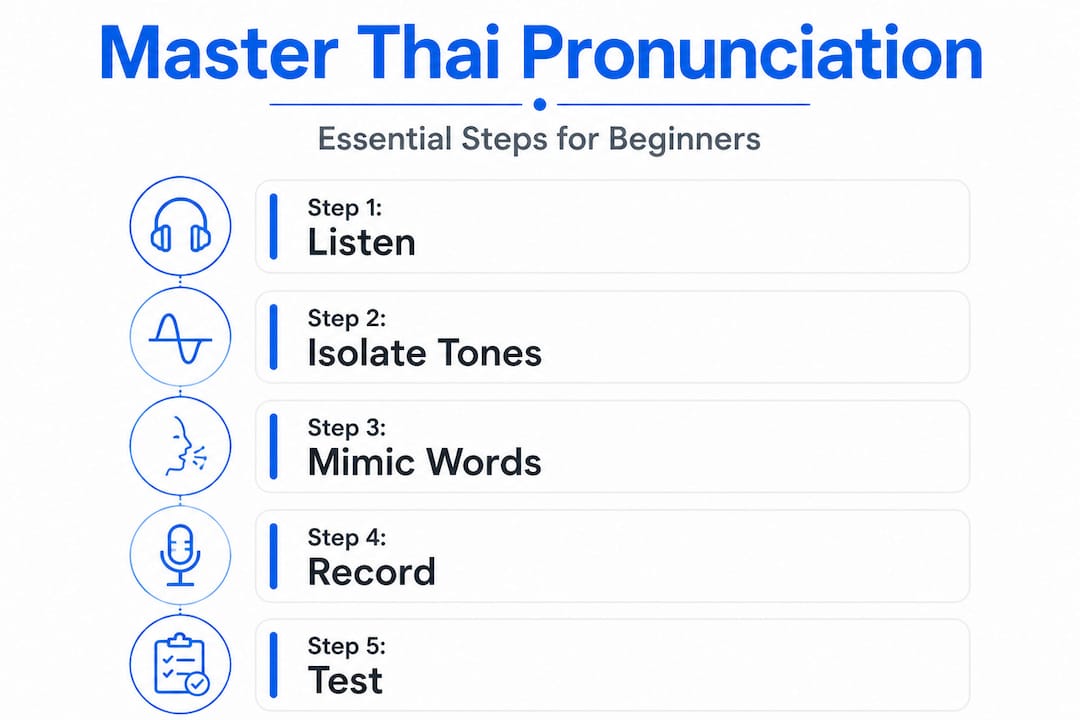
Here’s the sequence that works best for Singaporean beginners building their Thai pronunciation from scratch:
- Learn the five tones in isolation first. Don’t try to attach tones to real words yet. Just practice the pitch shapes: mid (flat), low (slightly lower), falling (high to low), high (slightly higher), rising (low to high). Use a piano or a tone app to hear the differences.
- Mimic single syllables. Choose 10 common Thai syllables and repeat each one 20 times daily. Focus entirely on matching the native speaker’s pitch and vowel shape.
- Apply tones to real words. Once you can reliably produce each tone shape, attach them to common vocabulary. Start with greetings and numbers, which you’ll use immediately.
- Do daily tone drills. Five minutes of focused tone practice drills every single day is more effective than longer, irregular sessions. Tone drills and mimicking native speakers are proven to accelerate pronunciation mastery significantly.
- Record and compare. Record yourself saying a short phrase, then play a native version of the same phrase and compare them directly. Be specific: is the vowel too short? Is the tone falling when it should be rising?
- Practice with real speakers. Find Thai-speaking communities in Singapore, try language exchange apps like Tandem or HelloTalk, or join a class where you interact with a native teacher. Practice with actual Thai conversations solidifies pronunciation in ways that solo drills simply cannot replicate.
- Use speech analysis tools. Apps like Google Translate’s speech-to-text feature or dedicated pronunciation tools like ELSA (adapted for tonal practice) can give you instant audio feedback on individual words.
| Practice method | Time per day | Skill developed |
|---|---|---|
| Tone isolation drills | 5 minutes | Tone accuracy |
| Word-level mimicking | 10 minutes | Consonant and vowel precision |
| Recording and comparison | 5 minutes | Self-awareness and error detection |
| Conversation with native speakers | 15 minutes | Real-world pronunciation fluency |
For Singaporean learners who want a structured path, a well-organized learn Thai online guide can help you build this routine around your working schedule.
Pro Tip: When mimicking, slow the audio down to 75% speed using YouTube’s playback settings. This lets you hear each tonal movement clearly before you try to replicate it at full speed.
Troubleshooting: Avoiding common Thai pronunciation mistakes
Even learners who work hard can develop stubborn errors. Here’s what to watch for:
- Using English phonetics as a crutch. The romanized spellings used in Thai textbooks are rough approximations. “ph” in Thai sounds like a softer “p,” not like the “f” sound it represents in English words like “photo.”
- Ignoring vowel length. Thai treats short and long vowels as completely different sounds. “Kao” (เก่า) meaning “old” and “kao” (ข้าว) meaning “rice” differ primarily in vowel length and tone.
- Skipping days. Pronunciation is a physical skill, like playing an instrument. Missing multiple days breaks the muscle memory you’re building.
- Guessing tones instead of learning tone rules. Thai has a logical system for predicting tones based on the class of the initial consonant and the tone mark present. Learning this system, rather than guessing, dramatically reduces random errors.
- Not seeking external feedback. Your own ear adjusts to your own voice over time, making errors harder to notice. A teacher, a language partner, or even a pronunciation test catches things you’ll miss.
“Tone mistakes are the most common and most critical errors for Thai learners. One wrong tone doesn’t just make you sound foreign, it can completely change what you’re saying.”
Mistakes with Thai tones are the most common and critical issue learners face. A practical way to self-correct is to maintain a dedicated “tone error log.” Every time a native speaker corrects you or looks confused, write down the word, what tone you used, and what tone it should have been. Reviewing this log twice a week accelerates correction faster than any app.

When you want to test how far you’ve come, a structured Thai pronunciation test gives you concrete data on your accuracy across all five tone categories.
Pro Tip: Record voice messages to yourself in Thai once a week and listen back three days later. Distance in time makes it much easier to hear your own errors objectively.
How to know you’re getting it right: Measuring Thai pronunciation progress
Progress in pronunciation can feel invisible, which is why tracking it deliberately matters so much. Without measurement, learners often assume they’re not improving when they actually are, and that false impression leads them to quit.
Practical milestones to track:
- Week 2 to 4: You can distinguish all five tones when you listen to a native speaker
- Month 1 to 2: You can produce all five tones in isolation accurately, at least 80% of the time
- Month 2 to 3: Native speakers understand your greetings and simple questions without needing you to repeat yourself
- Month 3 to 6: You can hold short, practical conversations and self-correct obvious tone errors in real time
| Milestone | How to measure it |
|---|---|
| Tone recognition | Tone identification quiz with audio |
| Tone production | Recording compared to native audio |
| Real-world comprehension | Reaction from native speakers |
| Conversational fluency | Duration and complexity of exchanges |
Test-based feedback and listening to native media are among the most reliable progress indicators for pronunciation learners. Beyond formal tests, watching Thai TV shows without subtitles for a few minutes each week gives you an honest read on how much your ear has developed.
Celebrate small wins deliberately. Getting a taxi driver in Thailand to understand your destination on the first try is a genuine milestone. So is a Thai friend laughing at a joke you told correctly with the right tones. These moments are not flukes. They are evidence of progress.
Pro Tip: Revisit recordings from your first week of practice every month. The improvement you’ll hear in your own voice is one of the most motivating experiences in language learning.
Why mastering Thai pronunciation is easier (and more fun) than most expect
Here’s an opinion that goes against most language learning advice: obsessing over perfect pronunciation before speaking is the worst thing a beginner can do. The fastest Thai learners we see at Thai Explorer are not the ones who drill tones in isolation for months before talking to anyone. They’re the ones who start conversations early, make tonal errors, laugh about them, and adjust.
Singaporeans have a genuine advantage here that often goes unnoticed. Growing up switching between English, Mandarin, Malay, or Tamil means your brain already knows how to hold multiple phonetic systems at once. The skill of “switching registers” in speech is precisely what Thai tones demand. You’re not learning a new cognitive skill. You’re applying one you already have.
The other shift that speeds everything up is treating incorrect tones as useful information rather than embarrassing failures. When you say “mai” with the wrong pitch and the person you’re talking to raises an eyebrow, that’s not a failure. That’s real-time feedback you can’t buy in a classroom.
Playing with Thai sounds out loud, without waiting until you’re “ready,” is what actually builds confidence. Confident pronunciation, even if imperfect, is far more communicative than hesitant, technically accurate mumbling. If you want to explore practical spoken Thai in real-world contexts, a great starting point is learning some essential Thai for travelers and using them in low-stakes conversations right away.
The shift from “I need to get this right” to “I need to make myself understood” is the moment most learners take off.
Continue your Thai pronunciation journey with expert support
Reading about Thai pronunciation is a start, but real improvement happens when you practice with someone who can hear you, correct you, and guide you in real time.

At Thai Explorer, our Thai language courses are structured specifically for Singapore learners, with qualified native Thai instructors who understand exactly where English and Mandarin speakers tend to struggle. Whether you prefer group classes for social learning, private Thai coaching for faster personalized progress, or flexible online sessions that fit around your schedule, there’s a format that works for you. Before you start, try our pronunciation test for Thai to get a clear picture of where you stand. We’re located right above Tanjong Pagar MRT, making it easy to stop by before or after work.
Frequently asked questions
What are the hardest Thai sounds for Singaporean learners?
The hardest elements are typically the five tones and the aspirated versus unaspirated consonant pairs, since these distinctions don’t exist in English or Mandarin. The tones and unfamiliar consonants are what trip up most first-time learners regardless of their language background.
How important are tones in Thai language?
Tones are absolutely central to Thai, because the same syllable spoken in five different tones can mean five completely different things. Mistakes with Thai tones are the most common critical errors learners make, so getting them right is not optional.
Can I learn Thai pronunciation online effectively?
Yes, with the right structure, online learning works well for Thai pronunciation. Good resources accelerate improvement noticeably when combined with regular practice and feedback from native speakers.
How do I test my Thai pronunciation progress?
The best methods are taking an online pronunciation test, recording yourself and comparing the audio to a native speaker, and having real conversations with Thai speakers. Test-based feedback combined with native media listening gives you the clearest picture of where you stand.