TL;DR:
- Blended Thai learning combines scheduled live instruction with self-paced online study, enhancing language skills through integrated sequencing. Research and practical applications confirm that well-designed programs with intentional sequencing, assessment, and cultural content produce significant proficiency gains. For effective results, learners and organizations should prioritize regular live sessions, qualified instructors, and cultural immersion to maximize fluency and social understanding.
Blended Thai learning is defined as an educational model that combines live instruction with online materials, giving adult learners control over when, where, and how fast they study. This is the recognized industry term for what some informally call “hybrid Thai education.” The model is not simply about adding an app to your weekly class. It redistributes learning activities between digital and face-to-face modes so each format does what it does best. Research from Thailand’s own classrooms and international language programs confirms that well-designed blended learning outperforms both fully online and traditional classroom-only instruction. If you are learning Thai for conversation, business, or cultural immersion, understanding how this model works gives you a real advantage in choosing the right program.
What is blended Thai learning and how does it work?
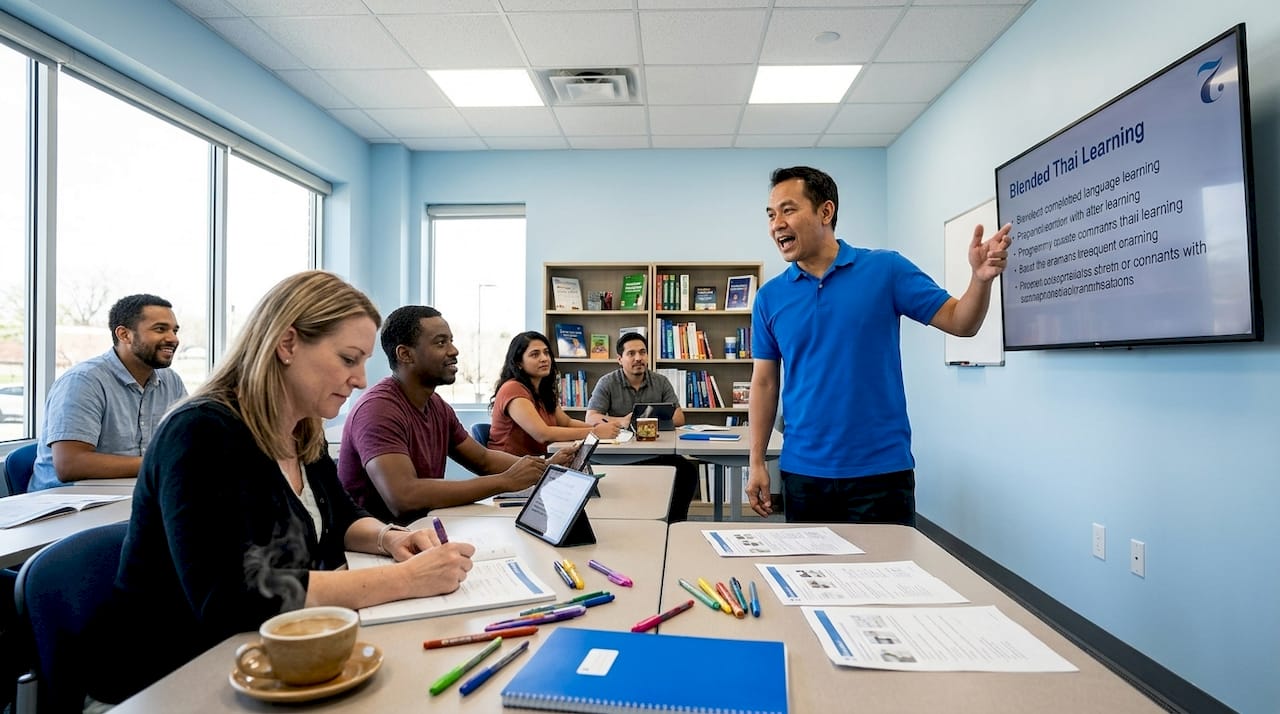
Blended Thai learning pairs scheduled live sessions with self-paced digital study in a single, integrated course. Inlingua Bangkok describes this as weekly in-person or virtual classes combined with online exercises completed between sessions. The two components are not parallel tracks. They are sequenced so each one feeds the other.
A typical structure works like this:
- Online preparation. Before each live session, learners complete grammar exercises, pronunciation drills, and vocabulary modules at their own pace. Platforms use interactive videos, writing assignments, and audio recordings to build foundational accuracy.
- Live session. The scheduled class, whether in-person or via Zoom, focuses entirely on communication. The instructor corrects pronunciation in real time, runs role-plays, and introduces cultural context that no app can replicate.
- Online reinforcement. After the live session, learners revisit new vocabulary, complete listening exercises, and practice writing. This extends the learning window far beyond the classroom hour.
This sequencing is the core of what makes blended learning work. When digital work handles controlled practice, live time is freed up for the kind of spontaneous, culturally rich conversation that builds real fluency. Online language learning components also give learners control over pace, which matters enormously for working adults who cannot always study at fixed hours.
Pro Tip: Set a non-negotiable rule for yourself: complete every online module before the live session, not after. Learners who arrive prepared get three to four times more speaking practice per class hour than those who use live time to catch up on basics.
What evidence supports blended learning’s effectiveness for Thai language acquisition?
The research case for blended learning in Thailand is strong and growing. UNESCO’s 2026 TEOSA initiative equipped 10 pilot schools in Buriram and Si Sa Ket with Smart Classrooms featuring high-speed internet, interactive digital displays, and AI-enabled collaborative platforms. This was not a technology showcase. It was a deliberate infrastructure investment to make blended instruction sustainable at scale.
“Effective blended learning in Thailand depends on comprehensive policy, infrastructure, teacher capacity, and platform support working together.” — UNESCO Thailand
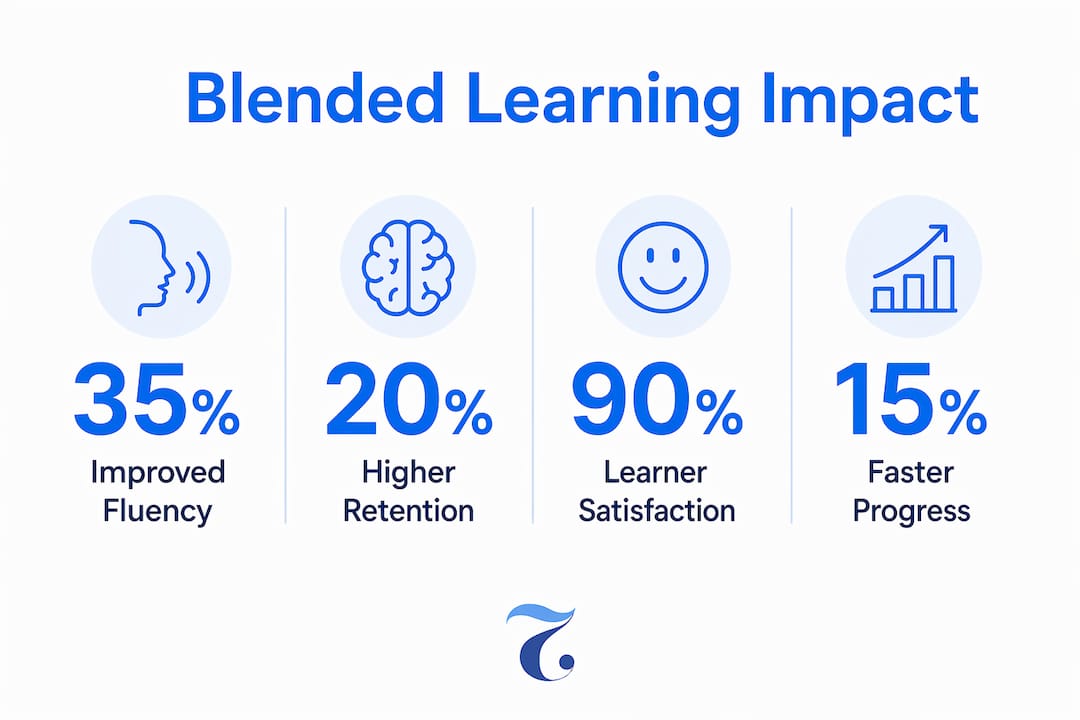
At the classroom level, a 2026 FLEX model study conducted in Thailand found statistically significant gains in critical English reading skills among 55 students who followed a blended program combining online modules with guided discussion sessions. The improvement was measured at the .05 significance level, meaning the results were not due to chance. This matters for Thai language learners because the same cognitive mechanisms that drive reading comprehension in one language transfer directly to another.
A separate 2026 systematic review of blended Business English programs analyzed 16 studies from 2020 to 2025 and confirmed consistent proficiency gains across programs. The review also flagged a critical weakness: many programs lacked standardized assessment frameworks, making it hard to measure speaking and listening progress accurately. This finding points directly to what separates a good blended program from a mediocre one.
| Evidence source | Key finding |
|---|---|
| UNESCO TEOSA pilot, 2026 | 10 Thai schools upgraded with Smart Classrooms and AI tools for blended instruction |
| FLEX model study, Thailand, 2026 | Significant reading skill gains at .05 level with 55 students |
| Systematic review of 16 studies, 2026 | Consistent proficiency gains; assessment standardization identified as critical gap |
| Inlingua Bangkok instructional model | Structured sequencing of digital and live components drives communicative outcomes |
The pattern across all three sources is consistent. Blended learning works when it is designed with intention. Infrastructure, sequencing, and assessment all have to be in place.
What are the key instructional design principles for effective blended Thai courses?
The National Learning Authority states clearly that blended learning must redistribute activities between online and face-to-face modes, not simply layer technology on top of existing teaching. This distinction separates programs that produce fluent speakers from those that produce learners who are good at completing modules.
The principles that define effective blended Thai course design are:
- Intentional sequencing. Online modules cover pronunciation, grammar, and controlled vocabulary practice. Live sessions are reserved for output: speaking, responding, and receiving real-time correction. Reversing this order wastes both formats.
- Live sessions as the output engine. Cultural immersion emerges from deliberately designed target-language interactions in live sessions. Online tasks prepare and reinforce these interactions but cannot replace them. A live instructor who is a bilingual native speaker brings tonal nuance and cultural context that no digital tool currently matches.
- Explicit assessment rubrics. Outcome measurement must include rubrics for speaking, listening, reading, and writing. Tracking module completion alone tells you nothing about whether a learner can hold a conversation in Thai.
- Personalized feedback loops. Effective programs use live sessions to identify individual pronunciation errors or grammar gaps, then assign specific online exercises to address them before the next class.
Pro Tip: When evaluating any blended Thai program, ask one question: “What happens in the live session?” If the answer is “we go through the textbook,” the program is not truly blended. Live time should be 80% speaking and listening, with the instructor responding to what you produce.
A common pitfall is treating the online and live components as separate courses that happen to share a schedule. Learning Thai effectively requires cultural context woven through both formats, not saved for occasional cultural notes at the end of a lesson.
How can adult learners and organizations apply blended Thai learning practically?
Adult learners and corporate teams face a specific challenge: limited time, high expectations, and the need for practical, usable Thai rather than academic proficiency. Blended learning addresses all three when the program is chosen carefully. Here is how to apply it effectively.
- Evaluate the live-to-digital ratio. A program where live instruction accounts for less than 30% of total learning time will struggle to build speaking confidence. Look for programs that schedule live sessions weekly, not monthly.
- Check instructor credentials. Native Thai instructors who are bilingual in Thai and English can explain tonal distinctions and cultural nuance in terms that make sense to English speakers. This is not a minor detail. Thai has five tones, and mispronunciation changes meaning entirely.
- Assess cultural content integration. The best blended programs weave cultural context into every lesson, not just dedicated “culture weeks.” Knowing that the phrase “kin khao reu yang” (have you eaten yet?) is a greeting, not a literal question, is the kind of knowledge that makes conversation feel natural.
- Use flexible scheduling as a feature, not just a benefit. Blended learning offers structured live classes plus flexible online practice, which is the combination working adults need. Schedule your online modules during commute time or lunch breaks, and protect your live session slots as non-negotiable.
- For corporate teams, prioritize remote access with live accountability. A blended program that delivers live Zoom sessions plus asynchronous online work lets geographically distributed teams study together without requiring everyone in the same room. Progress tracking tools allow managers to monitor engagement without micromanaging individual learners.
Combining a blended program with cultural immersion activities, such as Thai cooking classes, film screenings, or conversation exchange meetups, accelerates fluency in ways that coursework alone cannot. The online and live components build the language system. Cultural exposure gives you reasons to use it.
Key takeaways
Blended Thai learning works because it sequences online skill-building and live communicative practice so each format maximizes what the other cannot deliver.
| Point | Details |
|---|---|
| Definition of blended Thai learning | An integrated model combining live instruction and self-paced digital study, not just an app plus occasional class. |
| Sequencing drives results | Online modules handle grammar and pronunciation; live sessions focus on speaking, feedback, and cultural immersion. |
| Research confirms effectiveness | A 2026 FLEX study in Thailand showed significant language skill gains using a blended model with 55 students. |
| Assessment must be explicit | Programs should measure speaking, listening, reading, and writing, not just module completion rates. |
| Adult learners need live accountability | Weekly live sessions with a qualified native instructor are the non-negotiable core of any effective blended program. |
Why I think most learners underestimate the live component
After observing how adult learners approach blended programs, the pattern I see most often is this: people invest heavily in the digital side and treat the live session as optional or secondary. They complete every online exercise, download every vocabulary list, and then show up to class unprepared to speak. The app gave them confidence in recognition. The live session exposes the gap in production.
Thai is a tonal language with a script that has no spaces between words. No algorithm currently corrects your tones with the precision of a native speaker who can hear exactly where your pitch breaks down. The live instructor is not a supplement to the digital course. The live instructor is the reason the digital course works.
I have also seen learners dismiss cultural content as a “nice to have.” This is a mistake. Thai communication is deeply relational. Politeness particles like “krap” and “ka” are not optional formality. They signal respect and social awareness. A blended program that treats language as code to be memorized, without the cultural operating system behind it, produces learners who can read menus but cannot build relationships.
The most promising development in Thailand’s education sector right now is the growing digital infrastructure supporting blended instruction at scale. As connectivity improves and more qualified instructors move into hybrid delivery, the quality ceiling for blended Thai programs will rise significantly. The learners who benefit most will be those who treat live sessions as the core, not the bonus.
— Paul
Start learning Thai with a program built for adults
Thai Explorer’s blended Thai language courses are designed specifically for adult learners in Singapore who need practical, usable Thai for conversation, business, or cultural engagement. Live Zoom sessions with qualified native Thai instructors are the backbone of every course, supported by structured online materials that prepare you for each class and reinforce what you practice.
Corporate training options are available for teams that need flexible scheduling without sacrificing live instruction quality. Whether you are starting from zero or building on existing knowledge, Thai Explorer’s Thai language courses offer a structured path from beginner to confident speaker. The school is located at 10 Anson Road, #22-07, International Plaza, Singapore 079903, right above Tanjong Pagar MRT. Browse the course options for travel and culture to find the format that fits your schedule and goals.
FAQ
What is blended Thai learning in simple terms?
Blended Thai learning combines scheduled live classes, either in-person or via Zoom, with self-paced online study in a single integrated program. The two components are sequenced so online work builds foundational skills and live sessions focus on speaking and real-time feedback.
How is blended learning different from fully online Thai courses?
Fully online courses deliver all instruction digitally, with no scheduled live interaction. Blended learning includes regular live sessions with a qualified instructor, which research shows produces stronger speaking outcomes and deeper cultural understanding than digital-only study.
Does blended learning actually work for Thai language acquisition?
Yes. A 2026 FLEX model study in Thailand found statistically significant improvement in language skills among learners using a blended model, and a systematic review of 16 studies confirmed consistent proficiency gains across blended language programs.
How many live sessions per week does a blended Thai program need?
Weekly live sessions are the standard for effective blended programs. Programs that schedule live instruction less frequently than once a week tend to lose the communicative momentum that makes blended learning superior to self-study alone.
Can corporate teams use blended Thai learning effectively?
Yes. Blended programs that combine live Zoom sessions with asynchronous online modules are well-suited to corporate teams because they allow remote access without removing live accountability. Progress tracking tools help organizations monitor engagement across distributed teams.