
TL;DR:
- Group language classes are live, instructor-led sessions where multiple learners practice speaking, listening, and communication activities simultaneously. They offer real-time feedback, peer motivation, and structured schedules that accelerate language acquisition faster than self-study alone. Selecting a program with small groups, proficiency-based grouping, qualified native instructors, and trial options ensures effective and engaging learning experiences.
A group language class is a live, instructor-led session where a trained teacher guides multiple learners through structured speaking, listening, and communication activities at the same time. This format, used by providers like Berlitz, goFLUENT, and jandc Language School, is the most widely recognized approach to social language acquisition for adults. For anyone considering Thai, understanding how these sessions work, what they deliver, and how to choose the right one makes the difference between slow progress and real conversational confidence.
What is a group language class and how is it structured?
A group language class is defined as a scheduled, teacher-led learning session where multiple students practice a language together through planned activities, guided conversation, and real-time feedback. Unlike self-study apps or recorded video courses, the class happens live, whether in person or via video call, with a qualified instructor directing every part of the lesson.

The structure of a typical session follows a present-practice-perform model. The teacher introduces a grammar point or vocabulary set, learners practice it through exercises and speaking tasks, and then they apply it in a simulated real-world scenario. This three-stage flow is used by programs at Berlitz and goFLUENT because it moves learners from passive understanding to active use within a single session.
Sessions are usually 60 to 90 minutes long and meet two to three times per week. Live group sessions are often paired with self-paced digital modules that learners complete between classes, reinforcing vocabulary and grammar outside of scheduled time. This blended approach means the live class focuses on speaking and interaction, while digital tools handle repetition and review.
For Thai specifically, this structure matters because Thai is a tonal language with a unique script. A trained instructor can catch tonal errors in real time, something no app or workbook can replicate with the same precision.
How do group class sizes affect your learning progress?
Group size is the single most important variable in determining how much speaking practice each learner gets per session. Smaller groups mean more individualized correction, which is essential for rapid improvement in speaking skills.
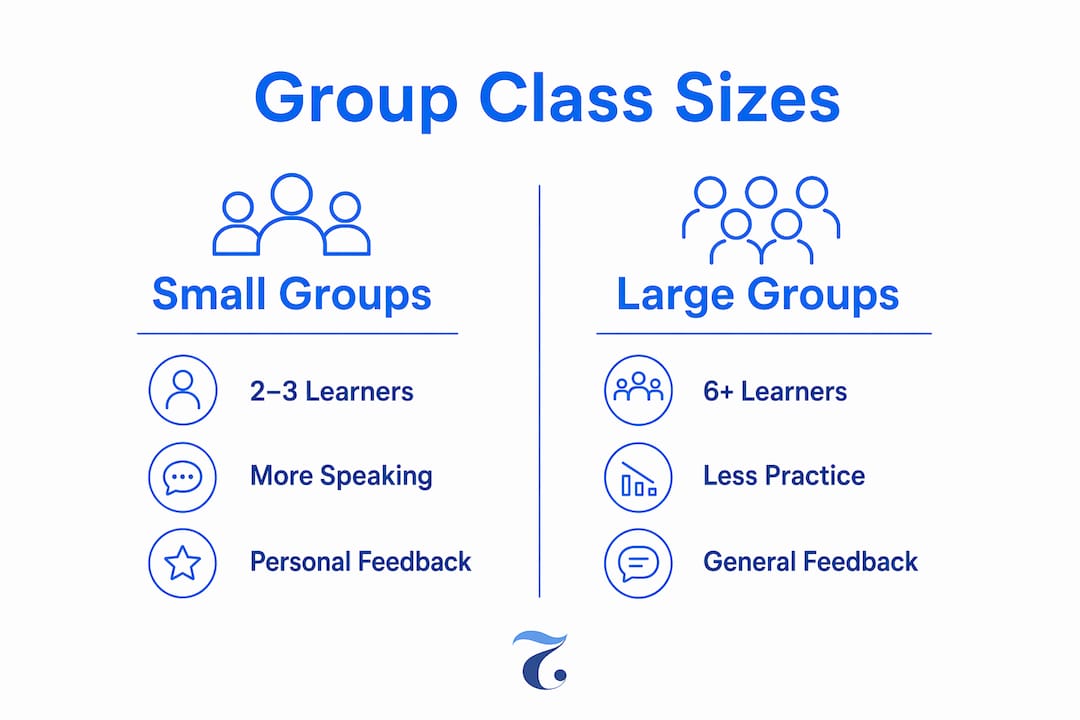
Most adult group language programs fall into two categories. Semi-private classes hold two to three learners and offer a near-private experience with maximum speaking time per person. Standard small groups hold four to eight learners, which balances social interaction with enough individual attention to stay productive. Berlitz caps its online group classes at six students specifically to prevent learners from getting lost in the session. EC English offers a “Mini Group” format with six or fewer students for the same reason.
The level of the group matters just as much as its size. Level-controlled groups ensure that tasks and feedback are matched to actual proficiency, which keeps speaking practice challenging but achievable. When a class mixes beginners with intermediate learners, the teacher is forced to slow down for some and rush past others, and nobody gets the most out of the session.
For Thai learners in Singapore, this means asking two questions before enrolling: how many students are in the class, and how does the school assess and group by level?
Pro Tip: Request a placement assessment before your first class. A good school will test your current level and place you in a group where the pace and content match your actual ability, not just your self-reported experience.
What are the benefits of group language classes compared to self-study?
Group language classes deliver benefits that self-study and even private lessons cannot fully replicate. The core advantage is live peer interaction, which forces learners to produce language under realistic social conditions rather than in isolation.
The key advantages of group learning include:
- Peer motivation. Classmates create accountability. When others show up and make progress, you are more likely to do the same.
- Real-time correction. A trained instructor catches errors in pronunciation, grammar, and tone the moment they occur, preventing bad habits from forming.
- Structured schedules. Fixed class times build a consistent study habit, which is the foundation of long-term language retention.
- Speaking confidence. Practicing in front of peers in a low-stakes environment reduces the fear of speaking that holds many adult learners back.
- Cost efficiency. Group classes are significantly more affordable than private Thai lessons, making consistent attendance financially sustainable over months of study.
“Peer motivation and real-time interaction accelerate learning by creating a supportive environment that lessens speaking fear.” — Lingeda
The fixed schedules with trained mentors improve learner commitment and discipline compared to self-study. This is not a minor benefit. Most adults who attempt language learning through apps or textbooks alone abandon the effort within weeks because there is no external structure holding them to a schedule.
Pro Tip: Treat your group class time like a work meeting. Block it in your calendar, show up prepared, and review your notes within 24 hours. The learners who progress fastest are the ones who treat class attendance as non-negotiable.
What types of activities happen in a group language class?
Group language class activities are designed to simulate real communication rather than test memorization. The goal is always to get learners speaking, responding, and thinking in the target language as quickly as possible.
Common activities in group classes include role plays, vocabulary quizzes, guided conversations, and structured discussions. For Thai learners, these activities are built around practical scenarios: ordering food, navigating transportation, introducing yourself in a business setting, or discussing Thai cultural events.
Here is how a typical Thai group class session might unfold:
- Warm-up conversation. The instructor opens with a short Thai dialogue or question to activate vocabulary from the previous session.
- New language input. A grammar point or vocabulary set is introduced, explained in both Thai and English, and demonstrated with examples.
- Pair or group practice. Learners practice the new language with each other through structured tasks, with the instructor monitoring and correcting.
- Role play or simulation. The class applies the lesson in a realistic scenario, such as booking a hotel room or asking for directions in Bangkok.
- Feedback and review. The instructor addresses common errors from the session and previews what comes next.
Immersive teaching methods, where the instructor speaks primarily in Thai during practice segments, are used to push learners past the habit of mentally translating every sentence. This approach, combined with interactive Thai lessons that blend cultural context with language practice, builds the kind of instinctive fluency that textbook study alone cannot produce.
Digital modules assigned between sessions reinforce the vocabulary and structures from each class. goFLUENT, for example, integrates live group sessions with online exercises that learners complete independently, extending practice time without requiring additional live instruction hours.
How to choose the right group language class for learning Thai
Choosing the right group class requires matching the program’s structure to your specific goals, schedule, and learning style. Not every group class is built the same way, and the wrong choice wastes both time and money.
When evaluating a group Thai language program, consider these factors:
- Group size. Prioritize programs with six or fewer students per class. Larger groups reduce your speaking time and limit how much individual feedback you receive.
- Level grouping. Confirm that the school uses placement assessments to group learners by proficiency. Avoid programs that mix levels in the same session.
- Class frequency. Two to three sessions per week is the minimum for building momentum. Once a week is rarely enough for adults with no prior exposure to Thai.
- Instructor qualifications. Look for native Thai speakers who are also bilingual in English. This combination allows clear explanations without sacrificing authentic pronunciation modeling.
- Online vs. in-person. Online group classes via Zoom or similar platforms offer flexibility without sacrificing live interaction. In-person classes add physical presence and spontaneous conversation, but require commuting. Both formats work well when the group size and instructor quality are right.
- Curriculum alignment. Programs aligned with recognized standards, such as the CU-TFL (Chulalongkorn University Proficiency Test of Thai as a Foreign Language), give you a clear progression path and measurable milestones.
- Trial options. A school confident in its program will offer a trial class or placement session. Use it to assess the instructor’s teaching style, the group dynamic, and whether the pace suits you.
For learners in Singapore, the right Thai language class is one that fits your weekly schedule, keeps groups small, and connects language learning to real cultural context rather than drilling grammar in isolation.
Key takeaways
Group language classes work because they combine live instruction, peer interaction, and structured schedules into a format that builds speaking confidence faster than self-study alone.
| Point | Details |
|---|---|
| Core definition | A group language class is a live, teacher-led session with multiple learners practicing together. |
| Optimal group size | Classes with six or fewer students give each learner more speaking time and direct feedback. |
| Level grouping matters | Proficiency-matched groups keep tasks relevant and correction precise for every learner. |
| Benefits over self-study | Peer motivation, real-time correction, and fixed schedules build habits that apps cannot replicate. |
| Choosing the right class | Evaluate group size, instructor qualifications, curriculum standards, and trial class availability. |
Why group classes changed how I think about language learning
I used to believe that private lessons were the gold standard for language learning. More teacher time, more personalized feedback, faster results. That logic sounds right until you actually sit in a well-run group class and watch what happens.
The moment a classmate makes a mistake you were about to make yourself, and the instructor corrects it in front of everyone, the lesson lands differently. You did not just hear the correction. You felt the near-miss. That kind of learning sticks in a way that a private correction in a one-on-one session rarely does, because there is no social dimension to anchor it.
What I have also observed is that the fear of speaking in front of others, which most adult learners cite as their biggest obstacle, dissolves faster in a group than in private lessons. In a private class, every silence is between you and the teacher. In a group, someone else fills the gap. That breathing room gives nervous learners the time to formulate a response without the pressure of being the only person in the room.
The blended format, live classes paired with digital practice between sessions, is where I have seen the most consistent progress. Learners who only attend live sessions without reviewing between classes plateau quickly. Those who treat the digital modules as part of the same commitment as attending class move through levels noticeably faster.
My honest advice: do not choose a group class based on price alone. Choose it based on group size, instructor quality, and whether the school actually tests your level before placing you. Those three factors predict outcomes more reliably than anything else.
— Paul
Start learning Thai with Thai Explorer’s group classes
Thai Explorer offers structured adult Thai group classes in Singapore, available both in person at International Plaza above Tanjong Pagar MRT and online via Zoom. Classes are kept small to maximize speaking time, and all sessions are led by qualified native Thai instructors who are bilingual in Thai and English.
The curriculum follows the CU-TFL framework, giving learners a clear progression from beginner to advanced levels with measurable outcomes at every stage. Whether your goal is conversational Thai for travel, cultural connection, or professional use, Thai Explorer’s adult Thai courses are designed to get you speaking with confidence from the first session. Explore the full range of Thai language courses and find the format that fits your schedule and goals.
FAQ
What is a group language class exactly?
A group language class is a live, instructor-led session where multiple learners practice a language together through structured activities, guided conversation, and real-time feedback from a trained teacher.
How many students are typically in a group language class?
Most adult group language programs hold between two and eight students per class. Berlitz limits online groups to six learners, while EC English’s Mini Group format also caps at six to maximize speaking time per student.
Are group language classes better than private lessons?
Group classes offer peer interaction, social accountability, and lower cost, while private lessons provide more personalized instruction. For most adult beginners, group classes build speaking confidence faster because of the social practice environment.
What activities are common in a group language class?
Typical activities include role plays, vocabulary quizzes, guided conversations, and real-life simulations. For Thai learners, these scenarios often cover practical situations like ordering food, traveling, or professional introductions.
Can I take group Thai language classes online?
Yes. Online group Thai classes delivered via Zoom or similar platforms provide the same live interaction and instructor feedback as in-person sessions, with the added flexibility of joining from any location.