
TL;DR:
- Proficiency in Thai language is essential for effective communication, trust-building, and navigating hierarchy in Thailand’s business environment. Learning Thai enhances relationship management, facilitates market entry, and provides a competitive advantage in Southeast Asia. Structured programs with native instructors can achieve functional fluency within six to twelve months.
The role of Thai in business is the foundation for effective communication, trust-building, and cultural fluency in Thailand’s commercial environment. Thai is not simply a spoken language. It is a system of social signals that tells your counterpart exactly where you stand in the relationship. For entrepreneurs and business professionals targeting Southeast Asian markets, understanding how Thai language and culture intersect is the difference between a deal that closes and one that quietly disappears.
Thailand’s economy is deeply relational. The country’s bilateral trade with China exceeded US$147.8 billion in 2025, growing 15.1% year on year. That scale of commerce does not happen through translators alone. It happens through professionals who understand what is said, what is implied, and what is deliberately left unspoken.

How does thai language proficiency affect business communication?
Thai language proficiency directly determines how clearly you communicate, negotiate, and build relationships in Thai commercial settings. The language is not phonetically or grammatically similar to English, and that gap creates real friction for unprepared professionals.
One of the most common obstacles is Tinglish, a hybrid form of communication that blends English vocabulary into Thai grammatical structures. English words alone will not help you follow a business conversation built on Thai syntax and transitional particles. A professional who relies on English fluency in a Thai meeting room will miss the connective tissue of the conversation.
Hierarchy shapes every exchange. Formal titles and pronouns are not optional courtesies. They are functional tools. In traditional business environments, the formal pronoun “Than” signals respect for seniority. Using casual address in the wrong setting can stall a process before it begins. Startups may tolerate informal registers, but established Thai firms and government-linked organizations do not.
Written communication carries equal weight. Formulaic phrases in Thai business emails are critical for sales promotions, account statements, and client management. Mastery of these rhetorical patterns directly supports revenue generation. An email that reads as blunt or imprecise in Thai signals cultural inexperience, regardless of how polished the English version might be.
Key communication gaps that Thai proficiency closes:
- Indirect feedback: Thai colleagues rarely say “no” directly. Language skills help you read polite deflection for what it is.
- Meeting dynamics: Silence in a Thai meeting often signals disagreement, not agreement. Knowing this prevents costly misreads.
- Promotional language: Thai marketing copy follows specific tonal and structural conventions that direct translation destroys.
- Email etiquette: Opening and closing phrases in Thai business correspondence follow established formulas that signal professionalism.
Pro Tip: Learn the five most common polite sentence-ending particles in Thai before your first client meeting. These small additions signal respect and dramatically change how your Thai counterparts perceive your communication style.
What cultural values linked to thai language shape business etiquette?
Thai business culture is built on two foundational concepts: Kreng Jai and Nâa (Face). Both are expressed through language, and both determine whether a business relationship advances or stalls.
Kreng Jai is the cultural instinct to avoid causing discomfort or embarrassment to another person. In practice, it means Thai colleagues will often agree verbally while disagreeing internally. Over 60% of expat managers in Thailand initially struggle to get direct feedback from their teams because of this dynamic. The solution is not to push harder for directness. The solution is to create informal channels where honest input can surface without threatening anyone’s Face.
Nâa, or Face, governs public perception and social standing. Criticizing a colleague or partner in front of others is one of the fastest ways to permanently damage a business relationship in Thailand. Language proficiency helps you recognize when a conversation is approaching dangerous territory and redirect it before Face is lost.
“In Thai business culture, actual decisions are made informally before meetings to avoid face loss during formal gatherings. Decision-making is consensus-driven outside formal contexts.” — Thai business decision-making
This insight reshapes how you should approach every formal meeting. The real negotiation happens over dinner, in a side conversation, or through a trusted intermediary. If you arrive at the formal meeting expecting to negotiate, you are already behind.
Hierarchy governs the structure of every interaction. Seniority determines speaking order, seating arrangements, and who receives direct communication. Understanding Thai business etiquette around business cards illustrates this clearly. Cards must be exchanged with both hands, received with visible attention, and never written on in the other person’s presence. Writing on a card signals that you view it as scrap paper, not as a representation of the person’s professional identity.
How Thai cultural values show up in daily business practice:
- Hierarchy in meetings: The most senior person speaks first and sets the tone. Interrupting or speaking over them is a serious misstep.
- Indirect disagreement: A smile paired with silence often means “no.” A Thai professional who says “we will consider it” is frequently closing the door politely.
- Relationship before transaction: Thai business partners expect social investment before commercial discussion. Rushing to the deal signals disrespect.
- Language register: Switching between formal and informal Thai without reading the room signals poor cultural judgment.
Western business culture prizes directness and speed. Thai business culture prizes harmony and patience. Professionals who understand this contrast through Thai culture and etiquette stop misreading politeness as agreement and start building relationships that actually convert.
How does thai language mastery support market penetration?
Thai language skills produce measurable commercial advantages. The most direct is trust. A foreign professional who speaks Thai, even at a functional level, signals long-term commitment to the market. That signal matters enormously in a culture where relationships precede transactions.
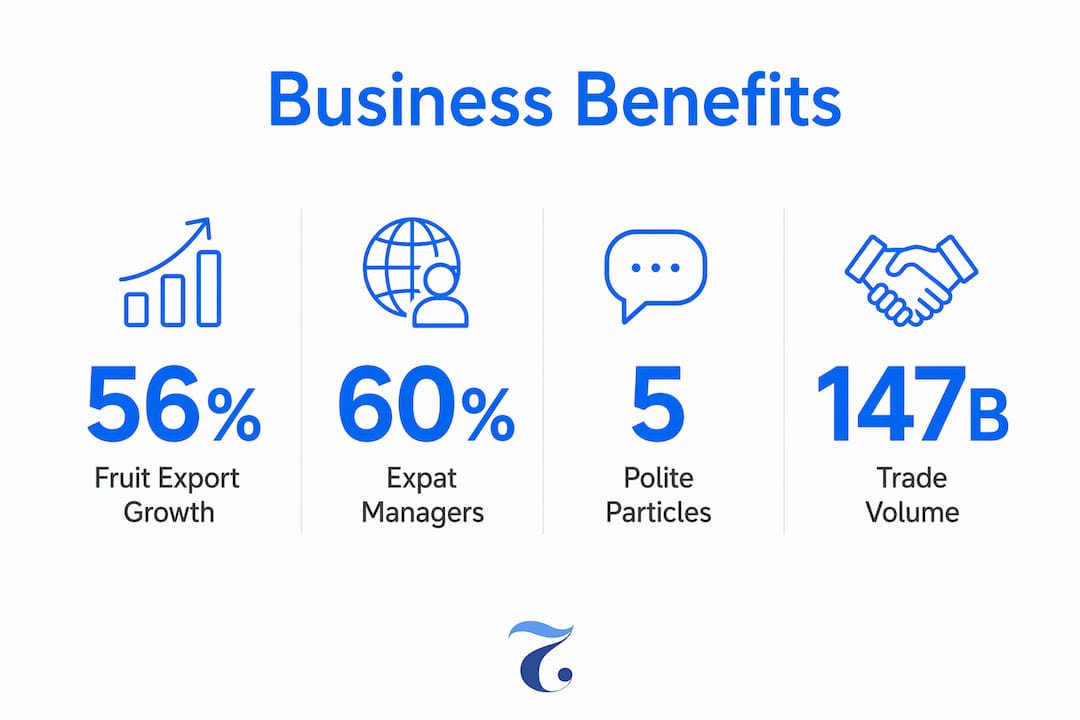
Thailand’s export sector demonstrates the commercial stakes. Thai fresh fruit exports surged 56.24% year on year in 2026, generating 22.285 billion Baht in revenue, with China accounting for 80–88% of that market. This growth was driven by digital marketing and supply-chain diplomacy, both of which require precise, culturally calibrated communication. Professionals who can operate in Thai have a direct advantage in these high-value trade corridors.
| Business Outcome | Without Thai Language Skills | With Thai Language Skills |
|---|---|---|
| Negotiation clarity | Relies on interpreters; nuance is lost | Direct communication; tone and intent preserved |
| Relationship building | Slow; perceived as transactional | Faster; signals cultural respect and commitment |
| Feedback quality | Filtered; indirect signals missed | Richer; informal channels accessible |
| Market entry speed | Delayed by cultural misreads | Accelerated by trust and local credibility |
| Email and written communication | Generic; misses rhetorical conventions | Precise; follows Thai professional norms |
Customer retention also improves with language competency. Thai consumers and partners respond to communication that reflects their cultural values. A pitch delivered in Thai, even imperfectly, carries more relational weight than a polished English presentation delivered through a translator.
Talent management is another underappreciated benefit. Multinational firms operating in Thailand report that managers who speak Thai build stronger teams. A study on Thai employees in Japanese firms found that professional communication needs scored a mean of 4.09 out of 5, with listening rated the most critical skill at a mean of 4.40. Managers who meet their teams in Thai close that gap directly.
Pro Tip: When entering a new Thai business partnership, invest in at least one formal dinner conducted primarily in Thai before any contract discussion. The relationship capital you build in that setting will outlast any legal document.
What are the best strategies for business professionals to learn thai?
Functional Thai for business is achievable within a structured learning program. The key is choosing a format that matches your professional schedule and learning goals.
-
Enroll in a structured adult course. Programs aligned with the CU-TFL (Chulalongkorn University Proficiency Test of Thai as a Foreign Language) standard cover speaking, listening, reading, and writing in a sequenced curriculum. This gives you a measurable benchmark for progress rather than informal exposure.
-
Choose native Thai instructors who are bilingual. A bilingual native speaker can explain cultural context in English while modeling authentic Thai communication. This combination is far more effective than a non-native teacher or an immersion-only approach that leaves cultural questions unanswered.
-
Prioritize business-specific vocabulary from day one. General conversational Thai and business Thai overlap, but professional registers require specific vocabulary for meetings, emails, negotiations, and formal introductions. Ask your program to weight these areas early.
-
Use online Zoom classes to maintain consistency. Travel schedules and project demands make in-person attendance unpredictable. Online classes remove that barrier. You can maintain weekly practice from Bangkok, Singapore, or anywhere with a stable connection.
-
Request corporate training for your team. If you manage a team that interacts with Thai partners or clients, group training builds shared cultural vocabulary. It also signals organizational commitment to the Thai market, which your partners will notice.
-
Practice in real business contexts between lessons. Write one email per week in Thai. Attend one meeting where you open with a Thai greeting and use formal titles. Small consistent applications accelerate fluency faster than classroom hours alone.
Learning Thai communication skills for professional use is not a years-long project. With the right structure and native instruction, a business professional can reach functional proficiency in six to twelve months of consistent study.
Key takeaways
Thai language proficiency is the single most effective tool for building trust, navigating hierarchy, and achieving commercial success in Thailand’s relationship-driven business environment.
| Point | Details |
|---|---|
| Language shapes every interaction | Thai pronouns, titles, and registers signal respect and determine how partners perceive your professionalism. |
| Kreng Jai and Face govern communication | Over 60% of expat managers struggle with indirect feedback; understanding these concepts prevents costly misreads. |
| Decisions happen before meetings | Pre-meeting consensus is standard in Thai business culture; formal meetings confirm, not negotiate. |
| Language skills accelerate market entry | Thai proficiency builds trust faster, improves customer retention, and strengthens team management. |
| Structured learning delivers results | CU-TFL-aligned programs with native bilingual instructors provide the fastest path to business-ready Thai fluency. |
Why i think most professionals underestimate thai language strategy
Most foreign professionals entering Thailand treat language as a logistics problem. They hire a translator, add a bilingual local to the team, and consider the communication issue solved. That approach works for contracts. It fails for relationships.
What I have observed repeatedly is that the real commercial decisions in Thailand happen in spaces where translators are not present. A side conversation at dinner. A phone call between a Thai partner and their senior colleague after your formal meeting ends. A casual exchange before the room fills. If you are not in those conversations, you are not in the decision.
The indirect communication style that frustrates so many Western professionals is not a barrier. It is a signal. When a Thai counterpart deflects, qualifies, or goes quiet, they are communicating something precise. The professionals who learn to read those signals gain access to information that never appears in meeting notes.
I also think the patience required by Thai business culture is undervalued as a commercial strategy. Harmony preservation is not inefficiency. It is relationship maintenance. The deal that takes three months longer to close in Thailand often lasts three times longer than a fast Western-style transaction. That math matters when you are building a regional presence, not just closing a single contract.
Cultural intelligence is not a soft skill in Southeast Asia. It is a revenue driver.
— Paul
Build your thai language skills for business with thai explorer
Thai Explorer is a leading Thai language school in Singapore, offering adult conversational and business Thai courses designed for professionals who need practical, real-world fluency. Whether you are preparing for client meetings in Bangkok, managing a Thai team, or entering the Thai market for the first time, the structured curriculum at Thai Explorer gives you the language and cultural tools to operate with confidence.
Classes are available in group, private, and online Thai course formats via Zoom, so your schedule does not limit your progress. Corporate training programs are also available for teams that need shared language and cultural competency. All lessons are taught by qualified native Thai instructors who are bilingual in Thai and English, based at 10 Anson Road, #22-07, International Plaza, Singapore 079903, right above Tanjong Pagar MRT. Explore the full range of Thai language courses and find the program that fits your professional goals.
FAQ
What is the role of thai in business communication?
Thai is the primary language of professional relationship-building, hierarchy signaling, and negotiation in Thailand’s commercial environment. Proficiency allows professionals to communicate directly, read indirect signals, and build trust with Thai partners and clients.
How does kreng jai affect business dealings in thailand?
Kreng Jai is a cultural value that discourages direct disagreement to preserve harmony. Over 60% of expat managers in Thailand initially struggle to receive direct feedback because of it, requiring informal channels to surface honest input.
Why do formal titles matter in thai business settings?
Thai business communication relies on correct pronouns and titles to signal respect for hierarchy. Using the wrong register in a traditional firm can stall decisions and damage professional credibility before a relationship is established.
How long does it take to reach business-level thai proficiency?
With a structured program using native bilingual instructors and consistent weekly practice, most adult learners reach functional business Thai proficiency within six to twelve months.
Is thai language training worth it for short-term market entry?
Yes. Even basic Thai proficiency signals long-term commitment to Thai partners, accelerates trust-building, and reduces the communication gaps that cause deals to stall or fail during early-stage market entry.