
TL;DR:
- Customizing Thai lessons involves tailoring your curriculum, tools, and schedule to meet your specific language goals and learning style. Defining precise objectives, assessing your current skills, and considering your available time are essential steps for effective personalization. Using a combination of private tutoring and targeted resources supports faster fluency, cultural understanding, and practical communication skills.
Customizing Thai lessons is defined as the process of aligning your curriculum, tools, and practice schedule with your specific language goals, lifestyle, and learning style. Generic group classes teach everyone the same content at the same pace. Personalized Thai language lessons, by contrast, let you focus on corporate vocabulary if you work with Thai partners, or on travel phrases if you are heading to Bangkok. Thai Explorer, HelloTalk, and the Ling App all offer resources that support this kind of tailored approach. The result is faster fluency, stronger motivation, and lessons that feel immediately useful.
How to customize Thai lessons: start with your goals
The single most important step in building custom Thai lesson plans is defining exactly what you want to achieve before you open a textbook or book a tutor.

Identify your primary use case
Your goal shapes every decision that follows. A professional negotiating contracts in Bangkok needs different vocabulary than a traveler ordering food in Chiang Mai. A cultural enthusiast studying Thai cinema has different priorities than someone preparing for the CU-TFL (Chulalongkorn University Proficiency Test of Thai as a Foreign Language). Write your goal in one sentence before you do anything else.
Common use cases for adult learners include:
- Conversational fluency for social situations, dating, or living in Thailand
- Business Thai for meetings, emails, and professional networking
- Travel Thai for navigation, shopping, and hospitality interactions
- Cultural immersion for understanding Thai media, literature, and etiquette
Assess your current skill level honestly
Knowing where you stand prevents wasted time. If you already recognize some spoken Thai from travel, you can skip basic phonetic drills and move directly to vocabulary building. If you are starting from zero, your first month should focus entirely on tones and pronunciation. Rate yourself across four skills: speaking, listening, reading, and writing. Most adult learners find speaking and listening are the highest priorities, which directly affects how you structure your individualized Thai learning strategy.
Factor in your schedule
Time availability is not a secondary concern. It is a design constraint. Learners who communicate specific goals upfront enable tutors to deliver highly relevant content rather than generic sequences. If you have 20 minutes per day, your plan looks very different from someone with two hours on weekends. Be honest about your real schedule, not your ideal one.
Pro Tip: Write three sentences describing your goal, your current level, and your weekly time budget. Hand this to any tutor or platform before your first session. It immediately filters out irrelevant content.
What tools and resources enable effective Thai lesson customization?
The right tool depends on your goal, budget, and preferred learning style. No single resource does everything well.
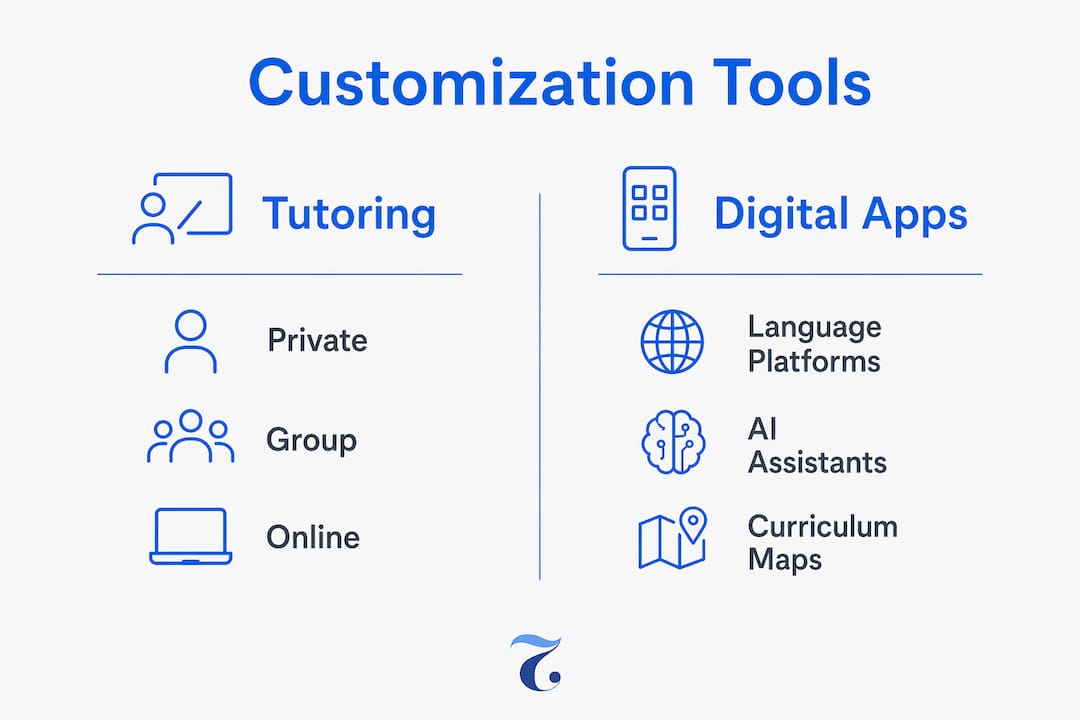
Private tutoring vs. platforms vs. apps
Private tutoring is the most effective way to customize Thai lessons because it adapts to your vocabulary needs and learning speed in real time. A tutor can pivot mid-lesson if you are struggling with tones, or skip ahead if you already know a topic. Group classes cannot do this.
| Tool | Best for | Customization level | Cost range |
|---|---|---|---|
| Private tutor | Professionals, fast-track learners | Very high | From $5/hour (basic) upward |
| Online platforms (Zoom lessons) | Flexible schedules, remote learners | High | Moderate |
| Apps (Ling, HelloTalk) | Supplementary practice, vocabulary | Medium | Low to free |
| YouTube channels, podcasts | Passive listening, cultural context | Low | Free |
Tutoring rates start at approximately $5 per hour for basic conversation practice, with professional instruction priced higher depending on the instructor’s qualifications and session structure. That price gap reflects a real difference in outcome quality.
Using AI and curriculum maps
A structured curriculum map detailing topics, prerequisites, and your performance is necessary for genuinely personalized learning. Without one, your study plan is guesswork. AI tools can generate a draft curriculum map if you feed them your goal, current level, and weekly hours. You then refine it with your tutor. Think of AI as the planner and your tutor as the executor.
Supplementary resources worth adding to any custom plan include:
- HelloTalk for real-time conversation practice with native speakers
- Ling App for structured vocabulary and tone exercises
- Thai-language YouTube channels focused on your niche (cooking, business, travel)
- Vocabulary worksheets built around your specific topic areas
Pro Tip: Do not use more than two apps at the same time. Spreading attention across five platforms creates the feeling of progress without actual retention. Pick one primary tool and one supplementary tool.
How to design and execute a personalized Thai learning plan
A plan without structure collapses within two weeks. Follow these steps to build one that holds.
-
Build your curriculum map first. List the topics you need to cover, rank them by priority, and identify what you already know. This map becomes the backbone of every session.
-
Start with phonetics, not script. Phonetic systems are recommended for the first one to two months before introducing Thai script. Starting with reading Thai characters creates a bottleneck that slows speaking confidence. Get your mouth working before your eyes.
-
Use short daily sessions tied to real contexts. Daily sessions of 10–15 minutes focused on real-life scenes help beginners achieve conversational confidence in eight weeks. Ten focused minutes beats one unfocused hour.
-
Integrate tones inside sentences, not in isolation. Tonal practice is most effective when embedded within phrases and sentences. Practicing tones as abstract musical notes disconnects them from meaning. Say “I want coffee” with the correct tones, not just the word “coffee” five times.
-
Add culture from week one. Thai language usage is inseparable from social hierarchy, politeness, and cultural context. Knowing the word for “you” is not enough. You need to know which form of “you” to use with your boss versus your friend. Build cultural fluency into your plan from the start.
-
Balance intensive tutoring with passive practice. Private tutoring demands constant engagement and can be mentally exhausting. Pair it with low-effort listening activities like Thai podcasts or TV shows to give your brain recovery time without stopping input.
| Phase | Focus | Duration |
|---|---|---|
| Phase 1 | Phonetics, tones, basic greetings | Weeks 1–4 |
| Phase 2 | Core vocabulary for your use case | Weeks 5–10 |
| Phase 3 | Sentence building, cultural context | Weeks 11–16 |
| Phase 4 | Fluency practice, script introduction | Week 17 onward |
Pro Tip: Track your sessions in a simple spreadsheet. Log the topic, what you struggled with, and one thing you want to revisit. This data makes your next session with a tutor far more productive.
What are common mistakes when customizing Thai lessons?
Personalized plans fail for predictable reasons. Knowing them in advance keeps you on track.
The most common mistake is overloading the plan. Adult learners often schedule two hours of study per day in week one, then drop to zero by week three. Set a daily minimum you can hit even on your worst day. Fifteen minutes is better than zero.
A second mistake is fixating on Thai script too early. The script is beautiful and worth learning. It is also a significant cognitive load for new learners. Delaying script study for the first one to two months prevents beginner bottlenecks and increases early speaking confidence. You can read menus later. Speak first.
A third mistake is practicing tones in isolation. Drilling tones as abstract sounds trains your ear for a test, not for conversation. Integrate them into real phrases from day one. Your brain learns patterns, not rules.
“Modern Thai teachers act more as learning facilitators and cultural mediators than just grammar correctors.” Journal of Asian Language Teaching and Learning
This matters because it reframes what you should expect from a tutor. Your instructor is not there to drill you on verb conjugations. They are there to help you communicate in real Thai contexts. If your sessions feel like grammar tests, tell your tutor to shift the focus.
- Avoid vague goals. “I want to speak Thai” is not a goal. “I want to order food and negotiate prices in a Thai market by August” is.
- Avoid skipping feedback. Short lessons with clear progress tracking promote long-term retention. Ask your tutor for specific corrections, not just encouragement.
- Avoid changing your plan every two weeks. Consistency compounds. Give any approach at least four weeks before judging its results.
Pro Tip: Tell your tutor your exact goal in the first session and ask them to redirect you whenever the lesson drifts off topic. Most tutors appreciate the clarity and will deliver better sessions as a result.
Key takeaways
The most effective way to customize Thai lessons is to define a specific goal, build a phased curriculum map, and pair private tutoring with short daily practice sessions tied to real-life contexts.
| Point | Details |
|---|---|
| Define your goal first | Identify your use case (travel, business, conversational) before selecting any tool or tutor. |
| Start with phonetics | Delay Thai script for the first one to two months to build speaking confidence faster. |
| Use a curriculum map | A structured map with topics and performance tracking makes personalized plans effective, not guesswork. |
| Integrate tones in context | Practice tones inside full sentences and phrases, not as isolated sounds. |
| Balance intensity | Pair private tutoring with passive listening to prevent mental fatigue and maintain consistency. |
What I have learned from watching learners personalize their Thai study
After working with adult learners across conversational, business, and travel Thai goals, one pattern stands out clearly. The learners who progress fastest are not the ones with the most study hours. They are the ones who communicate most clearly with their tutors about what they actually need.
I have seen professionals arrive with a vague goal of “learning Thai for work” and spend three months on content that never appears in their actual job. I have also seen travelers who told their tutor exactly which situations they needed to handle, and those learners were holding real conversations within six weeks. The difference was not talent. It was specificity.
Technology should support but not replace the teacher’s guidance in personalized Thai learning. Apps like Ling and HelloTalk are genuinely useful for vocabulary reinforcement and low-pressure practice. But they cannot read your confusion, adjust their tone, or explain why a phrase sounds rude in one context and polite in another. A qualified native Thai teacher does all three.
My honest advice: spend 30 minutes writing your learning profile before you book a single lesson. Document your goal, your schedule, your current level, and the three situations where you most need to use Thai. That document is worth more than any app subscription.
— Paul
How Thai Explorer supports your personalized Thai learning
Thai Explorer offers private, group, and online Thai courses designed for adult learners with specific goals in Singapore and beyond. Whether you are building business Thai for professional settings, conversational Thai for travel, or cultural fluency for personal growth, the school’s qualified native instructors adapt every lesson to your needs.
Private lessons at Thai Explorer give you direct control over your curriculum, pace, and focus areas. Group classes provide structured progression with cultural immersion built in. Online sessions via Zoom make it easy to learn from anywhere. Explore the full range of Thai language courses or go straight to private Thai lessons to start building a plan that fits your exact goals. Thai Explorer is located at 10 Anson Road, #22-07, International Plaza, Singapore 079903, right above Tanjong Pagar MRT.
FAQ
What is the fastest way to customize Thai lessons for beginners?
Define your specific goal first, then work with a private tutor to build a curriculum map around that goal. Short daily sessions of 10–15 minutes focused on real-life contexts can build conversational confidence in eight weeks.
Should I learn Thai script before speaking?
No. Experts recommend focusing on phonetics and spoken Thai for the first one to two months before introducing the script. This approach prevents early bottlenecks and builds speaking confidence faster.
How much does a private Thai tutor cost?
Basic tutoring starts at approximately $5 per hour for conversation practice, with professional instruction priced higher depending on qualifications and lesson structure. Online private lessons often offer more flexible pricing than in-person sessions.
How do I keep my personalized Thai plan on track?
Track every session with a short note on what you covered and what you struggled with. Share this log with your tutor so each lesson builds directly on the last. Consistency in short daily sessions outperforms sporadic long study blocks.
Can I learn Thai effectively without a tutor?
Apps like Ling and HelloTalk support vocabulary and tone practice independently. However, a qualified tutor provides cultural context, real-time correction, and curriculum adjustments that no app currently replicates for serious learners.