TL;DR:
- Active learning in language involves producing and recalling language consistently through speaking, writing, and retrieval tasks. It significantly boosts fluency and retention compared to passive recognition alone.
Active learning in language is defined as the deliberate practice of producing and recalling language through speaking, writing, and active retrieval, rather than passively receiving input. Research shows that active engagement doubles fluency gains compared to passive recognition strategies alone. This distinction matters enormously for adult learners and educators. Techniques like Think-Pair-Share, retrieval warm-ups, and Jigsaw learning are not classroom novelties. They are research-backed methods that rewire how the brain stores and accesses a new language. Whether you study Thai for travel, business, or personal growth, understanding this approach changes how you learn.
What is active learning in language, and why does it matter?
Active learning in language acquisition is the instructional approach where learners participate directly in knowledge-making rather than passively receiving content. A student who listens to a Thai vocabulary explanation is receiving input. A student who immediately uses those words in a spoken sentence is actively learning. The difference in outcome is significant.

The formal term used in applied linguistics and pedagogy is active language learning, sometimes called learner-centered instruction. Both terms describe the same core principle: the learner must produce, not just observe. This production forces the brain to retrieve, organize, and apply language in real time.
The importance of active learning extends beyond test scores. Learners who produce language regularly build faster recall, stronger pronunciation habits, and greater confidence in real conversations. For adult learners studying Thai in Singapore, this means the difference between recognizing a phrase and actually using it at a market in Bangkok or in a business meeting.
Educators benefit equally. When teachers shift from lecturing to facilitating, they gain immediate feedback on what students understand. That feedback loop makes lessons more efficient and more targeted.
What are common active learning methods for language learners?
Active learning methods range from simple classroom techniques to structured instructional frameworks. The most widely used include Think-Pair-Share, retrieval warm-ups, Jigsaw learning, and exit tickets. These techniques require minimal resources but consistently produce stronger critical thinking and engagement than passive instruction.
Here is how each method works in a language learning context:
- Think-Pair-Share: The teacher poses a question in the target language. Each learner thinks independently for 60–90 seconds, then pairs with a partner to compare answers, then shares with the group. This forces every learner to produce language, not just the confident few.
- Retrieval warm-ups: At the start of class, learners spend 3–5 minutes recalling vocabulary or grammar from the previous lesson without notes. This low-stakes recall strengthens long-term memory far more than re-reading notes.
- Jigsaw learning: Each learner becomes an “expert” on one piece of content and teaches it to peers. Teaching a concept in the target language is one of the most demanding and effective production tasks available.
- Exit tickets: At the end of a lesson, learners write one sentence summarizing what they learned in Thai. The teacher reads these before the next class to identify gaps.
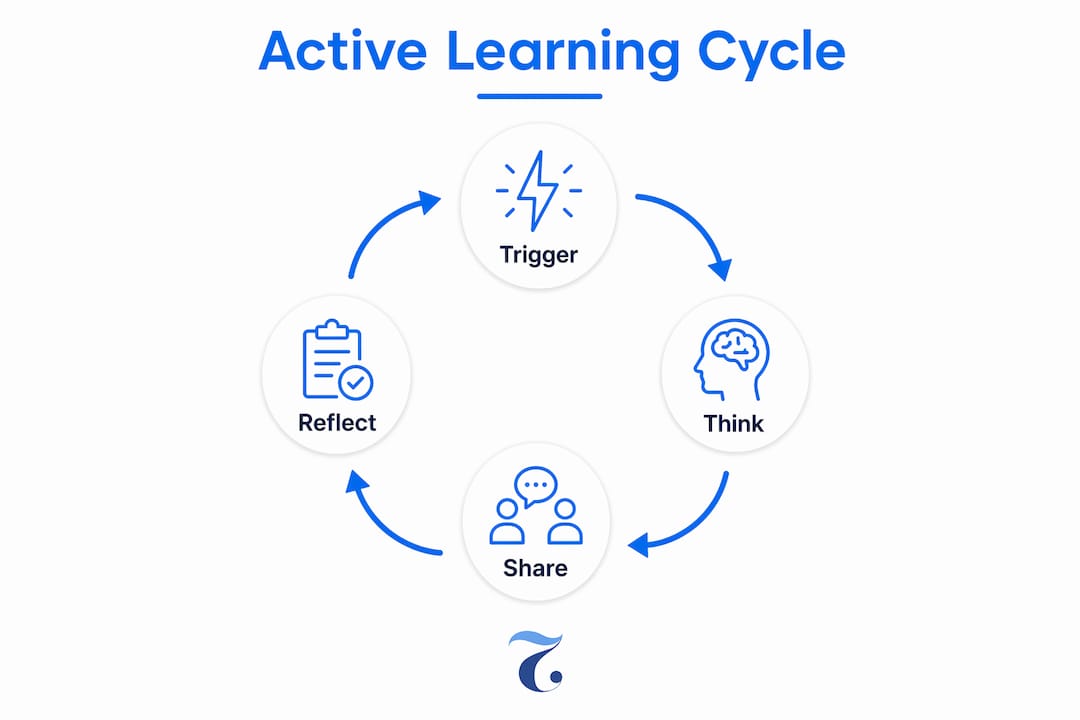
A structured framework that ties these methods together is the 4-part active learning loop: trigger question, solo thinking, group comparison, and visible output. This sequence has been tested with over one million students. It scales from a 60-second quick check to a 5-minute structured output task, making it practical for both group classes and self-study.
Pro Tip: If you study independently, replicate the loop by writing a question on a flashcard, answering it from memory, checking your answer, then saying the correct version aloud three times. That final spoken output is the step most self-study learners skip.
You can see many of these techniques in action through Thai classroom activities that blend structure with real conversation practice.
How does active learning differ from passive learning in language?
Passive learning includes listening to recordings, reading texts, and watching videos in the target language. These activities provide essential input. Active learning requires the learner to produce output: speaking, writing, summarizing, or explaining. Balancing passive input with active output is the foundation of effective language acquisition.
Stephen Krashen’s Input Hypothesis argues that comprehensible input is the primary driver of acquisition. Merrill Swain’s Output Hypothesis counters that production forces learners to notice gaps in their knowledge that input alone never reveals. Both are correct. Input provides the raw material. Output builds the skill.
A common misconception is that active learning replaces passive input entirely. It does not. A Thai learner who only speaks and never listens will develop pronunciation errors and vocabulary gaps. A learner who only listens and never speaks will understand Thai but struggle to produce it under pressure. The two modes are complementary, not competing.
| Feature | Passive learning | Active learning |
|---|---|---|
| Learner role | Receiver | Producer |
| Example activities | Listening, reading, watching | Speaking, writing, flashcards |
| Fluency impact | Builds comprehension | Builds production speed |
| Retention | Lower without review | Higher through retrieval |
| Cognitive effort | Low to moderate | High, productive struggle |
| Best used for | Building input and vocabulary | Consolidating and applying language |
The table above shows that neither mode is superior on its own. The most effective language learners use passive input to build comprehension, then shift to active output to lock in fluency.
What scientific evidence supports active learning in language acquisition?
Active learning forces the brain to struggle through retrieval and production, which strengthens neural pathways more effectively than passive exposure. This cognitive effort is intentional. The difficulty is the mechanism, not a side effect.
“Active learning invites students into knowledge-making rather than passive content receiving.” — Yale Poorvu Center for Teaching and Learning
Research in 2026 confirms that active learning improves fluency, engagement, and critical thinking. The same research notes that uneven adoption and institutional barriers remain real obstacles. Many educators recognize the benefits but face time restrictions and limited training in facilitation techniques.
The instructor’s role is central to making active learning work. Effective instructors shift from content deliverer to guide, moving between three modes: Observer, Guide, and Conductor, depending on the lesson phase. An Observer watches students work and notes misconceptions. A Guide asks questions that push thinking without giving answers. A Conductor manages pacing and transitions between tasks.
One of the most practical insights from facilitation research is the concept of “wobble points.” These are moments when student engagement drops or confusion peaks. Effective facilitators prepare prompts for these moments, sustaining productive struggle rather than rescuing students too quickly. For Thai language instructors, this might mean asking a student to rephrase a sentence differently rather than correcting it outright.
How can learners and educators implement active learning strategies?
Implementation does not require a full curriculum overhaul. Simple instructional swaps like chunking a 30-minute lecture into three 10-minute segments with active breaks, or converting a vocabulary worksheet into a station-based rotation, produce sustained engagement without major redesign.
For individual learners, these steps build a strong active learning habit:
- Use spaced flashcards with production. Tools like Anki force retrieval on a schedule. Add a speaking step: say the Thai word and use it in a sentence before flipping the card.
- Summarize aloud after every lesson. Spend two minutes after class explaining what you learned in English or Thai without notes. This retrieval practice locks in new material.
- Practice with a partner weekly. Even one 20-minute conversation session per week produces measurable fluency gains. Group class dynamics accelerate this further by providing multiple speaking partners.
- Write exit notes. After self-study, write one Thai sentence using the day’s vocabulary. Keep a running document and review it weekly.
- Record yourself speaking. Playback reveals pronunciation gaps that neither reading nor listening will catch.
For educators, the most effective classroom changes are structural. Break lessons into segments no longer than 15 minutes before inserting an active task. Use exit tickets to diagnose comprehension before the next class. Rotate between Think-Pair-Share and Jigsaw activities so learners practice both peer teaching and collaborative production.
Pro Tip: Start with one active technique per lesson rather than redesigning everything at once. Retrieval warm-ups at the start of class are the lowest-effort, highest-impact change most teachers can make immediately.
Balancing active and passive learning is the final piece. A practical ratio for adult language learners is roughly equal time on input and output, with output tasks increasing as proficiency grows. Beginners need more input to build vocabulary. Intermediate and advanced learners benefit most from maximizing production time.
Key Takeaways
Active learning in language acquisition works because it forces production and retrieval, which build fluency and retention far more effectively than passive input alone.
| Point | Details |
|---|---|
| Core definition | Active learning requires producing language through speaking, writing, or retrieval, not just receiving it. |
| Most effective methods | Think-Pair-Share, retrieval warm-ups, Jigsaw learning, and exit tickets are proven and low-resource. |
| Active vs. passive balance | Passive input builds comprehension; active output builds production speed. Both are necessary. |
| Scientific backing | Research confirms active engagement doubles fluency gains compared to passive recognition strategies. |
| Implementation tip | Start with one technique per lesson, such as a retrieval warm-up, before adding more active elements. |
Why I think most language learners underestimate the discomfort factor
Most learners I have observed want active learning to feel smooth. They want to speak Thai confidently from the first session. When it feels hard, they interpret that difficulty as failure and retreat to passive habits: more listening, more reading, more watching. That retreat is the single biggest obstacle to fluency.
The cognitive effort in active learning is not a sign that something is wrong. It is the mechanism. The struggle to recall a Thai word, the awkward pause before forming a sentence, the embarrassment of mispronouncing a tone: these are the moments when the brain is actually building new pathways. Removing that discomfort by switching back to passive input removes the learning.
What I have seen work consistently is reframing the difficulty. Learners who treat retrieval struggle as evidence of progress, rather than evidence of failure, stay with active practice longer. They also reach conversational fluency faster. The instructors who produce the best student outcomes are not the ones who make class feel easy. They are the ones who make the struggle feel purposeful and safe.
The balance between instructor guidance and student independence is genuinely difficult to calibrate. Too much guidance and learners never develop independent production. Too little and frustration kills motivation. The best approach I have seen is gradual release: heavy scaffolding early, then deliberate withdrawal of support as learners gain confidence. That progression mirrors how fluency actually develops.
— Paul
How Thai Explorer puts active learning into practice
Thai Explorer builds active learning into every course it offers, from conversational Thai for travel to business Thai for professionals in Singapore. Lessons are structured around production tasks, not passive lectures, with native Thai instructors who are bilingual in Thai and English guiding students through real communication scenarios.

Every class format, whether group, private, or online via Zoom, incorporates the active techniques described in this article: retrieval practice, partner speaking tasks, and structured output activities. The curriculum aligns with CU-TFL standards, so learners build skills that hold up in real-world Thai conversations. Thai Explorer is located at 10 Anson Road, #22-07, International Plaza, Singapore 079903, right above Tanjong Pagar MRT. Explore the full range of Thai language courses and find the format that fits your schedule and goals.
FAQ
What is active learning in language acquisition?
Active learning in language acquisition is the practice of producing and recalling language through speaking, writing, and retrieval tasks. Research shows it doubles fluency gains compared to passive recognition strategies alone.
What are the best active learning techniques for language learners?
Think-Pair-Share, retrieval warm-ups, Jigsaw learning, and exit tickets are the most widely used and research-supported techniques. They require minimal resources and work in both classroom and self-study settings.
Is passive learning bad for language acquisition?
Passive learning is not bad. It builds comprehension through listening and reading. The most effective approach combines passive input with active output, as both are necessary for full language acquisition.
How do educators implement active learning in language classes?
Educators can start by chunking lectures into shorter segments and adding active tasks between them. Simple changes like retrieval warm-ups and exit tickets produce strong engagement without redesigning an entire course.
How long does it take to see results from active learning?
Results vary by learner and frequency of practice, but consistent active output practice produces noticeable fluency improvements within weeks. The key factor is regularity of production tasks, not total study hours.