
TL;DR:
- Culture is essential to language learning because it improves communication and retention by linking language to social contexts. Understanding cultural norms and social cues helps learners respond appropriately and avoid misunderstandings, especially in politeness and indirect communication. Incorporating authentic materials and real situations into instruction enhances learners’ cultural and linguistic competence, leading to greater motivation and confidence.
Culture is the foundation of language learning, not an optional add-on. Without cultural knowledge, learners can memorize thousands of words and still fail to communicate effectively in real situations. The role of culture in language learning determines how well you interpret social cues, respond appropriately, and build genuine connections with native speakers. Research confirms that connecting language to lived cultural situations improves recall speed and retention more than rote memorization of isolated vocabulary. Thai Explorer builds this principle into every course it offers, treating cultural fluency as inseparable from linguistic skill.
How does the role of culture in language learning affect communication?
Cultural awareness is the difference between speaking a language and actually using it. Grammar and vocabulary give you the tools. Culture tells you when, how, and why to use them.
Politeness markers and social norms differ widely across cultures, and misreading them causes real friction. A direct refusal that sounds assertive in one culture reads as rude in another. A silence that signals respect in Thai conversation can feel dismissive to someone from a Western background. These gaps are not grammar problems. They are cultural ones.
Misinterpretation happens most often in three areas:
- Greetings and formality levels. Thai uses distinct registers for speaking to elders, peers, and strangers. Using the wrong register signals disrespect, even when your vocabulary is correct.
- Politeness rituals. Expressing gratitude differs across cultures. In some contexts, saying “thank you” too often sounds transactional rather than warm.
- Indirect communication. Many Asian cultures favor indirect phrasing to preserve face. Learners trained in direct communication styles often miss the actual message.
Moving beyond grammar to sociocultural contexts improves both efficiency and intercultural understanding. A learner who understands why Thai speakers use softening particles at the end of sentences will use them naturally. A learner who only memorizes the particles will use them mechanically and inconsistently.
Pro Tip: When you learn a new phrase, ask your instructor what social situation it belongs to. Knowing the context locks the phrase into memory far better than repetition alone.
How do language ideology and cultural perception shape acquisition?
Language ideology is the set of beliefs a community holds about how language should be used, who speaks it correctly, and what it signals about identity and status. These beliefs shape how learners are received and how they adjust their own speech.
The Sapir-Whorf hypothesis offers a useful frame here. It argues that language shapes perception of reality and influences how speakers interpret social interactions. Thai, for example, encodes social hierarchy directly into its pronoun system. Choosing the wrong pronoun is not just a grammar error. It signals a misunderstanding of the relationship between speaker and listener.
Four key ways language ideology affects learners:
- Identity pressure. Learners often feel caught between their native cultural identity and the norms of the target language community. This tension can slow progress if left unaddressed.
- Speech style adjustment. Language ideologies reveal struggles between social groups and directly influence how speakers behave. Learners entering a new cultural community must navigate these unspoken rules.
- Accent and correctness bias. Communities often judge non-native speakers by accent or phrasing. Awareness of this bias helps learners set realistic expectations and build resilience.
- Motivation shifts. Learners who feel culturally accepted progress faster. Those who feel judged or excluded often plateau, regardless of their linguistic ability.
Cultural identity is not separate from language learning. It is woven into every interaction. Recognizing this helps adult learners approach a new language with both confidence and realistic expectations. Thai Explorer’s native Thai instructors address these dynamics directly, helping learners navigate cultural norms alongside grammar and vocabulary.
What methods best integrate cultural knowledge into language learning?
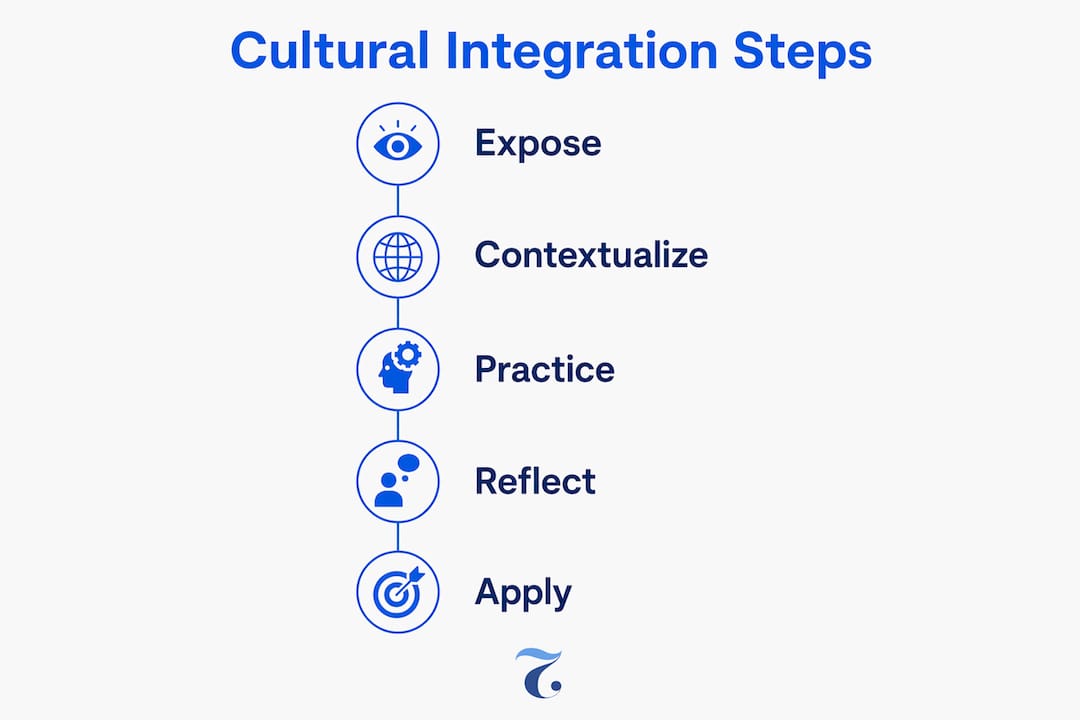
The most effective methods treat culture as curriculum, not background decoration. They use real materials, real contexts, and real interactions to build what researchers call linguocultural competence.

Multimedia and authentic materials
Online podcasts, videos, and social media provide exposure to evolving sociocultural contexts that textbooks cannot replicate. A Thai soap opera clip teaches tone, emotion, and register simultaneously. A street food vendor video teaches vocabulary in the context where it actually lives. These materials motivate learners because they feel relevant and alive.
Real-life sociocultural contexts
Placing language inside real situations accelerates retention. Cultural context serves as a mnemonic device that enhances memory and recall of language forms tied to traditions and emotions. Learners who associate a Thai phrase with a specific festival, meal, or social ritual remember it longer than those who learn it from a word list.
Avoiding stereotypes and overgeneralization
Cultural instruction fails when it reduces a culture to a checklist of traits. Effective cultural integration requires nuanced, stereotype-avoiding methodologies that respect complexity. Thai culture is not monolithic. Regional differences, generational shifts, and urban versus rural norms all shape how the language is used.
| Method | What it builds |
|---|---|
| Multimedia exposure | Vocabulary in real social context |
| Role-play scenarios | Politeness and register awareness |
| Cultural topic discussions | Intercultural motivation and empathy |
| Authentic text analysis | Reading comprehension and cultural literacy |
Pro Tip: Pair every grammar lesson with a cultural question: “When would a Thai speaker actually say this?” That one question shifts learning from passive memorization to active cultural understanding.
Practical language training that incorporates these methods produces learners who can adapt, not just recite. Thai Explorer’s curriculum is aligned with the CU-TFL (Chulalongkorn University Proficiency Test of Thai as a Foreign Language) standard, which evaluates exactly this kind of real-world communicative ability.
What are the benefits of cultural integration for adult language learners?
Adult learners bring life experience to the classroom. That experience becomes a major asset when cultural integration is built into instruction. Cultural knowledge does not just make language more interesting. It makes it stick.
The core benefits are concrete and well-supported:
- Stronger retention. Words and phrases learned inside cultural stories, rituals, or social scenarios are recalled faster and forgotten more slowly than vocabulary learned in isolation.
- Higher motivation. Cultural topics strongly motivate learners when introduced with nuanced, stereotype-avoiding approaches. Adult learners who feel connected to the culture they are studying stay enrolled longer and practice more consistently.
- Greater empathy. Understanding how another culture structures politeness, humor, and disagreement builds genuine perspective-taking. This matters especially for learners using Thai for business or professional relationships.
- Communicative competence. Language instruction that includes sociocultural context produces learners who can handle real conversations, not just scripted exchanges. This is the difference between passing a test and functioning in a real environment.
- Confidence in unfamiliar situations. Culturally literate learners know what to expect in social settings. That predictability reduces anxiety and increases willingness to speak.
Cultural immersion in language learning is not a luxury for advanced learners. It is the foundation that makes every other skill more durable. Adult learners who integrate cultural knowledge from the start build fluency faster than those who treat culture as a finishing layer.
Key takeaways
Cultural fluency and linguistic competence are inseparable: learners who understand the social and cultural context of a language communicate more accurately, retain vocabulary longer, and build confidence faster than those who focus on grammar alone.
| Point | Details |
|---|---|
| Culture drives retention | Words learned inside cultural contexts are recalled faster and forgotten more slowly. |
| Social norms shape meaning | Politeness, register, and indirect communication require cultural knowledge, not just vocabulary. |
| Language ideology matters | Beliefs about correct speech affect learner identity, motivation, and adjustment in new communities. |
| Authentic materials accelerate learning | Podcasts, videos, and real-life scenarios build linguocultural competence beyond what textbooks offer. |
| Cultural integration boosts motivation | Adult learners who connect with the target culture stay engaged longer and progress more consistently. |
Why culture belongs at the center, not the edges
I have watched adult learners hit a wall at intermediate level and not understand why. Their grammar is solid. Their vocabulary is growing. But conversations with native speakers feel awkward and stilted. The missing piece is almost always cultural, not linguistic.
The most common mistake I see is treating culture as enrichment. Learners add a cultural lesson here, a festival explanation there, and assume that covers it. It does not. Culture needs to be the frame around every lesson, not a decoration on top of it. When a learner understands that Thai uses different sentence-ending particles to signal gender, politeness, and emotional tone simultaneously, they stop treating those particles as optional extras. They start using them correctly because they understand what is at stake socially.
The other mistake is romanticizing culture. Learners who idealize Thai culture often struggle when real interactions do not match their expectations. Effective cultural learning means engaging with complexity, including the parts that feel unfamiliar or uncomfortable. That discomfort is where real fluency begins.
My advice: find a teacher who can explain not just what to say, but what it means to say it in that moment. That combination of linguistic and cultural instruction is what separates learners who plateau from those who genuinely connect.
— Paul
Thai Explorer’s approach to cultural and language learning
Thai Explorer’s adult Thai courses are built on the principle that language and culture must be taught together. Every lesson connects grammar and vocabulary to real social situations, so you leave each class knowing not just what to say, but how and when to say it.
Whether you are learning Thai for travel, professional use, or personal connection, Thai Explorer offers group, private, and online Thai courses that fit your schedule and goals. The curriculum is aligned with the CU-TFL standard and delivered by bilingual native Thai instructors who bring cultural context into every session. Located above Tanjong Pagar MRT at 10 Anson Road, #22-07, International Plaza, Singapore 079903, Thai Explorer is easy to reach. Explore the full range of adult Thai language courses and find the right fit for your level and purpose.
FAQ
Why is culture important in language learning?
Culture shapes how language is used in real social situations. Without cultural knowledge, learners misread politeness, tone, and intent, even when their grammar is correct.
How does culture affect language retention?
Words and phrases learned inside cultural contexts, such as social rituals or real-life scenarios, are recalled faster and retained longer than vocabulary memorized in isolation.
What is linguocultural competence?
Linguocultural competence is the ability to use language accurately within its cultural context. It combines grammatical knowledge with an understanding of social norms, politeness, and communication styles.
How do language ideologies affect adult learners?
Language ideologies are community beliefs about correct speech and identity. They influence how learners are received by native speakers and how learners adjust their own communication style in a new cultural environment.
Can online courses build cultural competence?
Yes. Online courses that use authentic materials such as videos, podcasts, and role-play scenarios effectively build cultural awareness alongside language skills, particularly when delivered by native-speaking instructors.