
TL;DR:
- Language proficiency testing assesses a person’s ability to communicate effectively across real-world situations. It evaluates listening, speaking, reading, and writing skills using established frameworks like CEFR and ACTFL. Results serve as official proof for academic, professional, and immigration purposes.
Language proficiency testing is the process of measuring a person’s ability to communicate effectively in a language across real-world, unrehearsed situations. These standardized assessments cover four core skill domains: listening, speaking, reading, and writing. Recognized frameworks like the CEFR (Common European Framework of Reference, A1–C2) and ACTFL (American Council on the Teaching of Foreign Languages) guidelines give test results meaning across borders. Universities, employers, and immigration authorities rely on these scores as objective evidence of functional ability. Understanding how these tests work helps you choose the right one, prepare with purpose, and use your results to move forward.
What is language proficiency testing and what does it measure?
Language proficiency testing is a standardized assessment of a person’s ability to communicate in real-world, spontaneous, and unrehearsed situations. That definition matters because it separates proficiency tests from classroom quizzes or vocabulary drills. A proficiency test asks: can this person actually function in the language when it counts?
The four core skill domains are listening, speaking, reading, and writing. Each domain tests a different dimension of communication. Listening measures comprehension of native-speed speech. Speaking tests the ability to produce language under real conversational pressure. Reading assesses understanding of authentic texts. Writing evaluates the ability to produce coherent, contextually appropriate content.

ACTFL evaluates performance using FACT criteria: Functions/tasks, Accuracy, Context/content, and Text type. These four criteria work together. A test taker who produces grammatically perfect sentences but fails to address the communicative task still does not meet the standard for a given level. High accuracy without appropriate content fails the proficiency requirement, even when the linguistic form is flawless.
Proficiency tests also differ from achievement tests and diagnostic tests. An achievement test measures what a student learned in a specific course. A diagnostic test identifies gaps before instruction begins. A proficiency test measures functional ability at a point in time, regardless of how or where the learner acquired the language.
Pro Tip: When preparing for any proficiency test, practice responding to topics you have never studied before. The ability to handle unexpected prompts is exactly what raters look for.
What are the common types of language proficiency tests?
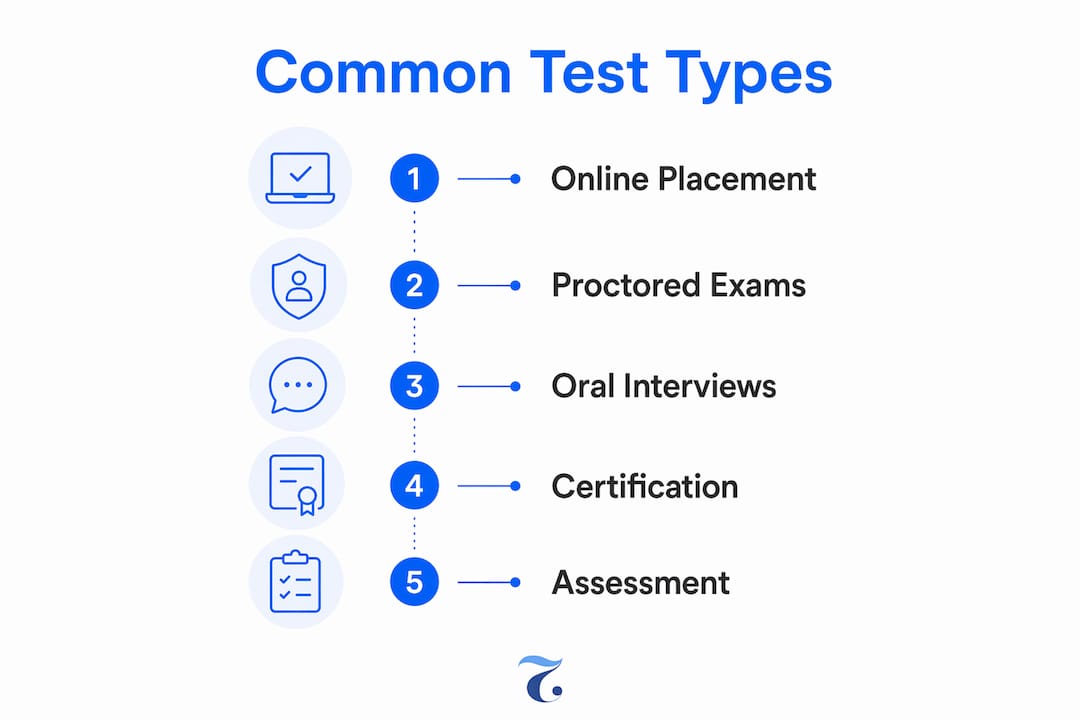
Test formats vary widely depending on the language, the purpose, and the level of certification required. Understanding the differences helps you choose the right assessment for your goal.
Online placement tests
Online placement tests are the most accessible entry point. They typically run 20–30 minutes and give an approximate level within the CEFR or ACTFL scale. Free online assessments like EF SET are widely used for self-evaluation. These tests are useful for gauging where you stand, but they carry a significant limitation: most omit speaking and writing, which limits their accuracy. Free test results are rough estimates, not official credentials for visa or academic use.
Thai Explorer’s own online placement tool gives Thai learners a quick read on their current level before enrolling in a course. That kind of placement check saves time and puts learners in the right class from day one.
Proctored certification exams
Proctored certification exams are the gold standard for official documentation. These tests run from 50 minutes to 4 hours depending on scope, and they assess multiple or all four skill domains under supervised conditions. Exam durations range from 20 minutes for basic placement to 4 hours for comprehensive certification. Providers like Avant Assessment align their proctored tests with academic credit standards.
Well-known examples include TOEFL and IELTS for English, DELF for French, JLPT for Japanese, and the CU-TFL (Chulalongkorn University Proficiency Test of Thai as a Foreign Language) for Thai. One notable exception: JLPT omits a speaking component entirely, which means it measures only three of the four core skill domains.
Oral proficiency interviews
The Oral Proficiency Interview (OPI), developed under ACTFL guidelines, is a live, one-on-one conversation between a trained rater and the test taker. ACTFL raters evaluate oral performance based on FACT criteria across unfamiliar communication contexts. The OPI is widely used for professional licensing and government employment in the United States.
The table below summarizes the key differences across test formats:
| Format | Skills assessed | Typical duration | Official credential? |
|---|---|---|---|
| Free online placement | Reading, listening | 20–30 minutes | No |
| Proctored certification exam | All four skills | 50 minutes to 4 hours | Yes |
| Oral proficiency interview | Speaking | 30–45 minutes | Yes |
| Writing proficiency test | Writing | 45–60 minutes | Yes |
CEFR defines six levels from A1 (beginner) to C2 (mastery). ACTFL uses its own scale from Novice to Distinguished. Conversion tables exist between these systems, which matters when a test result from one framework needs to be interpreted in another context. Understanding language proficiency levels before you test removes a lot of confusion when results arrive.
Why does language proficiency testing matter for academic and professional goals?
Proficiency scores are not just numbers. They function as official documents that open or close specific doors. Tests like TOEFL, IELTS, JLPT, and DELF assess functional ability at a point in time, and institutions treat them as objective evidence of communicative readiness.
The practical stakes are high across four main areas:
-
University admissions. Most English-medium universities require IELTS or TOEFL scores above a defined threshold. A score below the cutoff disqualifies an application regardless of academic merit. Some programs require B2 (CEFR) as a minimum; others demand C1 for graduate entry.
-
Visa processing. Immigration authorities in countries like the United Kingdom, Australia, and Canada require certified language test results as part of residency or student visa applications. A free online placement result does not satisfy this requirement.
-
Professional licensing. Healthcare, legal, and education sectors in many countries require proof of language proficiency before granting a license to practice. A nurse trained abroad may need to demonstrate B2 or higher in the country’s official language before working with patients.
-
Employment and global mobility. Multinational employers use proficiency scores to assess candidates for roles that require cross-cultural communication. A documented level on a recognized scale gives hiring managers a consistent reference point across applicants from different backgrounds.
The key insight here is that a proficiency score reflects what you can do right now, not how long you have studied. Two learners with the same number of study hours can score very differently if one has practiced real communication and the other has focused only on grammar rules. Proficiency tests measure functional, unrehearsed ability, and that distinction shapes how you should prepare.
For Thai learners in Singapore, understanding official certification pathways early in the learning process helps set realistic goals and choose the right course structure.
How can you prepare for and interpret proficiency test results?
Preparation for a proficiency test works best when it mirrors what the test actually measures. Rote memorization of vocabulary lists or grammar rules produces limited gains. Test takers who focus on memorization often score lower than those with genuine communicative competence when faced with unexpected prompt complications.
Effective preparation focuses on these areas:
- Expand your communicative range. Practice discussing topics outside your comfort zone: current events, abstract ideas, professional scenarios. The test will not stay in familiar territory.
- Work across all four skills. A strong reader who cannot hold a conversation will show an uneven profile. Balanced development across listening, speaking, reading, and writing produces a more accurate and useful result.
- Use test frameworks as a study map. Review the CEFR level descriptors or ACTFL guidelines for your target level. These documents describe exactly what you need to demonstrate. Language standards in learning give learners a concrete benchmark to work toward.
- Take more than one test type. Taking two or three different assessments gives a more accurate picture of actual ability. Different tests prioritize different skills, and triangulating results removes the blind spots any single test creates.
- Interpret results as a snapshot, not a verdict. Proficiency is a spectrum. A B1 result today does not define your ceiling. It defines your starting point for the next phase of development.
Pro Tip: After receiving your results, map each skill score against the CEFR or ACTFL level descriptors. Identify which domain scored lowest and build your next study cycle around closing that gap specifically.
An English accent diagnostic can also reveal pronunciation patterns that affect speaking scores, which is a dimension many learners overlook until test day.
For Thai learners working toward certification, Thai Explorer’s certification study guide offers a structured approach to building the skills that proficiency tests actually reward.
Key Takeaways
Language proficiency testing measures real-world communicative ability across listening, speaking, reading, and writing, using frameworks like CEFR and ACTFL to produce results that carry weight in academic, professional, and immigration contexts.
| Point | Details |
|---|---|
| Core skill domains | All four skills — listening, speaking, reading, and writing — must be developed for a complete proficiency profile. |
| FACT criteria | ACTFL evaluates Functions, Accuracy, Context, and Text type; accuracy alone does not satisfy the standard. |
| Test format matters | Free online tests give rough estimates; only proctored certification exams produce official credentials. |
| Real-world stakes | Proficiency scores serve as gatekeepers for university admission, visa processing, and professional licensing. |
| Results are a starting point | Proficiency is a spectrum; use scores to identify skill gaps and direct the next phase of learning. |
Why I think most people misunderstand what proficiency tests are actually for
Most test takers treat a proficiency exam as a finish line. Pass it, frame the certificate, move on. That mindset produces a specific kind of test anxiety and, more importantly, a specific kind of under-preparation. People drill sample questions, memorize topic-specific vocabulary, and practice the exact formats they expect to see. Then they hit an unexpected prompt in the speaking section and freeze.
The tests are designed to expose exactly that gap. True proficiency, as ACTFL and CEFR both define it, is the ability to function when the conversation goes somewhere you did not plan for. That is not a flaw in the testing system. It is the entire point.
What I have found is that learners who treat the test as a benchmark rather than a destination prepare differently. They spend less time on practice tests and more time in real conversations. They read content they find genuinely difficult. They write about topics they have never studied in the target language. By the time they sit the exam, the test feels like a conversation, not a performance.
The other misconception worth addressing: a single test score does not tell the full story. A learner might score B2 overall but be a strong C1 reader and a weak B1 speaker. That gap matters more than the aggregate score, especially for professional use. Use the breakdown, not just the headline number, to guide what you do next.
Proficiency testing, at its best, is a mirror. It shows you where you actually are, not where you think you are or where you wish you were. That kind of honest feedback is rare and worth taking seriously.
— Paul
Thai Explorer’s courses for proficiency-focused learners
Thai Explorer offers structured Thai language courses in Singapore for adults at every level, from complete beginners to advanced learners preparing for formal certification. The curriculum aligns with the CU-TFL standard, covering all four skill domains with qualified native Thai instructors who are bilingual in Thai and English.
Group classes, private lessons, and online Zoom sessions are all available, making it practical to build proficiency on a schedule that fits work and life. Corporate training options are also offered for teams that need Thai communication skills for business use. If you are ready to move from self-assessment to structured progress, explore the full range of Thai language courses at Thai Explorer and find the format that fits your goals.
FAQ
What is language proficiency testing?
Language proficiency testing is a standardized assessment of a person’s ability to communicate in a language across listening, speaking, reading, and writing in real-world, unrehearsed situations. Results are measured against recognized frameworks like CEFR (A1–C2) or ACTFL guidelines.
What is a language assessment vs. a proficiency test?
A language assessment is a broad term covering any evaluation of language ability, including diagnostic and achievement tests. A proficiency test specifically measures functional, real-world communicative ability independent of how or where the language was learned.
How long does a language proficiency test take?
Test duration ranges from 20–30 minutes for free online placement tests to 4 hours for comprehensive proctored certification exams, depending on the number of skills assessed and the level of official certification required.
Are free online language tests accurate?
Free online tests provide an approximate level within plus or minus half a band but omit speaking and writing in most cases. They are useful for self-assessment but are not accepted as official credentials for university admission or visa applications.
Which language proficiency framework should I use?
CEFR is the most internationally recognized framework, used across Europe and widely accepted in Asia. ACTFL is standard in the United States. The right framework depends on where you plan to use the credential and what the receiving institution or employer requires.