
TL;DR:
- Communicative language teaching focuses on real-world communication, aiming to develop practical language skills for social use. It emphasizes interaction, meaningful tasks, and learner-centered activities while balancing form and fluency. Effective implementation involves matching tasks to proficiency levels and incorporating both communicative and form-focused instruction.
Communicative language teaching (CLT) is defined as a learner-centered approach to language education that treats real-world communication as both the goal and the primary method of instruction. Rather than drilling grammar rules in isolation, CLT builds what linguists call communicative competence, the ability to use language accurately and appropriately in real social situations. This competence spans four dimensions: linguistic competence, sociolinguistic competence, discourse competence, and strategic competence. CLT emerged as a direct response to grammar-translation methods that produced learners who could parse sentences but could not hold a conversation. For educators and language learners alike, understanding CLT means understanding why interaction, not memorization, drives lasting fluency.
What is communicative language teaching and its core principles?
CLT is best understood as a dynamic curriculum framework that prioritizes real-world communicative ability over rigid, rule-based methods. Its flexibility allows it to adapt across diverse classroom settings, balancing experiential learning with analytical instruction. The approach does not prescribe a single fixed method. Instead, it offers a set of principles that guide how teachers design tasks and how learners engage with the language.
The core principles of communicative language teaching include:
- Meaning over form. Learners focus on communicating ideas first. Grammar is addressed in context, not as an abstract system to memorize before speaking.
- Learner-centeredness. The learner’s needs, goals, and interests shape the curriculum. Teachers act as facilitators, not lecturers.
- Interaction as the engine of learning. Language develops through negotiating meaning with others, asking for clarification, rephrasing, and responding in real time.
- Fluency before accuracy. Learners are encouraged to take risks and speak freely. Errors are treated as a natural part of acquisition, not as failures.
- Integration of the four skills. Speaking, listening, reading, and writing are taught together as they occur in real communication, not as separate, isolated subjects.
- Authentic materials and tasks. Activities simulate real-life scenarios: ordering food, negotiating a deal, or describing a problem to a colleague.
Delayed correction and recasting preserve communication flow and encourage learner risk-taking, which are crucial for language acquisition. Stopping a learner mid-sentence to fix a grammar error shuts down the communicative act entirely.
Pro Tip: When designing a CLT lesson, build in a “fluency phase” where learners speak freely without interruption, followed by a short “focus on form” phase where you address recurring errors as a group.

How does CLT improve language proficiency and engagement?
The evidence for CLT’s effectiveness is strong, particularly for spoken skills. CLT positively impacts speaking, listening, and classroom engagement when instructional activities align with learners’ proficiency levels. Every successful CLT program analyzed in a recent systematic review shared this alignment as a defining feature. That finding tells educators something concrete: the method works, but only when the task difficulty matches where the learner actually is.
Learner motivation also rises noticeably under CLT. When learners see that their language use produces real results, such as being understood, completing a task, or persuading a partner, their confidence builds quickly. This is the feedback loop that grammar drills cannot replicate.
The picture is not uniformly positive, however. CLT improves speaking and listening significantly but has less consistent impact on grammar, reading, and writing due to variation in instructional design. This gap matters. It means that educators who rely exclusively on communicative tasks may leave learners underprepared for writing-heavy assessments or formal grammar requirements.
The table below summarizes CLT’s impact across the four core language skills:
| Skill | CLT Impact | Key Condition |
|---|---|---|
| Speaking | Strong, consistent gains | Tasks must match proficiency level |
| Listening | Strong, consistent gains | Input must be rich and contextually varied |
| Reading | Moderate, variable gains | Depends on use of authentic texts |
| Writing | Less consistent | Requires explicit form-focused instruction alongside CLT |
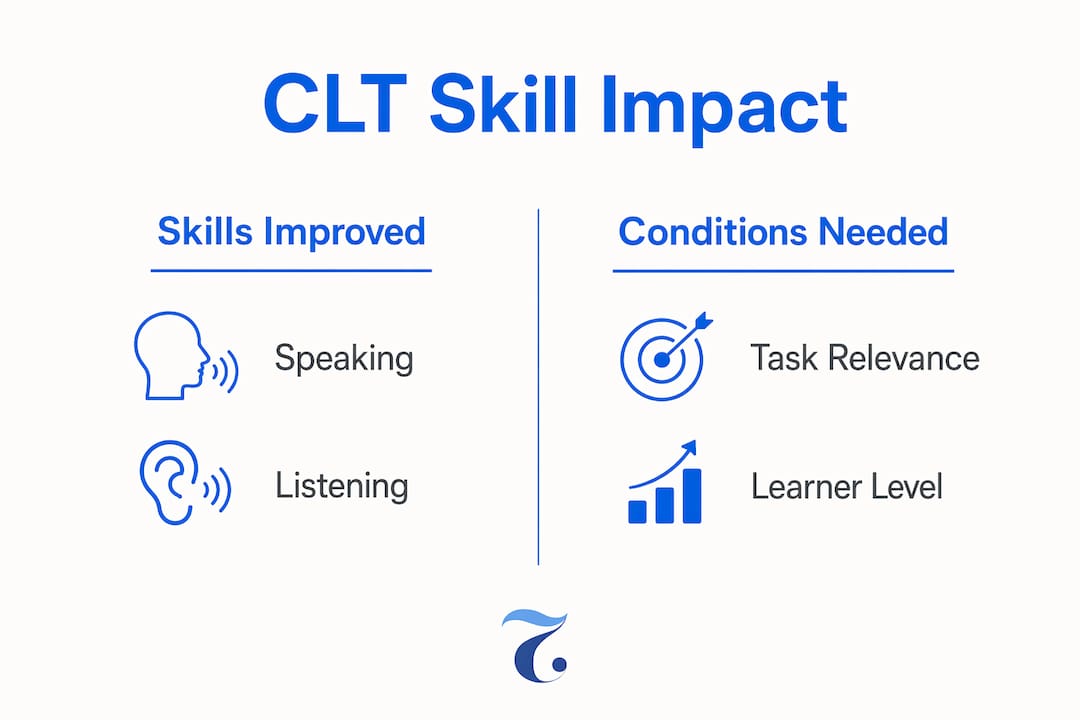
Matching tasks to learner proficiency is not optional in CLT. It is the mechanism that makes the whole approach work.
What challenges do educators face when implementing CLT?
CLT’s principles are clear on paper. Applying them in real classrooms is harder. Effective educators integrate communicative principles with practical curriculum requirements, but the gap between theory and practice is real and well-documented. The most common obstacles educators face are:
- Large class sizes. Managing open-ended communicative tasks with 30 or more learners is logistically difficult. Pair and small-group work helps, but requires careful monitoring.
- Mixed proficiency levels. When learners are at different stages, designing a single task that challenges everyone without overwhelming beginners takes skill and preparation.
- Limited teacher training. CLT demands that teachers facilitate rather than lecture. Teachers trained in grammar-translation methods often need significant retraining to shift roles effectively.
- Exam pressure. Standardized tests frequently reward grammar accuracy and reading comprehension over spoken fluency. This creates a structural tension between CLT goals and assessment demands.
- Curriculum rigidity. Some institutions mandate fixed syllabi that leave little room for open-ended communicative tasks.
The solution is not to abandon CLT but to adapt it. Balancing communicative and form-focused instruction within the same lesson enables compliance with both communicative goals and exam requirements. High-performing teachers often spend roughly 70% of class time on communicative tasks and 30% on form-focused instruction in exam-heavy classrooms. That ratio keeps the communicative core intact while addressing the accuracy demands of formal assessment.
CLT exists on a spectrum between “weak” and “strong” versions. The weak version uses communicative activities as supplements to a grammar-based course. The strong version treats communication as the entire curriculum. Most effective classrooms sit somewhere in the middle, adapting to context rather than applying a rigid formula. Understanding language standards in learning helps educators find that balance without sacrificing either goal.
Pro Tip: In exam-driven contexts, frame communicative tasks around the topics that appear in standardized tests. Learners practice real communication and build the vocabulary and structures they need for the exam at the same time.
How can educators and learners apply CLT principles effectively?
Applying CLT well means designing tasks that simulate real communication, not tasks that merely look communicative on paper. Role-play, problem-solving, and debates encourage negotiation of meaning and active participation, which are core to CLT methodology. These tasks simulate real-life communication scenarios and produce greater language retention than controlled drills.
Effective CLT activities share these characteristics:
- A real communicative purpose. The task has an outcome that requires language use, such as reaching a decision, sharing information, or solving a problem.
- An information gap. One learner has information the other needs. This gap forces genuine communication rather than scripted exchange.
- Learner choice. Learners decide what to say and how to say it. The teacher does not pre-script the language.
- Feedback that preserves flow. Teachers use recasting (rephrasing the learner’s error correctly without stopping the conversation) rather than direct correction mid-task.
- Cultural and contextual relevance. Tasks reflect situations learners will actually encounter, whether traveling, working, or socializing in the target language.
The comparison below shows how traditional drills differ from CLT tasks in practice:
| Feature | Traditional drill | CLT task |
|---|---|---|
| Goal | Produce a correct form | Communicate a message |
| Learner role | Respond to prompts | Initiate and negotiate |
| Error handling | Immediate correction | Delayed correction or recasting |
| Outcome | Accuracy in isolation | Fluency in context |
| Motivation source | Teacher approval | Task completion |
For learners, the practical advice is equally direct. Seek out interactive language teaching environments where you are expected to speak from the first lesson. Passive exposure to grammar rules does not build the neural pathways that real conversation does. The more you negotiate meaning, make mistakes, and get comprehensible feedback, the faster your proficiency grows. Authentic materials, such as podcasts, news clips, and real conversations with native speakers, accelerate this process because they expose you to the full range of how language actually works.
CLT’s adaptability to varied teaching contexts makes it a resilient approach in the post-method era, allowing teachers to personalize instruction effectively. That adaptability is precisely what makes it relevant across languages, levels, and learning goals.
Key Takeaways
Communicative language teaching works because it treats real interaction as both the method and the goal, producing learners who can use language, not just describe it.
| Point | Details |
|---|---|
| CLT builds communicative competence | It develops linguistic, sociolinguistic, discourse, and strategic competence together. |
| Proficiency alignment is non-negotiable | Tasks must match learner level for CLT to produce measurable gains in speaking and listening. |
| Fluency and accuracy both matter | Spend roughly 70% of class time on communicative tasks and 30% on form-focused instruction. |
| Delayed correction protects fluency | Recasting errors after a task preserves communication flow and builds learner confidence. |
| CLT adapts to context | Weak and strong versions of CLT allow educators to meet curriculum demands without abandoning communicative goals. |
Why I think most CLT classrooms still get the balance wrong
After spending years observing language classrooms and working with adult learners, I’ve noticed a consistent pattern. Teachers either go all-in on communication and neglect form entirely, or they treat CLT activities as a Friday afternoon add-on to an otherwise grammar-heavy week. Neither extreme works.
The teachers who produce the most confident, fluent learners are the ones who treat CLT as a framework, not a checklist. They know when to step back and let a conversation run, and they know when to pause and address a pattern of errors that is genuinely blocking communication. That judgment cannot be taught through a methodology course alone. It comes from watching learners closely and being willing to adapt mid-lesson.
The other thing I’ve learned is that cultural context is not optional in CLT. Language does not exist in a vacuum. When adult learners are preparing for real-world use, whether for travel, business, or daily life in a new country, the communicative tasks need to reflect that reality. Generic role-plays about “going to the supermarket” rarely build the confidence that a task grounded in the learner’s actual goals does.
CLT is not a perfect method. No method is. But its core insight, that people learn language by using it to mean something, is as solid as any finding in applied linguistics. The educators who hold onto that insight while staying flexible about everything else tend to get the best results.
— Paul
Thai language courses built around real communication
Thai Explorer designs its adult Thai language courses around the same principles that make CLT effective: real tasks, meaningful interaction, and instruction grounded in how you will actually use the language.

Whether you are preparing for travel, building professional relationships, or simply want to hold a genuine conversation, Thai Explorer’s adult Thai courses put communication at the center of every lesson. Qualified native Thai instructors, bilingual in Thai and English, guide you through speaking, listening, reading, and writing in context. Group classes, private Thai lessons, and online Zoom sessions are all available, so you can learn in the format that fits your schedule. Thai Explorer is located right above Tanjong Pagar MRT at 10 Anson Road, #22-07, International Plaza, Singapore 079903.
FAQ
What is the main goal of communicative language teaching?
The main goal of CLT is to develop communicative competence, the ability to use language accurately and appropriately in real social situations. It prioritizes meaningful interaction over memorizing grammar rules in isolation.
How does CLT differ from traditional grammar-based teaching?
Traditional grammar-based teaching focuses on learning rules and producing correct forms in controlled exercises. CLT focuses on using language to communicate real messages, with grammar addressed in context rather than as the primary lesson objective.
What are the most effective CLT classroom activities?
Role-plays, debates, and problem-solving tasks are the most effective CLT activities because they create information gaps and require genuine negotiation of meaning. Authentic materials such as news clips and real conversations also strengthen communicative skills.
Does CLT work for all language skills equally?
CLT produces strong, consistent gains in speaking and listening but has less consistent impact on writing and grammar. Educators need to supplement communicative tasks with targeted form-focused instruction to address writing and accuracy outcomes.
Can CLT be used in exam-focused language programs?
Yes. Successful CLT programs integrate communicative activities while respecting curriculum constraints like standardized testing. A practical ratio is 70% communicative tasks and 30% form-focused instruction within each lesson.