TL;DR:
- Most adult learners struggle to write Thai sentences despite recognizing spoken words due to script complexity. Structured practice starting with tracing, middle-class consonants, and cultural journaling helps learners build confidence and accuracy. Combining tactile worksheets, apps, and consistent routines optimizes progress and deepens cultural understanding.
Most adult learners who study Thai hit the same wall: they can recognize spoken words but freeze when asked to write a single sentence. The script looks ornate, the vowel placement seems unpredictable, and knowing where to start feels genuinely difficult. A structured list of Thai writing exercises cuts through that paralysis. When you practice in a deliberate sequence, from tracing consonants to writing short journal entries, the script stops feeling foreign and starts feeling like a tool. This article gives you exactly that sequence, with enough variety to keep practice sessions from feeling repetitive.
Table of Contents
- Key takeaways
- 1. Tracing Thai consonants with guided stroke order
- 2. Mastering middle-class consonants first
- 3. Vowel placement and tone mark writing drills
- 4. Fill-in-the-blank spelling exercises
- 5. Short journaling prompts in Thai
- 6. Dialogue and role-play script writing
- 7. Vocabulary sentence writing
- 8. Copying Thai texts by hand
- 9. Comparing resources: printable sheets vs. apps
- 10. Building a daily Thai writing routine
- My honest take on picking the right exercises
- Take your Thai writing further with Thai Explorer
- FAQ
Key takeaways
| Point | Details |
|---|---|
| Start with tracing | Trace Thai consonants with guided stroke order before attempting free-form writing. |
| Middle-class consonants first | Learning the nine middle-class consonants first simplifies tone rule mastery for beginners. |
| Drills build spelling accuracy | Categorization and fill-in-the-blank tasks train your eye for correct Thai spelling patterns. |
| Cultural context boosts retention | Writing prompts tied to Thai culture increase engagement and long-term memory. |
| Combine formats for best results | Mixing printable worksheets, apps, and creative tasks produces faster, more durable progress. |
1. Tracing Thai consonants with guided stroke order
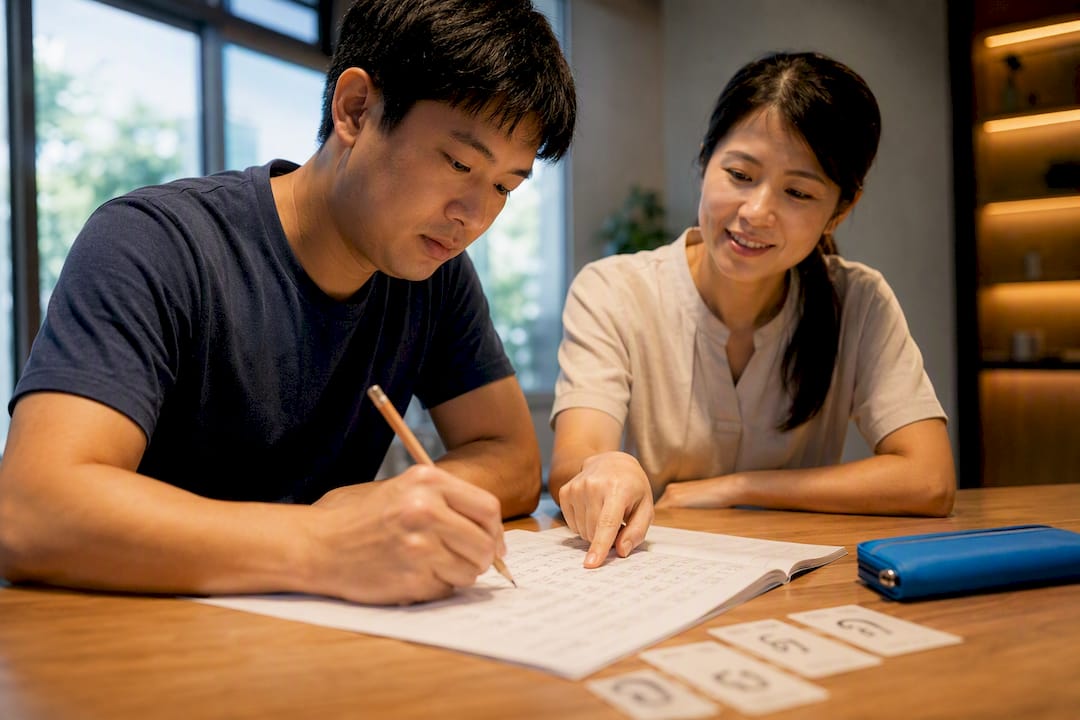
The foundation of any solid Thai writing practice routine is character tracing. Downloadable practice sheets for letter recognition help beginners understand the correct direction and sequence of every stroke before any free writing begins. This matters because Thai characters have a distinct internal logic. Writing strokes in the wrong order creates shapes that look close but read as incorrect to native speakers.
Start with printable sheets that show numbered stroke sequences for each consonant. Work through all 44 consonants slowly, giving yourself several repetitions per character before moving on. Your hand needs to build muscle memory, not just your brain.
- Trace each consonant at least five times per session
- Focus on the curve directions, which often differ from Roman letters
- Keep a dedicated notebook for tracing practice so you can track improvement over weeks
Pro Tip: Say the consonant’s name and its associated word aloud as you trace it. Speaking while writing reinforces both pronunciation and visual memory at the same time, which speeds up retention noticeably.
2. Mastering middle-class consonants first
Not all Thai consonants are created equal when it comes to learning order. Learners should focus on the nine middle-class consonants first because they form the backbone of Thai tone rules. Once you understand how tone works with middle-class consonants, applying those rules to high-class and low-class consonants becomes much more intuitive.
The nine middle-class consonants are ก, จ, ด, ต, บ, ป, อ, and their variants. Write each one in isolation, then in simple two-letter combinations. After that, write short words that use only middle-class consonants so you can practice tone application in context. This staged approach prevents the cognitive overload that hits learners who try to tackle the entire consonant inventory at once.

3. Vowel placement and tone mark writing drills
Thai vowels appear above, below, before, and after consonants. That flexibility confuses most beginners because it has no parallel in English. Dedicated vowel writing exercises train your eye and hand to place each vowel correctly relative to its consonant.
Create a simple grid exercise: write a consonant in the center of each box, then practice writing a specific vowel in its correct position around it. Repeat the same vowel across an entire row before switching. After single vowels, practice tone marks. Writing สระ and วรรณยุกต์ in isolation first, then in real words, builds the spatial awareness you need for fluent Thai script.
A particularly useful drill is to write the same consonant with four different tone marks and read each result aloud. You train writing and tonal recognition simultaneously.
4. Fill-in-the-blank spelling exercises
Drill-style exercises that focus on phonetic categories are some of the most underused tools in Thai language writing practice. Category-based word placement drills, where you sort vocabulary by their final consonant sounds, sharpen spelling accuracy faster than passive reading ever will.
Here is a practical format you can use right now:
- Write a list of 10 Thai words with the same final sound (for example, words ending in the แม่ กก sound)
- Cover the words and try to write them from memory
- Check your spelling character by character, not just by overall shape
- Repeat with a new phonetic category in the next session
This method also trains orthographic awareness, which is your ability to recognize and reproduce correct Thai spelling patterns. Adult learners who skip this step often plateau at a level where they can read Thai but cannot write it accurately under pressure. You can find worksheet templates that structure these drills well at resources like Worksheet Wonder Pro.
Pro Tip: Use the same 10 words across three consecutive days before replacing them. Spaced repetition at this micro level locks spelling into long-term memory far better than seeing 30 new words once.
5. Short journaling prompts in Thai
Once you have basic character recognition and spelling drills under your belt, journaling in Thai is one of the most powerful writing exercises in Thai you can add to your routine. The key is keeping the prompts short and specific enough that you are not staring at a blank page.
Try these Thai writing prompts to get started:
- Write three sentences about what you ate today, using Thai food vocabulary
- Describe your morning routine using time expressions like ตอนเช้า and ก่อน
- Write a short opinion about a Thai festival you have read about, such as Songkran or Loy Krathong
- Describe a place you want to visit in Thailand in two to three sentences
Integrating cultural topics into your writing prompts is not just about being interesting. It actively deepens your understanding of the language because Thai vocabulary and phrasing are often inseparable from cultural context. When you write about the concept of สนุก (sanuk), for example, you absorb a cultural value while practicing spelling and sentence construction at the same time.
6. Dialogue and role-play script writing
Writing dialogues pushes you to use Thai in a way that feels transactional and real. Pick a scenario you are likely to encounter, ordering food at a restaurant, checking into a hotel, or negotiating price at a market, and write out both sides of the conversation in Thai script.
This exercise builds several skills at once. You practice question forms, polite particles like ครับ and ค่ะ, and the natural rhythm of Thai conversation. You also produce a script you can then read aloud or share with a native speaker for feedback. The combination of writing and speaking practice accelerates fluency in both directions, which aligns with what multi-skill integration looks like in effective language learning routines.
7. Vocabulary sentence writing
Take a list of 10 new vocabulary words from your current lesson and write one original sentence in Thai for each word. Do not translate from English. Instead, think of a Thai context for the word and write directly in Thai.
This is harder than it sounds, and that difficulty is exactly what makes it valuable. You are forced to use the grammar structures you know, think about word order, and recall spelling without a word bank in front of you. Over time, this exercise dramatically improves your ability to produce Thai text spontaneously rather than just recognize it. If you are working through a step-by-step writing guide, this exercise pairs well with each new vocabulary set introduced.
8. Copying Thai texts by hand
Copywork has been used in language education for centuries, and it works just as well for Thai as it did for Latin students in medieval Europe. Find a short, authentic Thai text. A menu item description, a social media caption from a Thai account, or a line from a Thai song all work well. Copy it by hand, character by character.
This is not mindless repetition. Pay attention to spacing, punctuation, and how vowels stack around consonants in real published text. Authentic texts expose you to typographic and orthographic conventions that worksheets often simplify away. Accurate Thai script writing requires attention to Unicode and typographic consistency, and copying real texts is one of the fastest ways to internalize those conventions.
9. Comparing resources: printable sheets vs. apps
Choosing the right format for your writing exercises matters more than most learners realize. Both options have real strengths, and the most effective learners use both.
| Feature | Printable worksheets | Mobile apps |
|---|---|---|
| Stroke order guidance | Excellent, with static numbered guides | Good, with animated demonstrations |
| Immediate feedback | None | Yes, with auto-grading in many apps |
| Accessibility | Requires printing | Available anywhere with a phone |
| Tactile learning | Strong muscle memory benefit | Limited physical engagement |
| Best for | Beginners, character tracing | Intermediate learners, spelling review |
| Cost | Often free to download | Varies, some free with paid upgrades |
Printable sheets are ideal for tactile learners who build memory through physical repetition. Apps are better when you want instant correction and cannot carry a notebook. The honest answer is that combining both formats, sheets for foundational practice and apps for review, produces better results than relying on either alone. Assess your own learning style and rotate between them weekly.
10. Building a daily Thai writing routine
Having a list of creative Thai writing tasks is only useful if you actually use them consistently. A few structural habits make the difference between sporadic practice and real progress.
- Set a specific daily writing goal, even if it is just five minutes of tracing or two sentences of journaling
- Use spaced repetition to revisit characters and words from previous sessions rather than always moving forward
- Combine your writing sessions with listening practice by writing down words you hear in Thai podcasts or shows
- Find a writing partner or join an online Thai learning community where you can share written work and get feedback
Pro Tip: Do not sacrifice accuracy for speed during practice, but do not obsess over perfection either. Write a first draft quickly, then review and correct it. This mirrors how fluent writers actually work and builds self-correction habits that matter in real communication.
The key insight here is staged progression. Moving from letters to words to sentences, rather than jumping around, reduces overwhelm and keeps your skills building on each other rather than competing.
My honest take on picking the right exercises
I have worked with adult Thai learners at many stages, and the pattern I see repeatedly is this: people spend too much time searching for the perfect exercise and not enough time doing any exercise consistently.
In my experience, the learners who improve fastest are not the ones with the most resources. They are the ones who pick two or three exercises and do them every single day for months. Tracing and journaling alone, done consistently, will take most beginners further than any elaborate study system used sporadically.
What I also notice is that cultural context is underrated as a motivator. When a learner writes about Songkran because they genuinely want to understand what the festival means, their retention is measurably better than when they write generic sentences about “the cat sitting on the mat.” The script starts to feel meaningful rather than decorative.
My honest recommendation is to start with stroke order tracing for the first two weeks. Then add one journaling prompt per day. Only after that should you layer in drill exercises and app-based practice. That sequence builds confidence before complexity, which is what keeps adult learners from quitting.
And please, check your work against a native speaker when you can. Self-correction is a skill, but it has limits. An instructor who can spot a misplaced vowel or a tonal spelling error will save you weeks of reinforcing a bad habit.
— Paul
Take your Thai writing further with Thai Explorer
If you want more than self-study worksheets, Thai Explorer offers adult Thai language courses in Singapore that integrate writing practice into every stage of learning. Whether you are at the absolute beginner stage tracing consonants or at an intermediate level building conversational sentences, structured instruction with a native Thai instructor changes what is possible.

Thai Explorer’s courses cover speaking, listening, reading, and writing in a format aligned with recognized proficiency standards. Classes are available as group sessions, private lessons, and online Zoom classes, so your schedule does not have to be an obstacle. To explore the full range of options, visit the Thai course page or browse the learn Thai language course catalog. The school is located at 10 Anson Road, #22-07, International Plaza, Singapore 079903, right above Tanjong Pagar MRT.
FAQ
What is the best starting point for Thai writing practice?
Start by tracing Thai consonants using printable sheets with guided stroke order. Focus on the nine middle-class consonants first, as they are the simplest entry point for learning Thai tone rules.
How long does it take to learn to write Thai script?
Most adult learners can write all Thai consonants legibly within four to six weeks of daily practice. Producing accurate words and sentences fluently takes several months of consistent effort.
Are apps or printable worksheets better for Thai writing practice?
Both formats have distinct advantages. Printable sheets build muscle memory through tactile practice, while apps provide immediate feedback. Using both together produces better results than either alone.
How do I improve Thai spelling accuracy?
Use drill-style exercises that sort words by phonetic ending categories. Writing words from memory after exposure, rather than copying them directly, trains spelling accuracy faster than passive review.
Can journaling really help me improve Thai writing skills?
Yes. Writing short journal entries in Thai using culturally relevant prompts accelerates both vocabulary retention and sentence-level fluency. Even two to three sentences per day creates measurable improvement over several weeks.