TL;DR:
- Formal and informal Thai are two distinct language registers used for different social contexts, with formal Thai mainly employed in official situations and casual speech among friends. Mastering the appropriate register involves understanding vocabulary, pronouns, and polite particles, which reflect respect and social hierarchy. Properly reading the situation and people’s social signals ensures respectful communication and cultural fluency in Thailand.
Formal and informal Thai are two distinct registers of the same language, each governed by different vocabulary, pronouns, and social rules. Understanding what is formal vs informal Thai is the single most important step toward communicating naturally and respectfully in Thailand. The gap between these registers is wider than most learners expect. A phrase that works perfectly among friends can sound jarring in a business meeting, and the wrong pronoun choice can signal disrespect without you realizing it.
What is formal vs informal Thai, and why does it matter?
Formal Thai is a structured register used in official communication, education, media, government, and ceremonies. Informal Thai is the casual, spontaneous speech used among friends, family, and familiar acquaintances. These are not just style preferences. They are socially enforced norms that Thai speakers navigate every day.

Formal Thai is prevalent in media, education, government, and official occasions, while informal Thai dominates close relationships and casual conversation. That distinction tells you something important: the setting you are in, not just the topic you are discussing, determines which register you need. A Thai news anchor and a market vendor both speak Thai fluently, but they are using fundamentally different versions of the language.
Nearly 96% of Thailand’s population is proficient in Standard Thai, the official language used for formal communication. Standard Thai functions as the shared formal register that connects speakers across all regions. That near-universal reach makes it the safest starting point for any learner.
Key linguistic differences between formal and informal Thai
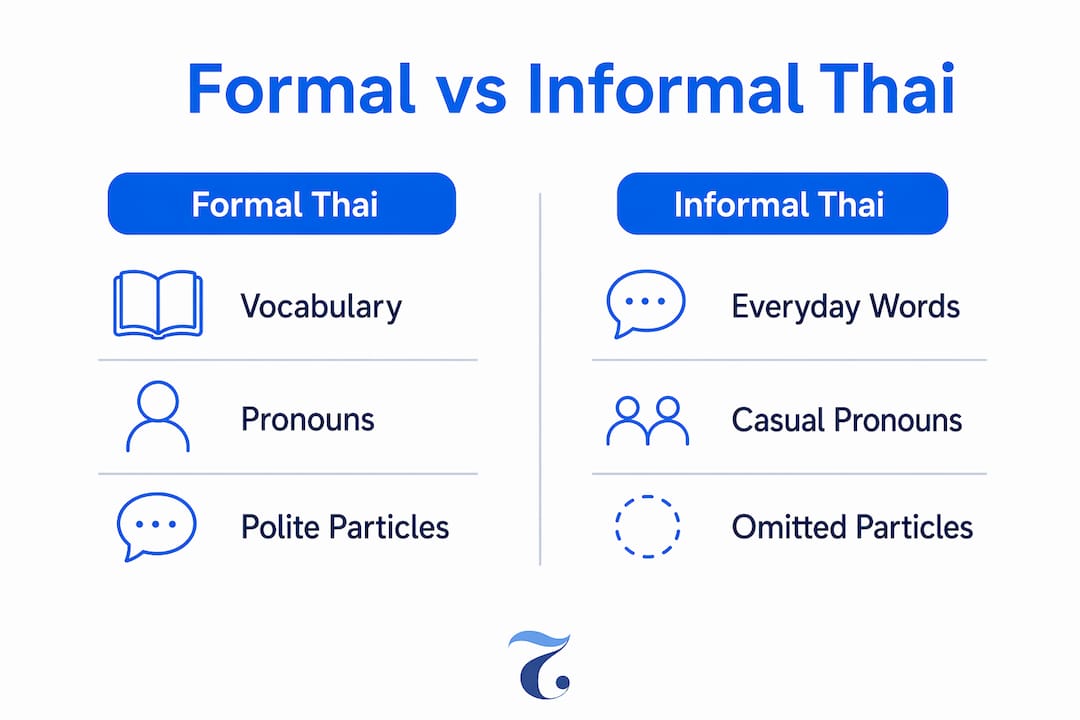
The clearest way to see the difference between Thai language variations is through vocabulary and pronouns. Formal Thai replaces everyday words with high-register alternatives. Informal Thai speech avoids the first-person pronouns and contractions used in formal speech and embraces colloquialisms among familiar speakers. The contrast is sharp and consistent.
Vocabulary: the most visible difference
Formal Thai replaces common verbs with specialized high-register vocabulary. The everyday word “kin” means “to eat,” but in a formal context, a Thai speaker uses “rapprathan” instead. That single swap signals education, respect, and awareness of social context. Learners who only know the casual word will be understood, but they will also stand out as unfamiliar with Thai language etiquette.
The same pattern applies to dozens of common words. Formal Thai has dedicated vocabulary for actions like sleeping, speaking, and arriving, each with a polished equivalent that casual speech never uses. Mastering even a handful of these formal substitutions makes a significant difference in professional or ceremonial settings.
Pronouns: the social hierarchy in one word
Pronoun choice is where formal vs informal speech in Thai becomes most socially loaded. Common formal pronouns include “khaphachao” for “I” in very formal male speech, while informal pronouns such as “chan” and “phom” vary by gender and context. Choosing the wrong pronoun does not just sound odd. It can communicate the wrong level of respect or intimacy entirely.
Thai has no single neutral word for “I.” Every option carries a social signal about your gender, your relationship to the listener, and the formality of the situation. That is a feature of the language, not a flaw. It reflects how deeply social awareness is built into Thai grammar.
Polite particles: the finishing touch
Using polite particles like “kráp” for male speakers and “kâ” for female speakers is required to convey respect in formal Thai speech. These particles appear at the end of sentences and adjust the tone dynamically. Dropping them in a formal context reads as blunt or even rude, even if every other word is correct.
Pro Tip: Add “kráp” or “kâ” to the end of every sentence when speaking to someone older, in a position of authority, or in a professional setting. This single habit will immediately improve how Thai speakers perceive your politeness.
| Feature | Formal Thai | Informal Thai |
|---|---|---|
| Vocabulary | High-register words (e.g., “rapprathan” for eat) | Everyday words (e.g., “kin” for eat) |
| Pronouns | “Khaphachao” and other formal first-person forms | “Chan,” “phom,” and context-dependent forms |
| Polite particles | “Kráp” and “kâ” used consistently | Often omitted among close friends |
| Tone | Measured, deliberate, structured | Relaxed, fast, and colloquial |
How social context shapes which register you use
Thai honorifics express social relationships grammatically, making pronoun and particle use central to respectful communication. This is not just a language rule. It reflects a cultural value system where age, status, and relationship define how people speak to each other. Thai language etiquette is inseparable from Thai social etiquette.
The settings that call for formal Thai are easy to identify:
- Government offices and official meetings
- Schools, universities, and academic presentations
- Television news, radio broadcasts, and formal speeches
- Religious ceremonies and royal contexts
- Job interviews and professional correspondence
Informal Thai, by contrast, fits naturally in:
- Conversations with close friends and family
- Casual shopping at local markets
- Text messages and social media among peers
- Relaxed social gatherings and meals
Social hierarchy and respect are embedded within Thai language use far deeper than vocabulary alone. Choosing the right register requires awareness of context, relationship, and relative status. A Thai person meeting a new colleague for the first time will default to formal speech until the relationship warms. That default is not stiffness. It is respect.
Regional culture also plays a role. Urban Bangkok speech tends to follow Standard Thai norms more closely, while rural and regional communities may blend formal structures with local informal patterns depending on the audience.
Practical guidance for using formal and informal Thai correctly
Switching between registers confidently is a skill that develops with practice. The good news is that a few clear principles cover most situations a learner will encounter.
-
Read the room before you speak. If you are in a government building, a school, or a formal event, default to formal Thai. If you are with friends at a restaurant or chatting with a neighbor, informal Thai is appropriate and even expected.
-
Match the register of the person speaking to you. Thai speakers signal the appropriate register through their own word choices. If someone uses formal pronouns and polite particles with you, mirror that register back.
-
Start formal and relax gradually. Learners are advised to start with Standard Thai, focusing on polite forms and formal vocabulary, while gradually incorporating informal speech for casual interactions. Starting formal is always safer than starting too casual.
-
Never drop polite particles in ambiguous situations. When you are unsure of the relationship or setting, keep “kráp” or “kâ” in every sentence. Removing them prematurely is a common mistake that signals overconfidence or disrespect.
-
Pay attention to tone and body language. Formal Thai speech is typically slower, more deliberate, and accompanied by upright posture. Informal Thai is faster and more relaxed. Matching your physical delivery to your word choices reinforces the right register.
Pro Tip: When learning Thai for professional or business use, practice formal vocabulary and pronouns first. You can always loosen your language as relationships develop, but you cannot undo a poor first impression caused by overly casual speech.
Understanding the cultural aspects of learning Thai alongside grammar rules accelerates this process significantly. Language and culture are not separate subjects in Thai. They are the same subject.
How regional dialects interact with formal and informal Thai
Standard Thai is the formal register and the national lingua franca. Regional dialects such as Isan, Northern Thai, and Southern Thai coexist with formal and informal speech, often prioritizing casual, efficient forms distinct from Standard Thai’s formal structures. This adds a layer of complexity that learners should understand.
| Region | Dialect | Relationship to Standard Thai |
|---|---|---|
| Northeast Thailand | Isan | Closely related to Lao; informal daily use |
| Northern Thailand | Kham Mueang | Distinct tones and vocabulary; informal contexts |
| Southern Thailand | Pak Tai | Fast speech patterns; informal and regional |
| Central Thailand | Standard Thai | Official formal register; used in education and media |
Dialect speakers in Thailand are typically bilingual in their regional dialect and Standard Thai. They switch to Standard Thai in formal settings such as schools, government offices, and national media. In family and community settings, the regional dialect takes over. This code-switching is natural and fluent for native speakers.
For learners, this means that Thai regional dialects can create confusion when traveling outside Bangkok. A phrase that sounds perfectly normal in Standard Thai may be unfamiliar or even humorous in a regional context. Starting with Standard Thai gives you the widest reach and the strongest foundation for navigating these variations.
Key Takeaways
Mastering formal and informal Thai requires understanding that register choice is a social act, not just a grammatical one, governed by context, relationship, and cultural respect.
| Point | Details |
|---|---|
| Two distinct registers | Formal Thai serves official and professional settings; informal Thai fits casual and personal interactions. |
| Vocabulary signals register | Words like “rapprathan” (formal) versus “kin” (informal) immediately signal your awareness of social context. |
| Pronouns carry social weight | Every Thai first-person pronoun communicates gender, formality, and relationship status simultaneously. |
| Polite particles are non-negotiable | Adding “kráp” or “kâ” to sentences is the fastest way to signal respect in any formal or ambiguous setting. |
| Start formal, relax gradually | Defaulting to Standard Thai and formal speech protects you from unintentional disrespect while relationships develop. |
Why formality in Thai is really about reading people
Most learners approach formal and informal Thai as a vocabulary problem. Memorize the formal words, add the right particles, and you are done. That approach works on a test. It falls short in real life.
What I have found, after years of observing how Thai is taught and used, is that the deeper skill is reading the person in front of you. Thai speakers do not just listen to your words. They watch how you position yourself socially through language. A foreigner who uses formal Thai with an elderly shopkeeper earns immediate warmth, not because the grammar was perfect, but because the effort signals respect.
The honorific system is more important for social integration in Thailand than merely knowing vocabulary. That insight reframes the entire learning process. You are not just learning words. You are learning how to signal who you are and how you see the person you are talking to.
The mistake I see most often is learners who rush to informal Thai because it feels more natural or friendly. Informal Thai among strangers does not read as friendly in Thai culture. It reads as presumptuous. The warmth comes after the respect, not before it. Patience with formality is one of the most culturally intelligent moves a learner can make.
— Paul
Thai Explorer: courses built for real-world Thai communication
Thai Explorer offers adult Thai language courses in Singapore designed to build both formal and informal communication skills from the ground up. Whether your goal is confident travel conversation, professional business Thai, or cultural fluency, the curriculum covers the full range of Thai language variations with native bilingual instructors.

Group classes, private lessons, and online Thai courses via Zoom give you the flexibility to learn at your own pace. Corporate training is also available for teams preparing for business engagement in Thailand. Thai Explorer’s curriculum aligns with the CU-TFL standard, giving your learning a recognized structure. Classes are held at 10 Anson Road, #22-07, International Plaza, Singapore 079903, right above Tanjong Pagar MRT. Explore the full Thai language course options and find the format that fits your schedule and goals.
FAQ
What is the main difference between formal and informal Thai?
Formal Thai uses high-register vocabulary, specific pronouns, and polite particles like “kráp” and “kâ,” while informal Thai uses everyday words and drops many of these markers. The setting and relationship between speakers determine which register is appropriate.
When should I use formal Thai?
Use formal Thai in government offices, schools, business meetings, religious ceremonies, and any interaction with someone older or in a position of authority. Defaulting to formal speech in unfamiliar situations is always the safer choice.
What are polite particles in Thai and why do they matter?
Polite particles are short words added to the end of sentences to signal respect and gender. “Kráp” is used by male speakers and “kâ” by female speakers. Omitting them in formal or professional contexts can come across as rude, even if the rest of the sentence is grammatically correct.
Do regional dialects follow the same formal and informal rules?
Regional dialects like Isan, Northern Thai, and Southern Thai tend to favor informal, casual forms in daily use. Speakers switch to Standard Thai, the formal register, in official and educational settings. Learners should prioritize Standard Thai to communicate effectively across all regions.
How do I start learning formal Thai as a beginner?
Start with Standard Thai, focusing on polite pronouns, formal vocabulary, and consistent use of polite particles. Thai Explorer’s structured Thai courses cover both registers with native instructors who guide learners through real-world application from the first lesson.