
TL;DR:
- Thai reading comprehension involves building foundational script knowledge, expanding vocabulary, mastering segmentation, and applying strategic techniques. Challenges include lack of word spacing, tonal marks, vowel placement, and absence of punctuation, requiring systematic practice and digital tools. Consistent self-assessment, patience, and combining formal instruction with independent reading accelerate progress effectively.
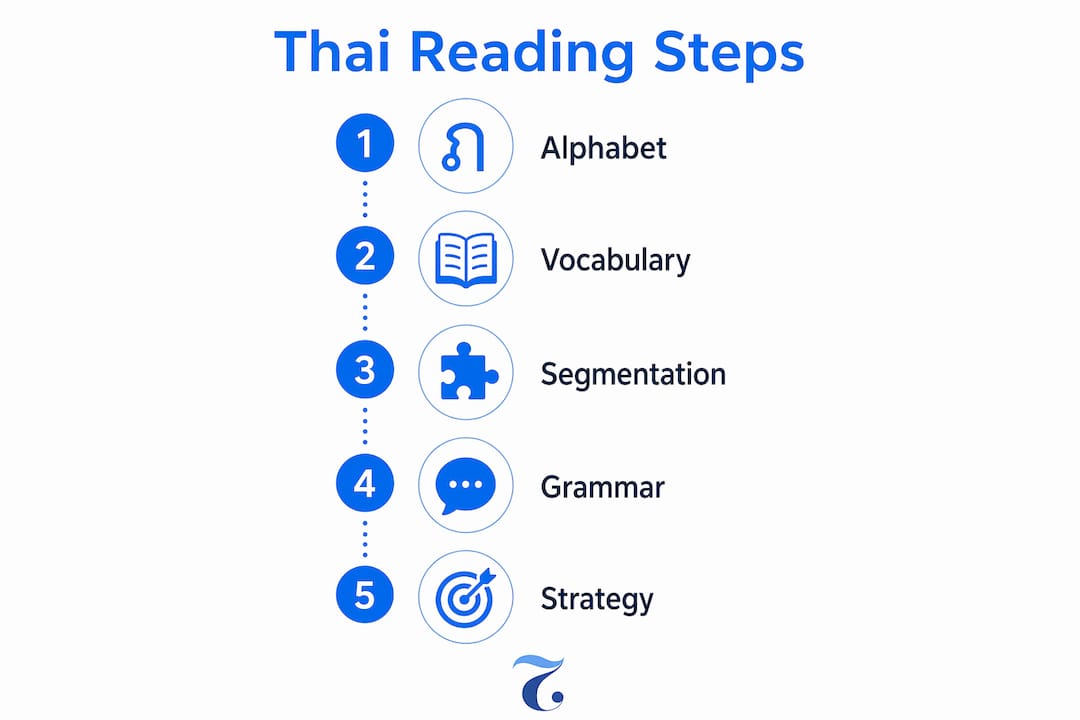
Thai reading comprehension is defined as the ability to decode, segment, and extract meaning from continuous Thai script, a skill that requires systematic steps rather than casual exposure. The core Thai reading comprehension steps are: build foundational script knowledge, expand vocabulary and grammar, master word segmentation, apply strategic reading techniques, and track measurable progress. Apps like TamraThai and libraries like pythainlp have made each of these steps more accessible for adult learners. Whether your goal is personal enrichment, academic study, or professional communication, this structured approach delivers results faster than isolated character drills ever will.
What are the unique challenges in Thai reading comprehension?
Thai script presents obstacles that learners of alphabetic languages rarely anticipate. Understanding these challenges upfront is the prerequisite to applying any reading improvement strategy effectively.
The most disorienting feature of written Thai is scriptio continua: no spaces between words. A single line of Thai text can contain seven or more distinct words with zero visual separation between them. This means your brain cannot rely on whitespace to locate word boundaries, which is the primary cue readers of English, Spanish, or German use automatically.
Beyond spacing, Thai script layers several other complexities:
- Tonal marks: Thai has five tones, and written markers above or below consonants signal which tone applies. Misreading a tone mark changes meaning entirely.
- Vowel placement: Thai vowels appear before, after, above, and below their base consonant, sometimes in combinations that wrap around the consonant cluster.
- 44 consonants and 32 vowel forms: The sheer inventory is larger than most European scripts, and consonants are grouped into three classes that affect tone rules.
- No capitalization or punctuation conventions: Sentence boundaries are not marked by periods in informal text, making it harder to identify where one idea ends and another begins.
Before applying any reading comprehension strategy, you need a working knowledge of the Thai alphabet, basic phonetics, and tone rules. Dictionaries like the Royal Institute Dictionary and digital tools that highlight word boundaries are practical prerequisites. Foundational reading skills built at this stage determine how quickly every subsequent step pays off.
How can vocabulary and grammar building improve your Thai reading comprehension?
Vocabulary knowledge is the single strongest predictor of reading comprehension in any language. In Thai, this relationship is even more direct because you cannot guess word boundaries without knowing what words look like. The more Thai words you recognize on sight, the faster you can segment and understand a sentence.

TamraThai is built on this principle, combining vocabulary and grammar learning specifically through reading Thai texts rather than isolated drills. This approach mirrors what research on English comprehension strategies consistently shows: contextual vocabulary acquisition transfers to reading far better than memorizing word lists in isolation.
Effective methods for building vocabulary and grammar together include:
- Contextual reading: Read short Thai texts slightly above your current level. When you encounter an unknown word, use surrounding context before reaching for a dictionary.
- Spaced repetition flashcards: Apps like Anki with Thai decks reinforce high-frequency vocabulary at optimal intervals.
- Grammar pattern recognition: Learn to identify common Thai sentence structures such as Subject-Verb-Object patterns and the placement of classifiers, so you can parse meaning even when individual words are unfamiliar.
- Real materials: Thai news headlines, menus, and short social media posts expose you to authentic vocabulary in natural contexts.
Grammar knowledge specifically helps you predict what part of speech comes next in a sentence. When you know that Thai adjectives follow nouns, you stop searching for meaning in the wrong direction. This predictive reading is a core Thai language understanding technique that separates intermediate readers from beginners.
Pro Tip: Set a target of 10 new Thai words per day drawn from texts you are already reading. This ties new vocabulary directly to reading practice rather than treating them as separate tasks.
What are practical steps and tools for developing segmentation skills in Thai?
Word segmentation is the process of identifying where one word ends and the next begins in continuous Thai text. It is the technical foundation of all reading comprehension, and Thai word segmentation cannot be skipped or approximated.
The most reliable segmentation approaches combine dictionary lookup with character cluster boundary constraints. The kham-core segmentation engine uses a DAG-based maximal matching algorithm constrained to Thai character clusters, which means it identifies word boundaries by matching against a dictionary while respecting the phonological rules of Thai syllable structure. For learners, this matters because it shows you the logic behind segmentation: Thai words follow predictable phonetic patterns, and recognizing those patterns trains your eye over time.
The Python library pythainlp applies dictionary-based tokenization to Thai text before any further processing, and the same principle applies to human readers. When you train yourself to spot Thai syllable clusters, you are essentially running the same boundary detection process manually.
Comparing segmentation approaches for learners
| Method | Best for | Limitation |
|---|---|---|
| Dictionary lookup (manual) | Building word recognition over time | Slow; requires large vocabulary base |
| pythainlp tokenization | Digital text analysis and study tools | Requires technical setup |
| kham-core algorithm | High-accuracy automated segmentation | Not a direct learner-facing tool |
| Sentence-level chunking | Breaking long passages into units | Does not resolve word-level ambiguity |
| Graded readers with spacing | Beginners building segmentation intuition | Limited authentic text availability |
Sentence-level segmentation offers more coherent reading units than character-level analysis. Splitting Thai text at natural sentence boundaries preserves meaning and gives you manageable chunks to process. Practically, this means reading one clause at a time rather than attempting to decode an entire paragraph in one pass.
Exercises that build segmentation skill include copying Thai sentences by hand, marking word boundaries with a pencil before reading aloud, and using digital tools that display tokenized Thai text alongside the original. The step-by-step reading guide from Thai Explorer walks through this process with structured exercises designed for adult learners.
Pro Tip: Copy a short Thai paragraph and insert a slash between each word you think you recognize. Then check against a dictionary or tokenizer. This single exercise builds segmentation intuition faster than passive reading alone.
What strategic reading techniques increase comprehension in Thai texts?
Strategic reading means approaching a text with deliberate techniques rather than reading word by word and hoping meaning accumulates. For Thai, where ambiguity is frequent and translation is tempting, strategy is what separates learners who plateau from those who keep improving.
Ambiguity tolerance is the psychological capacity to sit with uncertainty in a text without shutting down comprehension. Mindfulness practice improves second-language reading comprehension by increasing ambiguity tolerance, with a measured effect size of d=1.59 over eight weeks. That is a large effect by any research standard, meaning the psychological dimension of reading is not soft advice. It is a quantifiable performance factor.
The Directed Reading-Thinking Activity (DR-TA) is a cyclical reading method where you predict content before reading, read to confirm or revise your prediction, and then reflect on what you understood. A structured DR-TA intervention produced a 70.60% improvement in English reading comprehension scores, with mean scores rising from 11.71 to 21.18. The same predict-read-reflect cycle transfers directly to Thai reading practice.
Practical strategic reading techniques for Thai include:
- Preview before reading: Scan headings, images, and any familiar words before attempting a full read. This activates prior knowledge and reduces cognitive load.
- Read for gist first: On the first pass, aim to understand the general topic rather than every word. This builds a mental framework that makes the second pass far more productive.
- Use context to infer meaning: When you encounter an unknown word, look at the surrounding sentence. Thai context clues work the same way English comprehension strategies use them.
- Avoid immediate translation: Translating word by word breaks reading flow and prevents you from developing Thai-language intuition. Reserve translation for checking, not for primary comprehension.
- Read graded Thai stories: Materials calibrated to your level give you authentic reading practice without overwhelming ambiguity. Thai Explorer’s reading strategies for adults include graded text recommendations at multiple proficiency levels.
Combining mindfulness with DR-TA creates a reading practice that is both psychologically sustainable and structurally effective. You stay calm when you hit an unfamiliar passage, and you have a method for working through it rather than stopping.
How to troubleshoot common mistakes and measure progress in Thai reading
Most adult learners make the same set of errors when working through Thai reading comprehension steps. Recognizing them early saves months of frustration.
- Relying on immediate translation. Reaching for Google Translate after every unfamiliar word prevents you from building contextual inference skills. Use translation to verify, not to comprehend.
- Ignoring segmentation. Skipping segmentation practice and treating Thai text as a stream of characters rather than words is the most common beginner error. It makes every subsequent comprehension step harder.
- Skipping ambiguous passages. When a sentence does not make sense, the instinct is to move on. Instead, mark it, attempt a contextual guess, and return to it after finishing the paragraph.
- Measuring progress only by vocabulary count. Vocabulary growth is one metric, but timed reading speed and comprehension accuracy on unfamiliar texts are more reliable indicators of real improvement.
- Practicing only with familiar content. Re-reading texts you already understand feels productive but does not build new comprehension capacity. Introduce at least one unfamiliar text per week.
Self-assessment methods that work include comprehension questions after each reading session, timed reading exercises where you track how many words per minute you process accurately, and periodic testing using structured tools. The Thai language proficiency test at Thai Explorer gives you a calibrated benchmark against recognized standards, including the CU-TFL framework used by Chulalongkorn University.
Pro Tip: Keep a reading log. After each session, write two sentences in English summarizing what you read in Thai. If you cannot do it, you have identified exactly where your comprehension broke down.
Key takeaways
Mastering Thai reading comprehension requires building script knowledge, vocabulary, segmentation skill, and strategic reading habits in sequence, with consistent self-assessment to measure real progress.
| Point | Details |
|---|---|
| Segmentation is foundational | Thai has no word spaces, so learning to identify word boundaries is the first practical skill to develop. |
| Vocabulary drives comprehension | Contextual vocabulary learning through real Thai texts outperforms isolated word list memorization. |
| Ambiguity tolerance matters | Mindfulness-based practice measurably improves second-language reading by reducing anxiety around unknown content. |
| DR-TA accelerates gains | The predict-read-reflect cycle produces documented comprehension improvements and works directly in Thai reading practice. |
| Track progress with real metrics | Timed reading, comprehension questions, and proficiency tests give more accurate feedback than vocabulary counts alone. |
Why patience and strategy matter more than raw study hours
I have worked with adult Thai learners across a wide range of starting points, and the pattern I see most often is this: the learners who improve fastest are not the ones who study the most hours. They are the ones who study with the right sequence and stay calm when the text resists them.
Thai script genuinely does not behave like any writing system most adult learners have encountered before. The absence of spaces is not a minor quirk. It changes how your visual processing system has to work, and that takes time to rewire. Learners who accept this upfront stop feeling like they are failing when a sentence does not click immediately.
The technology available now, pythainlp, kham-core, TamraThai, genuinely changes what is possible for self-directed learners. But I have seen learners use all the right apps and still plateau because they skipped the segmentation work or never built ambiguity tolerance. Tools support the steps. They do not replace them.
My strongest recommendation is to blend structured course instruction with independent reading practice. Course instruction gives you the grammar framework and corrects errors you cannot catch alone. Independent reading builds the speed and intuition that only comes from volume. Neither works as well without the other. If you are serious about reading Thai for professional or academic purposes, that combination is not optional. It is the method.
— Paul
Build your Thai reading skills with Thai Explorer
Thai Explorer offers structured adult Thai language courses in Singapore designed to develop all four language skills, including reading comprehension, through a curriculum aligned with the CU-TFL framework. Whether you prefer group or private Thai lessons, or need the flexibility of online Thai courses via Zoom, every program is taught by qualified native Thai instructors who are bilingual in Thai and English.

Corporate training options are also available for teams seeking practical Thai communication skills for business use. Thai Explorer is located at 10 Anson Road, #22-07, International Plaza, Singapore 079903, directly above Tanjong Pagar MRT. Explore the full range of adult Thai courses and find the program that fits your reading and language goals.
FAQ
What are the first steps to improve Thai reading comprehension?
The first steps are learning the Thai alphabet and phonetics, then practicing word segmentation to identify boundaries in continuous script. Without these foundations, vocabulary and grammar study cannot transfer to actual reading.
Why is word segmentation so important in Thai reading?
Thai text contains no spaces between words, so readers must identify word boundaries manually. Skipping segmentation practice is the most common error among beginners and makes every other comprehension step harder.
How does ambiguity tolerance affect Thai reading skills?
Ambiguity tolerance is the ability to continue reading without understanding every word. Research shows it mediates second-language reading comprehension with an effect size of d=1.59, making it one of the most impactful factors in reading improvement.
What tools help with Thai reading comprehension practice?
TamraThai integrates vocabulary and grammar learning through Thai texts. pythainlp and kham-core provide dictionary-based word segmentation for digital study. Graded Thai readers and the Thai Explorer proficiency test round out a practical toolkit.
How long does it take to read Thai fluently?
Progress depends on study consistency, prior language background, and whether you follow structured steps. Adult learners who combine course instruction with daily independent reading typically reach functional reading ability within 12 to 18 months of consistent practice.