
TL;DR:
- Structured Thai courses offer a systematic progression that prevents learners from plateauing and ensures steady skill development. They incorporate cultural context, live practice, and assessments, leading to faster and more reliable fluency compared to self-study resources. Tailored to individual goals, these programs deliver authentic communication skills essential for travel, business, or social interactions.
Learning Thai from YouTube clips and free apps feels productive at first. Then you hit a wall. The tones blur together, grammar patterns stop making sense, and the scripts you memorized don’t work in real conversations. This is where the role of structured Thai courses becomes impossible to ignore. Free resources rarely take you from curious beginner to confident communicator because they were never designed to do that. A structured program builds your skills in the right order, holds you accountable, and gives you the cultural context that turns textbook Thai into real-world fluency.
Table of Contents
- Key takeaways
- The role of structured Thai courses in language mastery
- Why structured programs outperform self-study
- How structure adapts to your specific goals
- Choosing and using a structured Thai course effectively
- My honest take on why structure changes everything
- Start learning Thai with a program that works
- FAQ
Key takeaways
| Point | Details |
|---|---|
| Structure prevents plateaus | Systematic progression through tones, grammar, and script stops the stalling common with self-study. |
| Competency-based design works | Curricula built around measurable skills produce faster, more reliable language growth. |
| Culture is part of the language | Courses that integrate cultural context help you communicate naturally, not just correctly. |
| Goal alignment matters | Choosing a course built for your specific goal — travel, business, or social connection — accelerates results. |
| Active participation drives retention | Interactive lessons with feedback loops and progress tracking keep motivation high and outcomes measurable. |
The role of structured Thai courses in language mastery
Thai is not a language you can piece together casually. It has 44 consonants, 32 vowel forms, five tones that change word meaning entirely, and a script with no spaces between words. Getting any one of those elements wrong produces genuine miscommunication. A structured curriculum addresses each element in sequence, building the foundation before adding complexity.
The best structured Thai programs are built around several core components:
- Phonetics and tones first. Before vocabulary or grammar, learners need accurate pronunciation. A structured course isolates tonal patterns and consonant classes so they become instinct, not guesswork.
- Grammar sequencing. Thai grammar is analytic and relies heavily on word order and particles. A good course introduces these progressively, not all at once.
- Script reading and writing. Structured courses integrate the Thai script from early levels so reading becomes a tool for reinforcement, not a separate challenge tackled later.
- Cultural context woven throughout. Language is behavior. Structured programs teach not just what to say but when and how to say it, which is something no app teaches well.
- Competency checkpoints. Frequent assessments like quizzes and unit exams validate that learners are actually progressing rather than just moving through material.
Behind the scenes, a structured course also runs on operational logistics that most learners never think about. Timetables, teacher allocation, and progress monitoring keep both the learner and the instructor on track. Without these systems, even well-designed curriculum materials fail to produce consistent results.
Pro Tip: Before enrolling in any Thai course, ask the school directly how they track your progress. A school with a real answer is a school with a real structure.
Why structured programs outperform self-study
The comparison is not even close once you look at outcomes. Free resources have genuine value for supplementing your learning, but they share a critical flaw. Self-study resources typically lack complete learning sequences, which causes learners to plateau after basic phrases and never progress to natural conversation.
Here is a direct comparison of what each approach delivers:
| Factor | Structured Thai courses | Self-study / free resources |
|---|---|---|
| Curriculum design | Sequenced, skill-building, validated | Random, topic-driven, inconsistent |
| Progress tracking | Regular assessments and teacher feedback | Self-assessed, often optimistic |
| Cultural integration | Built into every lesson level | Rare, usually surface-level |
| Accountability | Scheduled classes, teacher monitoring | Entirely self-motivated |
| Speaking practice | Live interaction with correction | Limited, often zero |
| Time to functional fluency | Predictable with consistent pacing | Highly variable, often stalled |
The time factor is worth calling out specifically. Completing a core Thai curriculum at just 20 to 30 minutes of daily study takes approximately six to seven months. That kind of pacing is only possible when someone has already mapped the curriculum and built the milestones for you. Left to self-study, most learners spend those same months re-covering content they already saw rather than advancing.
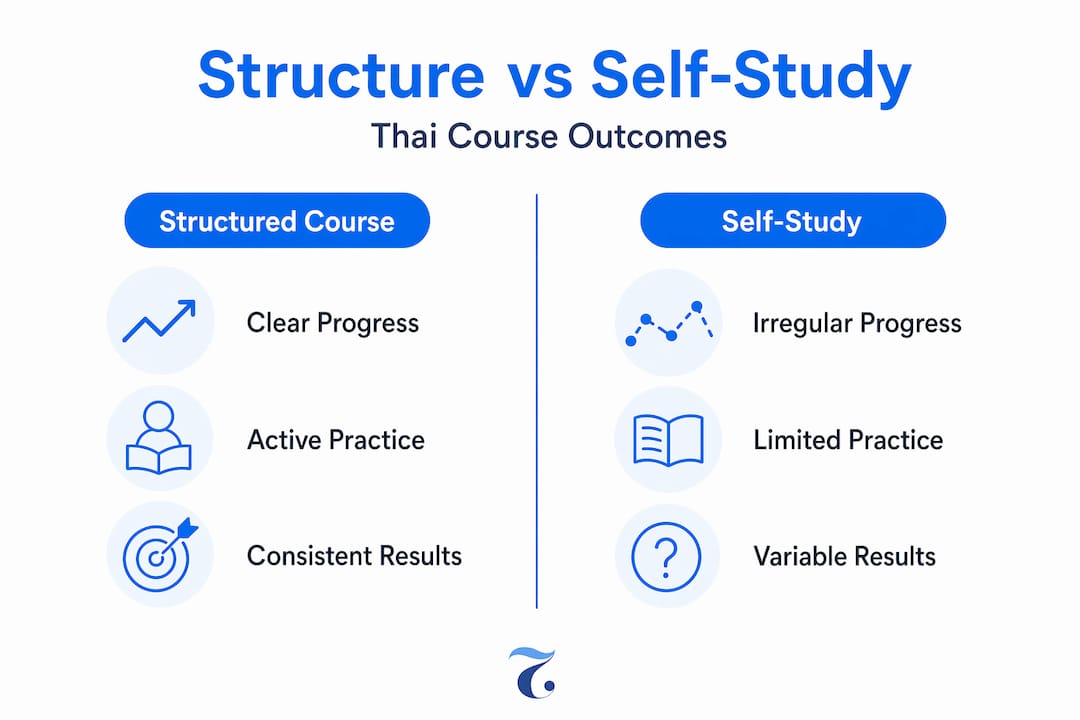
The engagement difference also matters. Interactive lesson plans and progress tracking increase both learner motivation and retention. Structured classes create situations where you cannot coast. You speak, get corrected, and improve in real time.
A competency-based curriculum with active learning and evaluation consistently produces better language management outcomes than informal exposure alone. That is not a preference. It is a measurable result replicated across language education research.
How structure adapts to your specific goals
One of the most underrated benefits of structured Thai courses is how well a good program can be shaped around what you actually need. The curriculum for someone preparing for business meetings in Bangkok looks different from the one designed for a traveler wanting to navigate markets and social situations in Chiang Mai.
Here is how structured programs serve different adult learner goals:
- Conversational Thai. Courses focused here prioritize spoken fluency, natural phrasing, and tonal accuracy in everyday contexts. Role plays, listening exercises, and real-scenario practice replace grammar drills as the main activity.
- Business Thai. These programs add professional vocabulary, formal register, and understanding of workplace etiquette. Knowing when to use polite particles and how to read the social hierarchy in a Thai office setting is not optional if you want to work effectively with Thai colleagues.
- Travel and cultural appreciation. Here the cultural modules take center stage. You learn the language of mealtimes, temple visits, market negotiations, and social gatherings. Native Thai instructors are especially valuable in this context because they carry authentic cultural knowledge that no curriculum document can fully capture.
- Online learning for adults. Flexible structured formats including online Zoom classes and corporate training give working adults consistent scheduling without sacrificing the interactive feedback that makes structured learning effective.
The ability to tailor a structured program to your goal is what separates a useful course from a generic one. And it is what separates a language school with genuine teaching methodology from one that simply sells access to content.
Choosing and using a structured Thai course effectively

Knowing that structured courses work is only half the equation. You also need to know which ones are worth your time and how to get the most out of them once you commit.
Here is a practical process for evaluating and engaging with any structured Thai program:
- Examine the curriculum outline. A credible course should be able to show you what skills you will develop at each stage. Vague descriptions like “you will learn Thai basics” are a warning sign. Look for specific competencies, topics, and skill areas at each level.
- Ask about assessment and feedback. How does the school know you are progressing? Quality programs use quizzes, oral assessments, and teacher feedback at regular intervals rather than waiting for a final exam to reveal problems.
- Check teacher qualifications. Bilingual native speakers who are also trained in language instruction deliver a qualitatively different experience than fluent speakers without pedagogical training. The ability to explain why something works in Thai matters as much as demonstrating it.
- Look at the format options. Does the course offer group, private, and online formats? This tells you whether the school has genuinely thought about different learner needs or is offering a one-size approach.
- Clarify expected time commitment. A course that does not give you a realistic estimate of weekly study time is not being honest about what fluency requires.
Pro Tip: Commit to one full course level before switching programs or formats. Jumping between resources before completing a structured cycle is the fastest way to repeat the same plateau you were trying to escape.
You can also get more context from reading through a step-by-step Thai course guide before you make a decision. Understanding how course levels connect helps you choose the right entry point and plan your learning trajectory realistically. The cognitive and social benefits of structured language learning extend well beyond the language itself, making the investment worthwhile on multiple levels.
My honest take on why structure changes everything
In my experience watching adult learners attempt Thai through apps, YouTube channels, and occasional language exchange meetups, the pattern is almost always the same. Enthusiasm in the first two months. Noticeable plateau by month three. Near-total dropout by month five.
What I’ve found is that the problem is almost never motivation. People genuinely want to learn. The problem is that free and unstructured resources create the feeling of progress without the actual foundation. You can learn to say “sawasdee kha” and order pad thai. But the moment a native speaker responds at normal speed, the illusion collapses.
What I’ve seen work, consistently, is structure built around real competency growth. Not hours logged. Not lessons completed. Actual demonstrated ability at each stage before moving forward. The schools that take curriculum design and learner-context alignment seriously produce students who can hold real conversations. The ones that don’t produce students who can recite phrases.
My recommendation is to look for programs with native teachers who are also trained educators, not just fluent speakers. And look for evidence that cultural fluency is treated as part of the language instruction, not as a bonus module at the end. Thai communication is deeply tied to social context. A course that ignores that is teaching you only half the language.
— Paul
Start learning Thai with a program that works
Thai Explorer is a Thai language school in Singapore that was built specifically for adult learners who want results they can use. Every structured Thai language course is taught by qualified native Thai instructors who are bilingual in Thai and English, so explanations are clear and corrections are precise. The curriculum covers speaking, listening, reading, and writing with cultural context embedded at every level. Whether your goal is conversational confidence, professional communication, or travel readiness, there are group, private, and online class formats to match your schedule. Thai Explorer is located right above Tanjong Pagar MRT at 10 Anson Road, #22-07, International Plaza, Singapore 079903. Explore the full course options and find the level that fits where you are right now.
FAQ
What is the role of structured Thai courses for beginners?
Structured Thai courses give beginners a sequenced path through the fundamentals: tones, consonants, script, and grammar in the right order. Without this sequence, learners commonly stall at surface-level phrases and cannot progress to real conversation.
How long does it take to complete a structured Thai course?
At a consistent pace of 20 to 30 minutes of daily study, a core Thai curriculum typically takes six to seven months to complete. Structured programs make this timeline realistic by mapping milestones clearly from the start.
Why choose structured Thai classes over free apps?
Free apps lack the systematic progression, live speaking practice, and cultural integration that structured courses provide. They work well as supplements but rarely produce functional fluency on their own.
Do structured Thai programs work for business purposes?
Yes. Business-focused structured programs cover professional vocabulary, formal register, and Thai workplace etiquette, giving learners the specific communication skills needed for professional contexts in Thailand or with Thai colleagues.
How do structured Thai courses integrate cultural learning?
Quality structured programs weave cultural context into every lesson rather than treating it as a separate topic. Native teachers play a key role here, providing authentic insight into social norms, communication styles, and cultural expectations that textbooks alone cannot convey.