
TL;DR:
- Flexible language programs adapt scheduling, pace, and content to individual goals, improving test scores and motivation. Combining digital tools with qualified instructors enhances outcomes, with students benefiting from personalized feedback and goal setting. Choosing a program aligned with specific objectives and ensuring it maintains structure and instructor support is key to success.
A flexible language program is a learner-centered approach that adjusts scheduling, pace, and content to fit the individual rather than forcing the individual to fit a fixed curriculum. Unlike traditional classroom models with locked timetables and uniform syllabi, flexible programs let you start when you are ready, move at your own speed, and focus on the skills that matter most to your goals. Research shows that flexible tutoring models improve test performance by 12% over traditional approaches. That single figure captures why so many adult learners are moving away from rigid courses and toward programs built around their real lives.
What is a flexible language program and how does it work?
A flexible language program, also called a customizable or adaptive language program, is defined by three core features: adjustable scheduling, personalized content, and variable pacing. Each feature addresses a different barrier that causes learners to quit traditional courses.

Scheduling adaptations remove the biggest obstacle for working adults. Instead of committing to a fixed class every Tuesday at 7 p.m., you choose from on-demand sessions, rotating time slots, or modular terms. Modular programs built on 8-week blocks let learners start, pause, and resume without losing progress or paying for missed weeks. That structure reduces pressure and keeps motivation intact across months of study.
Content customization means your lessons reflect your actual goals. A traveler preparing for a trip to Thailand needs conversational phrases, tonal pronunciation, and cultural context. A professional preparing for business meetings needs formal registers, industry vocabulary, and negotiation language. A program that treats both learners identically wastes everyone’s time.
Pace flexibility separates self-paced digital learning from live scheduled sessions. Self-paced formats suit learners who absorb material quickly or who study in short bursts between work commitments. Scheduled live sessions, even when held online, create accountability and allow real-time correction from a qualified instructor.
| Feature | Rigid program | Flexible program |
|---|---|---|
| Schedule | Fixed days and times | On-demand or rotating slots |
| Content | Uniform syllabus for all | Customized to learner goals |
| Pace | Set by class average | Learner-controlled |
| Start date | Fixed enrollment periods | Rolling or modular entry |
| Feedback | Group-based | Personalized from instructor |
Pro Tip: When evaluating any program, ask whether you can adjust your schedule mid-term without penalty. A genuinely flexible program builds that option into its structure from the start.
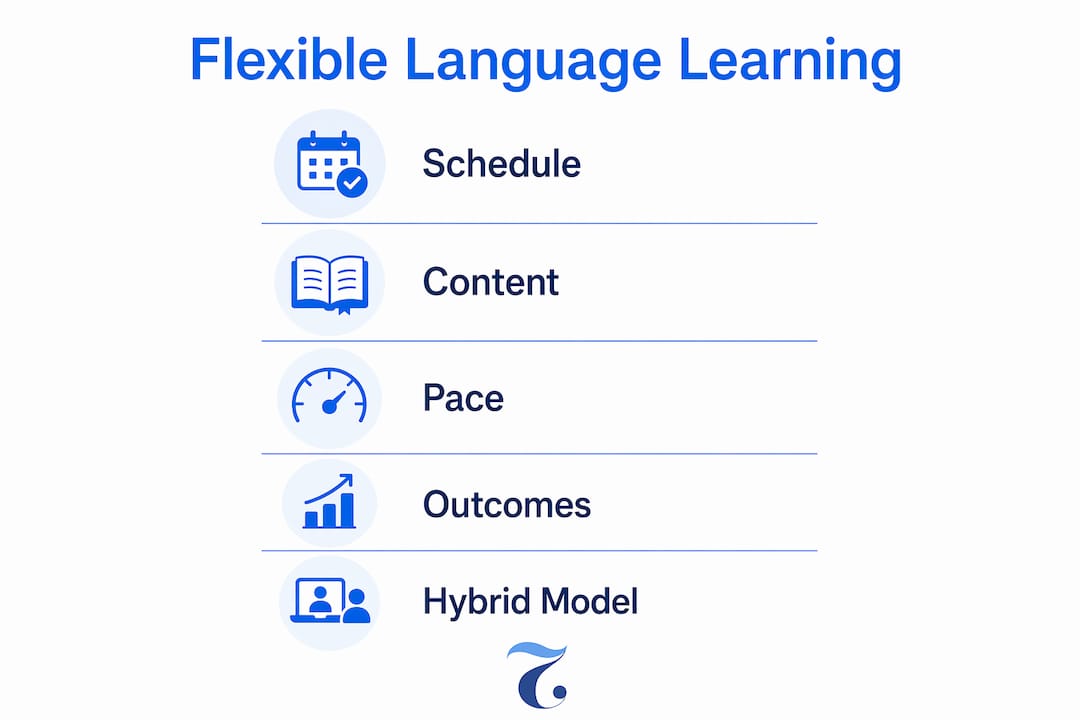
The most effective flexible programs combine digital convenience with qualified human instruction. Hybrid models pairing digital tools with expert tutors produce better personalized feedback and higher engagement than either format alone. You get the convenience of studying from your phone at midnight and the accuracy correction that only a trained instructor can provide.
What are the proven benefits of flexible language programs?
Flexible language learning produces measurable gains across multiple dimensions, not just test scores. The evidence points to cognitive, motivational, and practical advantages that rigid programs cannot replicate.
- Higher test performance. Learners in flexible tutoring programs outperform peers by 12% on standardized assessments. The gain comes from personalized pacing that lets learners consolidate difficult material before moving forward.
- Lower burnout rates. Modular scheduling reduces the pressure that causes learners to abandon courses. When you can pause a module during a busy work period and resume the following month, you protect your motivation rather than sacrificing it.
- Stronger cognitive skills. Language learning builds executive functioning, including task prioritization and problem-solving. Managing a flexible schedule adds a second layer of benefit by developing goal-setting and adaptability as practical soft skills.
- Greater learner satisfaction. Students in flexible programs report feeling happier and more in control of their progress. That sense of ownership converts into longer study streaks and higher completion rates.
- Broader access. Flexible programs remove geographic and timing constraints, opening quality instruction to learners who cannot attend fixed in-person classes.
“Flexibility in language programs is a sustainability strategy that prevents burnout by adapting intensity according to real-life demands.” — Growing Up Multilingual
The benefits of learning languages extend well beyond vocabulary. Flexible scheduling teaches you to manage competing priorities, a skill that transfers directly to professional and personal life. That dual return on investment is one reason adult learners increasingly choose adaptive programs over fixed-term courses.
Common misconceptions about flexible language learning
The biggest misconception about flexible programs is that flexibility means low standards or minimal effort. Flexibility describes the structure of delivery, not the rigor of the content. A well-designed flexible program holds learners to the same proficiency targets as any structured course. The difference is in how and when you reach those targets.
A second misconception is that self-paced learning is always better. Flexible learning requires higher self-discipline than fixed-schedule courses. Without a set class time, some learners drift and accumulate progress gaps. The solution is not to abandon flexibility but to pair it with periodic expert feedback that catches errors before they become habits.
A third misunderstanding involves vocabulary development. Early or unstructured exposure to a language can produce short-term vocabulary deficits of 12–18% compared to structured programs, even when phonological accuracy improves. That finding does not argue against flexibility. It argues for balance: flexible scheduling combined with a structured content sequence.
- Flexibility does not excuse skipping sessions or ignoring feedback.
- Progress gaps form when learners avoid difficult material because no one is tracking their work.
- Bad pronunciation habits fossilize quickly without qualified instructor correction.
- Self-study apps alone cannot replace the nuanced feedback a trained teacher provides.
The concept of structured Thai courses illustrates this balance well. A course can offer flexible scheduling while maintaining a clear content sequence, defined milestones, and regular instructor check-ins. That combination preserves the benefits of flexibility without the risks of unguided self-study.
Pro Tip: Write down three non-negotiable weekly goals before each study week. Goals like “complete one speaking exercise” or “review tones for 20 minutes” give your flexible schedule a spine. You adjust the timing; the goals stay fixed.
How to choose the best flexible language course for your needs
Choosing a flexible language program requires matching program features to your specific goals, schedule, and learning style. A program that works well for casual travel preparation may be entirely wrong for business language training.
-
Define your goal precisely. Conversational fluency, business communication, exam preparation, and cultural enrichment each require different content emphases. A traveler needs survival phrases and cultural context. A professional needs formal registers and industry-specific vocabulary. Write your goal in one sentence before you evaluate any program.
-
Audit your schedule honestly. Count the hours per week you can realistically commit to study. Then check whether the program’s minimum time requirements fit that number. A program requiring 10 hours per week is not flexible for someone with 4 hours available.
-
Evaluate scheduling options. Look for rolling enrollment, on-demand session booking, and the ability to reschedule without penalty. Programs that offer online language learning via live virtual classes give you flexibility without sacrificing real-time interaction.
-
Check for human instructor support. Self-paced apps have their place, but programs matching goals to feedback needs consistently outperform fully automated formats for business and exam contexts. Confirm that a qualified instructor reviews your speaking and writing, not just an algorithm.
-
Assess progress tracking. A good flexible program includes milestone assessments, not just open-ended study. Ask how the program measures your progress and what happens if you plateau. Programs aligned with recognized standards, such as the CU-TFL (Chulalongkorn University Proficiency Test of Thai as a Foreign Language), give you external benchmarks that mean something beyond the course itself.
-
Test the content customization. Ask whether the syllabus adapts to your level and goals or whether every learner follows the same path. True customization means your week-three content looks different from another learner’s week-three content if your goals differ.
Customizing Thai lessons to your specific aims is one of the clearest examples of this process in practice. The same principle applies to any language: the more precisely a program maps to your objectives, the faster and more durably you will progress.
Key Takeaways
A flexible language program succeeds when it combines learner-controlled scheduling with a structured content sequence, qualified instructor feedback, and clear non-negotiable goals.
| Point | Details |
|---|---|
| Core definition | Flexible programs adjust schedule, pace, and content to individual learner needs. |
| Proven performance gain | Flexible tutoring models improve test scores by 12% over traditional fixed-format courses. |
| Biggest risk | Without self-discipline and instructor feedback, progress gaps and bad habits form quickly. |
| Best program design | Hybrid models combining digital tools with qualified human instruction produce the strongest outcomes. |
| Selection priority | Match program features to your specific goal: conversational, business, or exam preparation. |
Flexibility is a strategy, not a shortcut
I have watched adult learners cycle through language programs for years, and the pattern is consistent. The ones who quit are not the ones who chose flexible programs. They are the ones who confused flexibility with permission to be inconsistent.
The learners who succeed treat flexible structure as a tool, not a loophole. They set non-negotiable weekly goals and then adjust only the timing around those goals. A session moves from Wednesday to Saturday because of a work deadline. The session does not disappear.
What excites me most about the current direction of flexible language learning is its potential to reach people who were previously locked out entirely. A professional in Singapore who travels three weeks out of four, or someone working rotating shifts, could never commit to a fixed Thursday evening class. A well-designed flexible program removes that barrier without lowering the standard.
The one thing I push back on is the idea that any flexible program is better than a rigid one. A poorly designed flexible program with no instructor feedback and no progress tracking is worse than a structured course with a good teacher. Flexibility amplifies whatever quality the underlying program already has. Choose the program first, then confirm it is flexible.
— Paul
Thai Explorer’s flexible Thai courses for adult learners
Thai Explorer offers adult learners in Singapore a practical path to Thai fluency without the constraints of fixed-term classroom schedules.
Group classes, private lessons, and live online Zoom sessions give you genuine scheduling choice. Corporate training options extend that flexibility to teams with varied availability. Every course is taught by qualified native Thai instructors who are bilingual in Thai and English, so you receive accurate, nuanced feedback at every stage. The curriculum aligns with the CU-TFL standard, giving your progress an external benchmark that holds weight beyond the classroom. Whether your goal is conversational confidence for travel or professional Thai for business, you can explore the full range of Thai language courses at Thai Explorer’s center above Tanjong Pagar MRT or join a live online Thai course from anywhere.
FAQ
What is a flexible language program?
A flexible language program is a learner-centered course that adjusts its schedule, pace, and content to match individual goals and availability rather than enforcing a fixed curriculum. It differs from traditional programs by allowing rolling enrollment, modular study blocks, and personalized content selection.
How does flexible language learning improve outcomes?
Flexible tutoring models improve test performance by 12% over traditional fixed-format courses. The gain comes from personalized pacing that lets learners consolidate difficult material before advancing.
Does a flexible program mean less structure?
No. Flexibility refers to scheduling and delivery, not to the rigor of the content. Successful flexible learners maintain clear, non-negotiable goals and adjust only the timing of their study sessions as life demands change.
What is the best way to learn a language flexibly?
The most effective approach combines self-paced digital study with regular sessions from a qualified instructor. That hybrid model provides scheduling freedom while preventing the error fossilization that unguided self-study can cause.
Are flexible language courses suitable for business goals?
Yes, provided the program includes structured content for professional contexts and regular instructor feedback. Programs aligned with recognized proficiency standards, such as the CU-TFL, are particularly well suited for learners with business or exam preparation goals.