
TL;DR:
- Interactive language teaching is a learner-centered approach that enhances real-world communication through purposeful activities. It shifts focus from passive grammar drills to active language use, resulting in a 25–30% improvement in communicative skills. Structured tasks, teacher facilitation, and authentic interaction are essential for effective implementation and learner motivation.
Interactive language teaching is defined as a learner-centered approach that develops real-world communication skills through purposeful, structured activities rather than passive grammar drills. Rooted in Communicative Language Teaching (CLT) principles, it treats meaningful interaction as the primary vehicle for language acquisition. The method shifts classroom focus from memorizing rules to using language actively in context. Research shows students taught through interactive methods achieved 25–30% improvement in communicative competence compared to traditional instruction. For educators and language enthusiasts, understanding what is interactive language teaching means understanding how people actually become fluent.
What is interactive language teaching and how does it work?
Interactive language teaching is the practical application of CLT principles inside a structured classroom. The teacher stops being the sole source of knowledge and becomes a facilitator who designs tasks with clear communicative goals. Every activity, whether a role-play, a group discussion, or a problem-solving task, requires learners to produce and respond to real language.

The core mechanism is simple. Learners cannot become fluent by watching someone else speak. Interaction forces real-time processing and requires adapting to unpredictable conversational turns, which is exactly what happens in real life. This bridges the gap between passive knowledge and active fluency faster than any lecture-based method.
The approach is also grounded in recognized pedagogical standards. Task-Based Language Teaching (TBLT), a framework within CLT, sequences every lesson into pre-task preparation, the task itself, and a post-task reflection phase. This structure reduces learner anxiety and builds confidence systematically. Thai Explorer’s curriculum, for example, aligns with the CU-TFL (Chulalongkorn University Proficiency Test of Thai as a Foreign Language) standard, which demands exactly this kind of four-skills communicative development.
What are the key principles and methods of interactive language teaching?
The foundation of interactive language teaching rests on one principle: communication is both the means and the goal of instruction. Every classroom activity must serve a real communicative purpose. Activities that lack a clear goal produce noise, not language development.
The most effective interactive language teaching methods include:
- Pair work and role-plays: Learners practice authentic exchanges, such as negotiating, asking directions, or handling workplace conversations, in a low-stakes setting.
- Project-based tasks: Small groups research a topic and present findings in the target language, combining all four skills.
- Peer collaboration: Learners give and receive feedback, which builds both accuracy and confidence.
- Task-Based Language Teaching (TBLT): Activities follow pre-task, task, and post-task stages to reduce learner anxiety and reinforce learning.
- Computer-Assisted Language Learning (CALL): Digital tools extend practice beyond class hours. Digital tools act as scaffolds for independent practice but do not replace the teacher.
The teacher’s role is equally defined. Interactive teaching shifts the teacher from authoritative lecturer to a facilitator who anchors every interaction in real-world communicative goals. This is not a passive role. The teacher monitors task complexity, injects prompts, and adjusts the challenge level in real time.
Pro Tip: Design every activity with one specific communicative goal written down before class. If you cannot state what learners will be able to do after the activity, the task is not ready.
How does interactive language teaching improve language skills?
The evidence for interactive methods is strong. Students in a study of 30 intermediate-level learners using pair work, role-plays, and project-based tasks showed a 25–30% improvement in communicative competence over those taught through traditional instruction. That gap represents the difference between a learner who can recite grammar rules and one who can hold a real conversation.
The benefits extend across all four language skills:
- Speaking and fluency: Frequent interaction builds the habit of thinking in the target language rather than translating from the native one.
- Listening: Responding to unpredictable input from peers trains real-time comprehension far better than scripted audio tracks.
- Vocabulary retention: Techniques like games, songs, and role-plays enhance vocabulary retention and motivation, as shown in observational research.
- Confidence: Collaborative environments reduce the fear of making mistakes, which is the single biggest barrier for adult learners.
- Writing: Post-task reflection phases, where learners summarize or analyze what they discussed, reinforce written accuracy.
The anxiety reduction factor deserves attention. Adult learners, in particular, carry significant self-consciousness about errors. A well-structured interactive classroom normalizes mistakes as part of the learning process. Peer collaboration and technology-based activities foster a student-centered environment where learners support each other rather than compete. That shift in dynamic produces measurable gains in motivation and persistence.
Understanding active learning in language helps clarify why passive exposure alone rarely produces fluency. The brain retains language it has used, not just heard.
What are practical strategies to implement interactive language teaching?
Effective implementation requires more than choosing fun activities. Structure is what separates productive interaction from wasted class time. Here is a proven sequence for designing interactive lessons:
- Set a communicative objective. Write it in learner terms: “By the end of this task, learners will be able to ask for and give directions in Thai.” Vague objectives produce vague outcomes.
- Design a pre-task phase. Introduce vocabulary, model the target language, and clarify roles before learners begin. This preparation reduces the chance of learners reverting to their native language mid-task.
- Run the task with active monitoring. The teacher circulates, listens, and notes errors without interrupting flow. Adjust complexity if learners are struggling or coasting.
- Use explicit role definitions. Without clear role definitions, interactive time degrades into off-topic discussion. Assign specific roles such as speaker, listener, and note-taker in group tasks.
- Run a post-task reflection. Ask learners to report back, analyze what worked, and identify language gaps. This phase consolidates learning and gives the teacher feedback on task effectiveness.
- Integrate digital tools selectively. Technology enables multimedia-rich environments that promote engagement, but only when the tool serves the communicative goal. A video prompt that sparks discussion is useful. A grammar quiz that replaces conversation is not.
- Sequence tasks by difficulty. Start with controlled practice, move to guided interaction, then open-ended communication. This scaffolding builds confidence before demanding independent production.
Pro Tip: Record a 60-second audio clip of a learner at the start of a course and again at week eight. Hearing their own progress is one of the most powerful motivators you can give an adult learner.
Managing classroom dynamics is the hardest part of implementation. Successful interactive classrooms sequence activities in pre-task, task, and post-task stages precisely because structure prevents the drift that kills engagement. Time constraints are real, especially in corporate training settings. Shorter, tightly designed tasks of 10–15 minutes outperform long, loosely structured ones every time.
Explore effective classroom activities that apply these principles in a Thai language context for concrete examples you can adapt immediately.
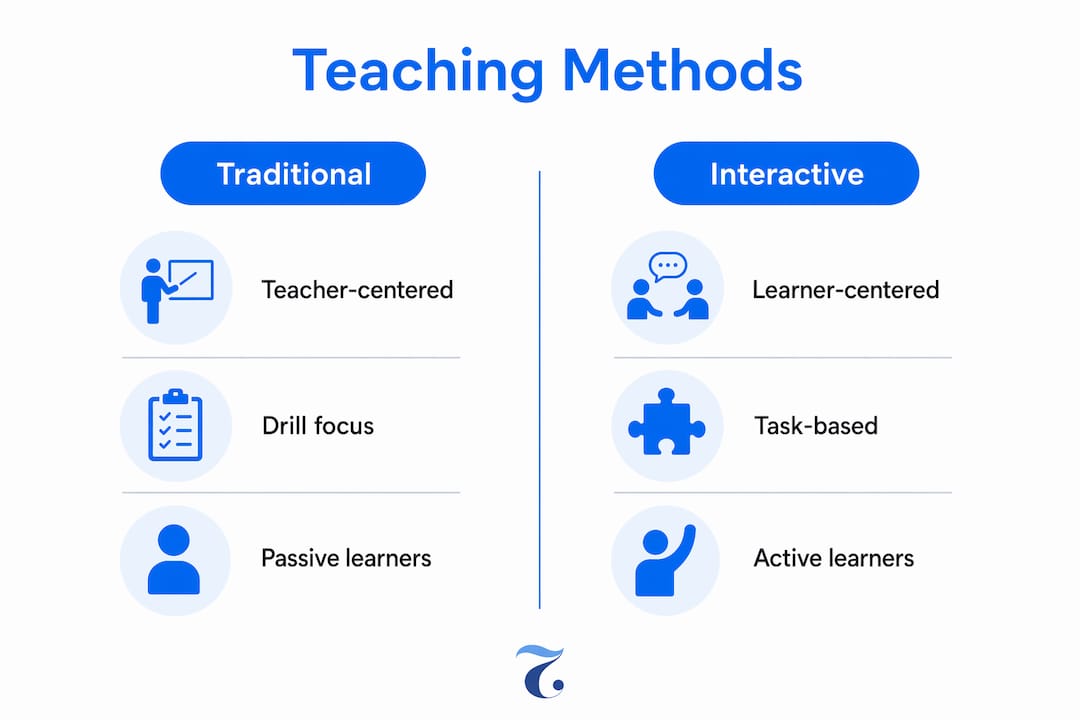
How does interactive language teaching differ from traditional approaches?
The distinction is not just philosophical. It changes what happens every minute of class time.
A common misconception is that interactive teaching means aimless chatting. In reality, every activity must have a communicative goal to be effective. The difference between interactive and traditional teaching is the difference between a learner who practices ordering food in Thai and one who conjugates Thai verbs on a worksheet.
| Dimension | Traditional teaching | Interactive teaching |
|---|---|---|
| Classroom focus | Teacher-centered instruction | Learner-centered participation |
| Primary goal | Grammatical accuracy | Communicative competence |
| Materials | Textbooks and grammar drills | Authentic texts, real-world tasks |
| Teacher role | Lecturer and error corrector | Facilitator and task designer |
| Assessment | Written tests of form | Performance-based communicative tasks |
| Learner activity | Passive reception | Active production and interaction |
The table above shows that the differences run through every layer of the classroom. Traditional methods are not without value. Grammar instruction builds accuracy. But accuracy without fluency produces learners who can pass a test and freeze in a real conversation.
Group classes in language learning demonstrate this contrast clearly. A group lesson built around interactive tasks produces more speaking time per learner than any lecture-based equivalent.
Key takeaways
Interactive language teaching produces measurable gains in communicative competence because it requires learners to use language actively, not just study it passively.
| Point | Details |
|---|---|
| Core definition | Interactive language teaching is a learner-centered method built on CLT principles and real communicative tasks. |
| Proven outcomes | Studies show 25–30% improvement in communicative competence over traditional instruction. |
| Structural requirement | Tasks must follow pre-task, task, and post-task stages to reduce anxiety and build confidence. |
| Teacher’s role | The teacher acts as a facilitator who monitors complexity and injects communicative goals, not a passive observer. |
| Technology’s place | Digital tools extend practice outside class but support the teacher rather than replace structured interaction. |
Why structure is the real secret in interactive teaching
Most educators who struggle with interactive methods are not failing because the approach is wrong. They are failing because they underestimate how much structure it demands. I have seen classrooms where pair work dissolved into native-language chatter within two minutes, not because the learners were unmotivated, but because the task had no defined outcome and no accountability mechanism.
The transformative effect on learner motivation is real, but it does not happen automatically. It happens when a learner completes a role-play and realizes they just negotiated a price in Thai without stopping to think about grammar. That moment of surprise is what builds intrinsic motivation. You cannot manufacture it with a worksheet.
The hardest adjustment for experienced teachers is giving up control of the room. Facilitating interaction feels messier than lecturing. There is noise, there are errors, and there are moments of confusion. Those moments are not failures. They are the learning happening in real time.
Technology deserves a measured view. Apps and platforms are excellent for extending practice between sessions, but they cannot replicate the unpredictability of human conversation. A learner who spends an hour on a language app and an hour in a structured role-play with a skilled instructor will gain more from the second hour every time. Use technology as a supplement, not a substitute.
The educators who get the best results treat every interactive activity as a designed experience with a beginning, a middle, and a debrief. They plan the chaos, which sounds contradictory but is exactly right.
— Paul
Thai Explorer’s interactive adult Thai language courses
Thai Explorer brings interactive language teaching into every lesson for adult learners in Singapore. The school’s Thai language courses are built around communicative tasks, role-plays, and real-world scenarios that develop speaking, listening, reading, and writing skills together.
Qualified native Thai instructors, bilingual in Thai and English, facilitate every session as trained task designers, not lecturers. Group classes, private lessons, and online Thai courses via Zoom are available for learners at every level, including corporate teams. The curriculum aligns with the CU-TFL standard, giving learners a clear benchmark for progress. Thai Explorer is located at 10 Anson Road, #22-07, International Plaza, Singapore 079903, right above Tanjong Pagar MRT.
FAQ
What is interactive language teaching in simple terms?
Interactive language teaching is a method where learners develop communication skills through active, purposeful tasks like role-plays, discussions, and group projects rather than passive grammar instruction. The teacher acts as a facilitator, not a lecturer.
How does interactive language learning differ from traditional methods?
Traditional methods focus on grammatical accuracy through drills and written tests. Interactive language learning prioritizes communicative competence through real-world tasks, authentic materials, and learner-to-learner interaction.
What are the main benefits of interactive teaching for adult learners?
Research shows a 25–30% improvement in communicative competence compared to traditional instruction, along with stronger vocabulary retention, reduced anxiety, and higher motivation. Adults benefit especially from the collaborative, low-stakes environment.
What is Task-Based Language Teaching and how does it relate?
Task-Based Language Teaching (TBLT) is a structured framework within interactive language teaching that sequences lessons into pre-task, task, and post-task stages. This sequencing reduces learner anxiety and builds confidence progressively.
Can interactive language teaching work in online classes?
Interactive teaching works effectively online when tasks are well-structured and digital tools are used as scaffolds rather than replacements for real interaction. Breakout rooms, live role-plays, and collaborative documents replicate the core mechanics of face-to-face interactive sessions.