
TL;DR:
- Thai is the official language of Thailand and a key regional tongue spoken by over 70 million people worldwide. It serves as a cultural, religious, and economic connector across Southeast Asia, with strong ties to related Tai-Kadai languages and regional identity.
Thai is defined as the official language of Thailand and one of Southeast Asia’s most consequential regional tongues, spoken by over 70 million people across the globe. The importance of Thai in Southeast Asia goes far beyond national borders. Thai functions as a cultural anchor, a trade facilitator, and a linguistic bridge connecting mainland Southeast Asia from the Mekong Delta to the Malay Peninsula. Thailand’s central position in ASEAN, its Buddhist cultural heritage, and its growing economic infrastructure make Thai one of the most strategically valuable languages a learner can acquire in 2026.
What is the linguistic significance of Thai in Southeast Asia?
Thai belongs to the Tai-Kadai language family, a group of roughly 70 languages spoken by over 100 million people stretching from southern China to the Malay Peninsula. That geographic spread means learning Thai gives you access to a much wider linguistic continuum than most learners expect. Closely related languages include Lao, Shan, and Zhuang, all of which share tonal structures and vocabulary roots with Standard Thai.
Thai’s speaker base is substantial. With approximately 60 million native speakers and over 70 million total speakers, Thai ranks as the 21st most spoken language in the world. That places it ahead of many European languages in raw speaker count, yet it receives far less attention from Western language learners. That gap represents a real opportunity for anyone building a career or network in Southeast Asia.
Standard Thai serves as the language of national education, formal media, and government communication throughout Thailand. Nearly all Thais are bilingual, using Standard Thai for formal contexts and a regional dialect for local interaction. This creates a layered communication environment that rewards learners who understand both registers.
Over 50% of Thai vocabulary derives from ancient languages including Pali, Sanskrit, Mon, and Khmer. That linguistic inheritance connects Thai directly to the region’s religious and historical roots, making it a window into broader Southeast Asian civilization.
Key linguistic features that define Thai’s regional reach:
- Tonal system: Thai uses five tones, a feature shared with related Tai-Kadai languages, making cross-language comprehension more accessible once you master the tonal logic.
- Script: The Thai alphabet is an abugida derived from Old Khmer script, reflecting centuries of regional exchange.
- Loanword depth: Pali and Sanskrit loanwords dominate formal and religious vocabulary, linking Thai to Buddhist traditions across Myanmar, Cambodia, and Laos.
- Mutual intelligibility: Standard Thai and Lao share enough vocabulary that speakers can often communicate with effort, reinforcing Thai’s role as a regional lingua franca.
Pro Tip: If you already speak Lao or have studied Mandarin tones, your ear is already calibrated for Thai’s tonal distinctions. Use that advantage early in your studies.
How does Thai reflect and shape cultural identity in the region?
Thai culture in Southeast Asia is inseparable from Buddhism. 94.6% of Thailand’s population identifies as Buddhist, and over 40,000 temples shape daily life, social norms, and the language itself. That religious saturation means Thai vocabulary, greetings, and even casual speech carry Buddhist undertones that non-speakers simply miss.

Language and identity are tightly bound in Thailand. The Thai phrase “chat, satsana, phra mahakasat” (nation, religion, monarchy) is not just a political slogan. It is a cultural operating system embedded in how Thais speak, address each other, and organize social life. Understanding Thai means understanding why these three pillars appear constantly in media, education, and ceremony.
Thai’s role as a cultural unifier shows up in four concrete ways:
- Education: Standard Thai is the sole medium of instruction in Thai schools, creating a shared linguistic identity across all 77 provinces regardless of regional dialect.
- Media: Thai-language television, film, and music dominate domestic consumption and export significantly to neighboring countries, spreading cultural norms and vocabulary.
- Ceremony: Buddhist rituals, royal ceremonies, and national holidays are conducted in Thai, reinforcing the language’s role as a marker of national belonging.
- Politeness markers: Thai uses gendered sentence particles (krap for men, ka for women) that signal respect and social awareness. Using them correctly signals cultural literacy, not just language skill.
The cultural impact of Thai extends beyond Thailand’s borders. Thai soap operas are widely watched in Laos, Cambodia, and parts of Myanmar. Thai pop music circulates across the region. This soft cultural export reinforces Thai as a prestige language in mainland Southeast Asia, giving learners a cultural footprint that extends well past Bangkok.
What economic and geopolitical roles does Thai play in Southeast Asia?
Thailand is one of ASEAN’s largest economies and its geographic position makes it a natural trade and logistics hub. The country borders Myanmar, Laos, Cambodia, and Malaysia, giving it direct land access to five of the ten ASEAN member states. That connectivity means Thai language proficiency directly supports cross-border business, supply chain management, and regional diplomacy.
Thailand’s infrastructure investments, including the proposed Southern Thailand land bridge connecting the Gulf of Thailand to the Andaman Sea, signal a long-term commitment to becoming a regional trade corridor. Projects of this scale attract multinational investment, regional labor migration, and diplomatic engagement, all of which require Thai language capability at the negotiating table.
| Economic domain | Thai language role |
|---|---|
| Cross-border trade | Facilitates negotiation with Thai suppliers and logistics partners |
| Tourism | Thailand receives tens of millions of visitors annually; Thai fluency improves service quality and client relationships |
| Regional diplomacy | Thai is used in ASEAN bilateral meetings involving Thailand |
| Corporate operations | Multinationals with Thai offices require staff who can communicate locally |
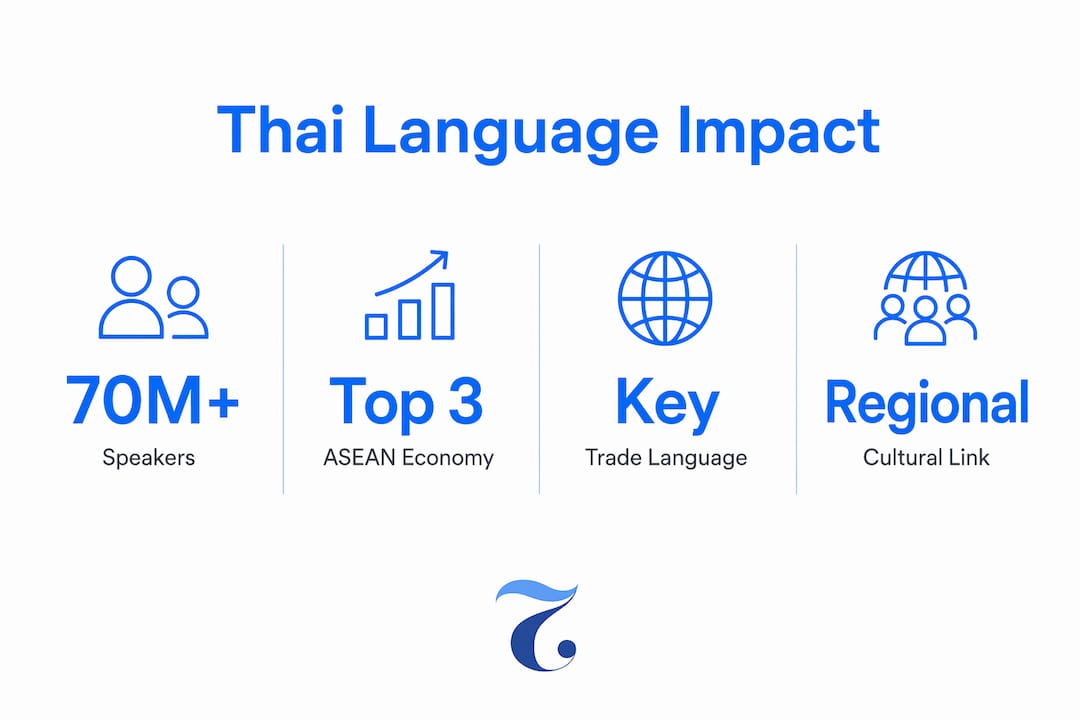
Geopolitically, Thailand sits at the intersection of US and Chinese influence in Southeast Asia. That great power competition shapes trade agreements, infrastructure funding, and diplomatic alignments. Thai language proficiency positions professionals to operate effectively regardless of which direction regional alliances shift.
Pro Tip: If you work in logistics, hospitality, or regional consulting, even conversational Thai signals to Thai counterparts that you are a long-term partner, not a short-term visitor. That distinction opens doors that English alone cannot.
Why learn Thai: career, travel, and social advantages in Southeast Asia
Proficiency in Thai is viewed as a mark of respect and cultural commitment, and it measurably lowers social barriers in networking and professional contexts. That is not a soft benefit. In Thailand and across mainland Southeast Asia, the willingness to speak Thai signals that you are invested in the relationship, not just the transaction.
Career advantages are concrete. Professionals who speak Thai gain access to roles in trade, tourism, regional management, and government liaison work that are effectively closed to English-only speakers. For those building a career in Southeast Asia, Thai fluency is a differentiator that compounds over time.
Travel benefits are equally real. Thailand’s tourism infrastructure is world-class, but most of it operates in Thai. Travelers who speak the language access local markets, rural communities, and authentic cultural experiences that tour groups never reach. Thai cuisine in Southeast Asia, for example, varies dramatically by region. Ordering in Thai in a Chiang Mai market versus a Bangkok restaurant produces entirely different results from the same dish name.
Key advantages of Thai language proficiency for non-native speakers:
- Social integration: Thais respond warmly to foreigners who attempt the language. Even basic phrases shift the dynamic from tourist to guest.
- Professional credibility: In ASEAN business settings, Thai speakers are trusted with more responsibility and deeper client relationships.
- Cultural depth: Understanding Thai unlocks Buddhist ceremonies, traditional festivals like Songkran and Loy Krathong, and the social codes that govern Thai hospitality.
- Regional mobility: Thai proficiency transfers partially to Lao and creates a foundation for understanding Shan and other Tai-Kadai languages.
How do Thai dialects and sociolinguistic features affect regional communication?
Central Thai is the standard, but it coexists with four major regional dialects: Northern Thai (Kham Mueang), Northeastern Thai (Isan), Southern Thai, and Eastern Thai. Each dialect carries distinct vocabulary, tones, and cultural associations. Central Thai serves as the lingua franca for education and business, but regional dialects are the language of trust and social rapport in local settings.
Isan, spoken in Thailand’s northeast, is closely related to Lao and reflects the cultural ties between Thailand and Laos. Northern Thai carries vocabulary and tonal patterns distinct enough that Central Thai speakers sometimes struggle to follow it. For learners, this means Central Thai is the right starting point, but awareness of regional variation builds credibility and cultural sensitivity.
| Feature | Central Thai | Regional dialects (e.g., Isan, Northern Thai) |
|---|---|---|
| Primary use | Education, media, formal business | Local community, family, informal settings |
| Mutual intelligibility | Understood by all Thais | Varies; Isan is close to Lao |
| Prestige | High (national standard) | Cultural authenticity, local trust |
| Learner priority | Start here | Build awareness after intermediate level |
Rachasap, the Royal Thai language, adds another layer. This specialized register uses distinct vocabulary for addressing or referring to royalty and is used in formal ceremonies, official broadcasts, and national media. You will hear Rachasap in news broadcasts and royal announcements. Understanding it is not required for daily communication, but recognizing it signals genuine cultural literacy. Learners interested in Thai dialects and regional variation will find this sociolinguistic depth one of the most rewarding aspects of advanced study.
Key Takeaways
Thai’s importance in Southeast Asia rests on three pillars: its reach as a Tai-Kadai lingua franca spoken by over 70 million people, its role as a cultural and Buddhist identity marker, and Thailand’s position as an ASEAN economic and geopolitical hub.
| Point | Details |
|---|---|
| Major regional language | Thai has over 70 million total speakers and ranks as the 21st most spoken language worldwide. |
| Linguistic gateway | Thai belongs to the Tai-Kadai family, connecting learners to related languages across mainland Southeast Asia. |
| Cultural identity anchor | With 94.6% of Thailand’s population Buddhist, Thai language carries deep religious and social meaning. |
| Economic asset | Thai fluency supports careers in trade, tourism, and regional management across ASEAN. |
| Dialect awareness matters | Central Thai is the standard, but regional dialects like Isan build local trust and cultural credibility. |
Thai in 2026: why I think most learners underestimate it
Most people who consider learning Thai frame it as a travel language. That framing undersells it by a wide margin. What I have observed over years of watching learners engage with Southeast Asia is that Thai functions more like a master key than a single-door opener. The moment you speak Thai with genuine competence, your entire relationship with the region shifts.
The geopolitical dimension is something few language guides address honestly. Thailand is navigating real pressure between US and Chinese interests, and that tension is reshaping trade routes, infrastructure funding, and regional alliances. Professionals who speak Thai are not just communicating. They are positioned inside that conversation rather than outside it.
My practical advice: do not wait until you are “ready” to engage with Thai culture. The language and the culture are learned together, not sequentially. Learners who study Thai grammar in isolation and plan to add culture later almost always plateau. The ones who engage with Thai food, film, music, and ceremony from day one build fluency faster and retain it longer. Thai Explorer’s curriculum is built on exactly that principle, pairing language instruction with cultural immersion in learning from the first lesson.
The Thai language is not a niche skill. It is a regional asset that compounds in value the deeper you go.
— Paul
Thai Explorer: structured Thai courses for adult learners
Thai Explorer offers adult Thai language courses in Singapore built for real-world use, whether your goal is conversational fluency, business communication, or corporate training. Courses are available as group classes, private lessons, and online sessions via Zoom, giving you flexibility without sacrificing structure.
The curriculum aligns with the CU-TFL (Chulalongkorn University Proficiency Test of Thai as a Foreign Language) standard, covering speaking, listening, reading, and writing in a progression that builds genuine competence. All lessons are taught by qualified native Thai instructors who are bilingual in Thai and English. Thai Explorer is located above Tanjong Pagar MRT at 10 Anson Road, #22-07, International Plaza, Singapore 079903. Explore the full range of adult Thai courses and find the format that fits your schedule and goals.
FAQ
How many people speak Thai in Southeast Asia?
Thai has over 70 million total speakers worldwide, with approximately 60 million native speakers concentrated in Thailand. It ranks as the 21st most spoken language globally.
Is Thai useful for business in Southeast Asia?
Thai is directly useful for business across ASEAN, particularly in trade, logistics, tourism, and regional management roles. Proficiency signals cultural commitment and opens professional relationships that English alone cannot access.
What language family does Thai belong to?
Thai belongs to the Tai-Kadai language family, which includes roughly 70 languages spoken by over 100 million people from southern China to the Malay Peninsula.
What is Rachasap in Thai?
Rachasap is the Royal Thai language register, a specialized vocabulary used when addressing or referring to royalty. It appears in formal broadcasts, national ceremonies, and official media.
How does Thai connect to other Southeast Asian languages?
Thai shares tonal structures and vocabulary roots with Lao, Shan, and Zhuang through the Tai-Kadai family. Over 50% of Thai vocabulary also derives from Pali, Sanskrit, Mon, and Khmer, linking it to the broader linguistic heritage of the region.