TL;DR:
- More Singaporeans are learning Thai, and obtaining official recognition for their skills simplifies meaningful validation.
- Recognized Thai language tests, endorsed by institutions like the Thai Ministry of Education and Chulalongkorn University, are essential for academic, professional, and visa purposes.
More Singaporeans are learning Thai than ever before, and many are realizing that their skills deserve official proof. The good news is that getting a recognized Thai language certification is far more straightforward than most people assume. Whether you are studying for university admission in Thailand, building a stronger resume for regional business roles, or simply wanting proof of your progress, official Thai tests give you a credential that others actually accept. This guide walks you through the main recognized tests, breaks down how they differ, and shows you exactly how to prepare.
Table of Contents
- Why recognition matters for Thai language tests
- Overview of officially recognized Thai language tests
- CU-TFL vs TCT: Key differences for Singapore learners
- How to prepare: Strategies and resources
- What most learners get wrong about Thai language testing
- Next steps: Get ready for recognized Thai testing success
- Frequently asked questions
Key Takeaways
| Point | Details |
|---|---|
| Official recognition matters | Only officially recognized Thai language tests are accepted by employers, schools, and visa authorities. |
| CU-TFL and TCT lead | CU-TFL and TCT are the top certified options for proving Thai proficiency in Singapore. |
| Fit the test to your goal | Choose a test based on why you need it: career, academic, or personal achievement. |
| Preparation needs strategy | Succeeding in recognized tests takes targeted practice and the right resources. |
| Practice beats credentials | Real communication skills combined with your official result bring the best opportunities. |
Why recognition matters for Thai language tests
To start, it’s crucial to know what “recognized” actually means and why it should matter for your goals.
A recognized test is one that is officially endorsed and accepted by governments, educational institutions, or employers as valid evidence of language ability. Not every Thai quiz or school certificate carries that weight. The tests that count are those backed by major institutions such as the Thai Ministry of Education or a respected university like Chulalongkorn University. These bodies set the standards, verify the results, and maintain the credibility of the certification you receive.
For Singaporeans, recognition opens real doors. If you are applying to study at a university in Thailand, a recognized test score can satisfy the language admission requirement. If your company is expanding into Bangkok or Chiang Mai, an employer may ask for proof of Thai proficiency rather than taking your word for it. Even visa processes and work permit applications sometimes require documented language ability. Without a formally recognized result, you are relying solely on trust, which does not always hold up in official settings.
Here is what recognition typically means for a Thai language test:
- Backed by a government body or major university rather than a private language center acting alone
- Accepted for academic, employment, or immigration purposes with consistent standards across test-takers
- Standardized scoring and levels that institutions and employers can interpret without ambiguity
- Official certificates issued under a verifiable testing body that third parties can confirm
One test that meets all these criteria is the Thai Competency Test (TCT). Developed by the Thai Ministry of Education, the TCT assesses four language skills including listening, speaking, reading, and writing across multiple proficiency levels, and provides an official certificate that can be used for employment, study, and visa purposes. That kind of institutional backing is exactly what makes a test worth pursuing.
Understanding Thai language test formats before you register helps you choose the right path and avoid wasting preparation time on the wrong material.
Overview of officially recognized Thai language tests
With recognition defined, let’s dive into which Thai language tests are actually officially accepted and how they differ.
Two tests dominate when it comes to international recognition for Thai as a foreign language: the CU-TFL and the TCT.
CU-TFL (Chulalongkorn University Thai Test for Foreigners) is administered by Chulalongkorn University (often called Chula), one of Thailand’s most prestigious academic institutions. It is the test most commonly used in academic contexts and carries strong recognition among universities and research institutions globally. The CU-TFL has five main levels: Chula Novice (Basic), Intermediate, Advanced, Superior, and Distinguished, with Plus variants at certain tiers. These map directly onto the CEFR (Common European Framework of Reference) scale from A1 through C2, making it easy for institutions worldwide to interpret your result.
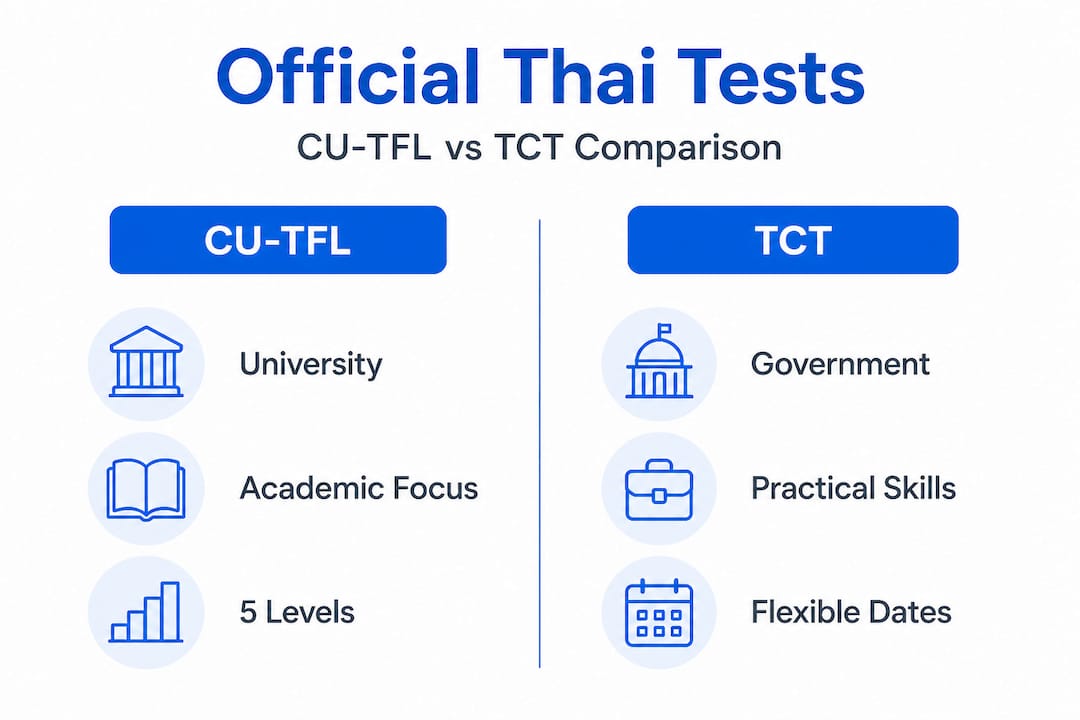
Thai Competency Test (TCT) is a government-issued test from the Thai Ministry of Education. It targets practical communication ability and has been gaining strong international traction, particularly among people in business and professional settings.
Here is a side-by-side summary:
| Feature | CU-TFL | TCT |
|---|---|---|
| Provider | Chulalongkorn University | Thai Ministry of Education |
| Skills tested | Reading, writing, listening, speaking | Listening, speaking, reading, writing |
| Level framework | CEFR A1 to C2 | Multiple levels |
| Primary use | Academic, research, study | Employment, study, visas |
| Test frequency | Set windows, advance registration required | More frequent testing periods |
| Focus | Academic depth | Practical, business communication |
For learners who want to work on their reading foundation before sitting a test, this guide on improving Thai reading skills is a practical starting point. And if writing intimidates you, the resource on mastering Thai writing covers the fundamentals step by step.
Pro Tip: Always check whether the test you choose is aligned to the CEFR framework. If your target employer, school, or visa authority uses CEFR as their reference standard (which is common in Singapore and across Asia), a CEFR-mapped result like CU-TFL makes your certification immediately readable without any guesswork.
CU-TFL vs TCT: Key differences for Singapore learners
Now that you know the key tests, understanding their differences helps you pick the best match for your personal situation.
Both tests are legitimate and officially recognized, but they serve somewhat different audiences. Choosing the wrong one does not invalidate your effort, but choosing the right one can make your certification far more useful.
Here is a more detailed comparison:
| Criteria | CU-TFL | TCT |
|---|---|---|
| Academic recognition | Very high, strong at universities | Growing, especially for professional bodies |
| Business recognition | Moderate | High, business-focused |
| Difficulty | Academically rigorous | More accessible entry levels |
| CEFR alignment | Yes, A1 to C2 | Not directly mapped to CEFR |
| Certificate validity | Widely accepted internationally | Strong within Thailand and ASEAN contexts |
| Cost and access | May require travel to testing centers | More flexible test access |
The TCT’s more frequent testing schedule makes it easier to plan around, which matters for Singaporeans balancing work or study alongside their preparation. The TCT is also specifically designed with business and employment use in mind, so it tends to suit people heading into corporate, trade, or hospitality roles in Thailand.
The CU-TFL’s five structured levels aligned to CEFR make it the better choice for anyone targeting university admission, academic research, or roles at organizations that specifically reference the CEFR scale.
Here are the three most common learner scenarios and which test fits best:
- Studying at a Thai university: Choose CU-TFL. Universities in Thailand and internationally recognize its CEFR alignment and Chulalongkorn’s academic credibility.
- Working or doing business in Thailand: Choose TCT. Its official government backing and business-oriented design make it a stronger signal for employers and HR teams.
- Personal achievement or travel preparation: Either test works, but CU-TFL gives you a more internationally portable result if you plan to use the credential across different countries.
Structured preparation makes a big difference. Exploring Thai courses in Singapore designed around these tests can fast-track your readiness significantly. If your interest leans toward travel and cultural immersion, checking out the dedicated Thai for travel program is worth your time.
Pro Tip: Look carefully at the specific assessment modes of each test before you commit. If you are stronger in speaking and listening than in reading and writing, note which test weights those skills more heavily. CU-TFL includes rigorous written components at upper levels, while TCT places practical communication at the center at all levels.
How to prepare: Strategies and resources
Choosing the right test is only half the battle. Effective preparation is what really opens doors.
Many learners in Singapore are self-taught up to a certain point, but official test preparation requires a more systematic approach. Relying on general language apps or informal practice often leaves gaps in exactly the areas that tests measure. Here is how to build a preparation strategy that actually works.
Resources available in Singapore:
- Structured Thai language courses aligned to test syllabuses, particularly those covering all four skill areas
- Private lessons for targeted, one-on-one coaching on your weakest areas
- Online materials including sample papers and mock tests available through test providers
- Study groups with other Singaporean learners to practice speaking and listening
Skill-by-skill tips:
Listening: Expose yourself to authentic Thai audio daily. Thai podcasts, news clips, and YouTube channels designed for learners are excellent. Shadow native speakers to sharpen your ear for tone and rhythm.
Speaking: Practice structured conversations rather than random small talk. Use role-play scenarios based on topics that appear in tests, such as formal introductions, travel situations, and workplace dialogues.
Reading: Start by mastering the alphabet and tones, then work through graded reading passages. The CU-TFL reading components at upper levels require strong comprehension of more formal written Thai, so consistent reading practice across different text types is essential.
Writing: Many learners underestimate this area. Thai script is phonetic but complex, and formal writing has conventions different from spoken Thai. Practice writing structured paragraphs and short essays in Thai from an early stage, not just in the final weeks before your test.
Common preparation pitfalls:
- Over-relying on memorization instead of building genuine communicative ability. Rote vocabulary lists will not carry you through listening or speaking tasks.
- Ignoring writing until the last moment. Written Thai takes consistent practice over months, not weeks. Start early.
- Skipping mock tests. Doing practice tests under timed conditions is one of the highest-impact things you can do. It reveals exactly where your time management breaks down.
Building a strong foundation in Thai grammar basics early in your preparation prevents the kind of structural errors that cost marks in both writing and speaking assessments. You should also build habits around daily Thai practice rather than intense cramming sessions close to the test date.
Pro Tip: Use the CEFR descriptions to self-assess even if you are taking the TCT. Because CEFR labels like B1 or B2 describe specific communicative behaviors (can handle routine travel situations, can express opinions clearly), you can use them to benchmark your readiness honestly. Ask yourself: can I actually do what a B1 speaker can do in Thai? If not, you know exactly what to practice next.
What most learners get wrong about Thai language testing
Here is an uncomfortable but important truth: most people who prepare for Thai language tests spend the most energy on passing rather than on actually improving.
There is a meaningful difference between the two. Passing a test means knowing what the test rewards and optimizing for that. Actually improving means building the kind of language ability that works outside the exam room, on a street in Bangkok, in a business meeting in Chiang Mai, or reading a contract in Thai. The tests themselves are designed to measure real communication skills, so both goals should align. But in practice, learners treat test preparation as a shortcut instead of a foundation.
We have seen this pattern repeatedly at Thai Explorer. Students come in focused on scoring at a specific level, and when we ask them to have a free conversation in Thai, they freeze. That is a sign that preparation has been too narrow and too mechanical.
The real value of a recognized Thai certificate is not the piece of paper. It is what the certificate should represent: that you can actually communicate in Thai with confidence. When that is true, the credential naturally follows. And crucially, that genuine ability is what creates opportunities, not just a score sitting in your portfolio.
The most effective approach combines formal preparation with daily real-world language use. Study for the test structure, yes. But also watch Thai media without subtitles, practice practical Thai reading on real signs and articles, and speak Thai whenever you get the chance. The learners who do this consistently are the ones who not only pass but actually thrive in Thai-speaking environments.
Thai language certification matters most when it reflects genuine ability. Aim for that, and the test result will take care of itself.
Next steps: Get ready for recognized Thai testing success
Ready to show your Thai skills with an official result? These next steps and resources can help you succeed.
Thai Explorer’s curriculum is directly aligned to recognized test standards, so every lesson you take builds toward a result that actually counts. Whether you are a complete beginner or already conversational, there is a structured path for you.
You can start by exploring the recognized Thai test options to understand which test suits your current level and goals. If you are looking for flexible, funded options, Thai Explorer offers SkillsFuture Thai courses that make quality preparation accessible. For learners who prefer focused, personalized guidance, private Thai lessons let you target exactly the skills you need to strengthen before test day. Thai Explorer is located right above Tanjong Pagar MRT, making it easy to fit lessons into a busy Singapore schedule. The right certification is closer than you think.
Frequently asked questions
Which Thai language test is best for a work visa?
The Thai Competency Test (TCT) is widely recommended for work, study, and visa applications because it carries official Ministry of Education recognition and is specifically designed to demonstrate practical language ability for employment and immigration purposes.
What are the main levels of the CU-TFL test?
CU-TFL features five main levels ranging from Chula Novice through Distinguished, each mapped to the CEFR scale from A1 to C2, so institutions can immediately understand what your score means.
Can I take recognized Thai tests online from Singapore?
Some tests, including the CU-TFL, may offer online or digital components, but availability changes regularly, so always check directly with the test provider for the most current and accurate registration options.
Are recognized Thai tests valid for university admission?
Yes, both CU-TFL and TCT are accepted by institutions and can fulfill language requirements for study programs in Thailand, with the TCT’s official certification covering academic, employment, and visa uses.
How often are official Thai language tests offered?
The TCT has a more frequent testing schedule throughout the year compared to CU-TFL, which typically has set testing windows and requires advance registration to secure your spot.