
TL;DR:
- Thai script is an abugida with consonant classes, vowels, and tone marks that follow internal rules.
- Learning middle class consonants first and recognizing syllable patterns accelerates reading without memorizing all symbols.
- Practice with real words and context, using recognition tools and community support, leads to faster Thai reading fluency.
You’re standing at a street stall in Bangkok, surrounded by signs you can’t decode. The menu is entirely in Thai script, the road signs are unreadable, and even the MRT-style transit maps offer no English fallback. Most travelers just point and guess. But imagine being the person who can actually read the menu, spot the right bus stop, and understand the promotional sign in a shop window. That shift from frustrated tourist to confident reader is real, and it starts with understanding Thai script in a structured, logical way that works for learners right here in Singapore.
Table of Contents
- What makes Thai script unique?
- Step 1: Get familiar with Thai script essentials
- Step 2: Decode real Thai words and phrases
- Common challenges and how to troubleshoot
- Why the fastest path isn’t always best: our experience teaching Thai reading
- Next steps: learn Thai efficiently with local resources
- Frequently asked questions
Key Takeaways
| Point | Details |
|---|---|
| Thai script basics | Understanding consonants, vowels, and tones is essential for reading Thai. |
| Context matters | Breaking down real phrases accelerates recognition more than rote memorization. |
| Troubleshooting tips | Learn to spot clusters and silent vowels to avoid confusion. |
| Local learning options | Singapore-based courses and guides help you master Thai reading more efficiently. |
What makes Thai script unique?
Now that you see why reading Thai is valuable, let’s break down what makes its script different and what you’ll actually be learning.
Thai script is not random. It follows consistent internal rules, and once you understand the system, it becomes far less intimidating. Thai script is an abugida, meaning each consonant carries an inherent vowel sound that can be changed with additional marks. It has 44 consonants divided into three classes: high (11 consonants), middle (9 consonants), and low (24 consonants). There are 32 vowels, made up of 18 long forms and 14 short forms, and four tone marks that represent five distinct tones: mid, low, falling, high, and rising.
Here’s a quick breakdown of what each element does:
- Consonant class determines which tone rule applies to a syllable
- Vowel length changes both meaning and tone in the same syllable
- Tone marks visually signal the spoken pitch of a word
- Consonant position (initial vs. final) affects pronunciation entirely
| Element | Count | What it controls |
|---|---|---|
| Consonants | 44 (3 classes) | Tone class, initial and final sounds |
| Vowels | 32 (long and short) | Vowel sound and syllable tone |
| Tone marks | 4 marks, 5 tones | Spoken pitch of each syllable |
“No spaces between words; spaces separate phrases and sentences. Thai is read left to right.”
One of the most disorienting features for new learners is the lack of spaces between individual words. Thai text runs continuously, with spaces only appearing between phrases or sentences. To a beginner, a paragraph of Thai text can look like one impossibly long word. But knowing this upfront is actually empowering. Instead of searching for word breaks that don’t exist, you learn to spot syllable patterns and phrase boundaries, which is a genuinely different reading skill that becomes natural with practice.
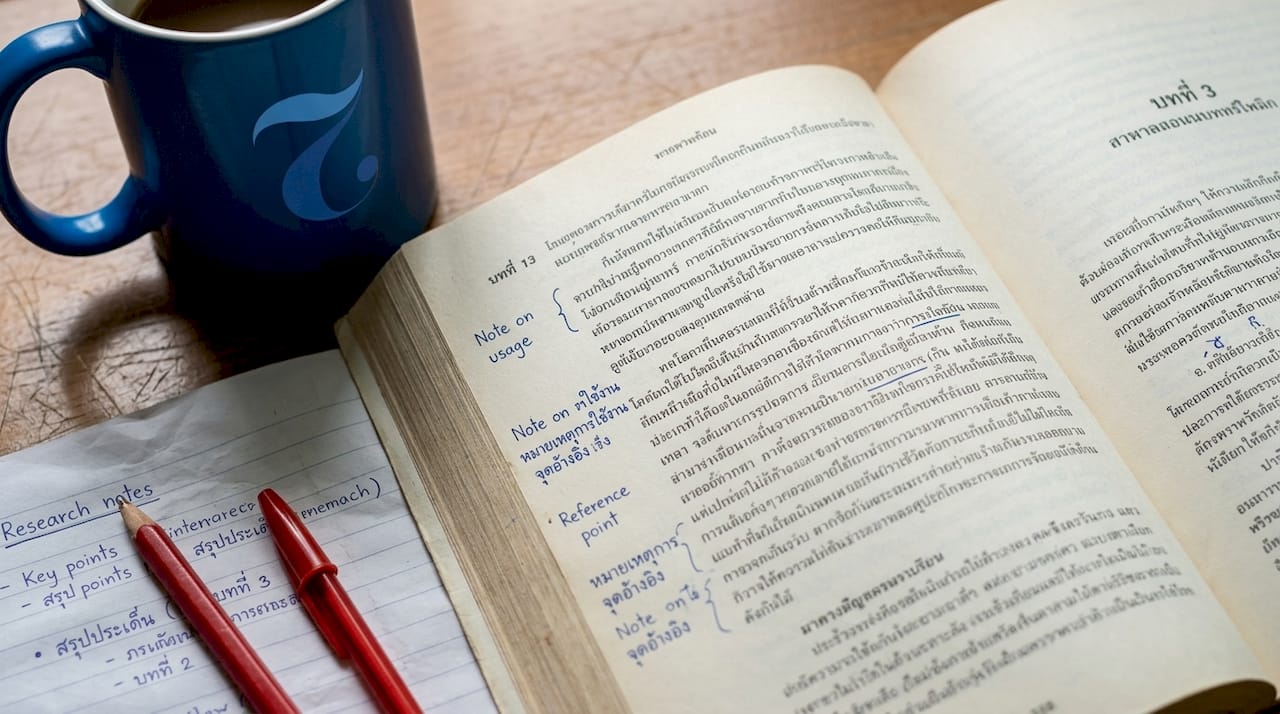
Understanding the three consonant classes early matters more than most learners realize. Each class follows its own set of tone rules, so grouping your learning by class rather than trying to memorize all 44 consonants in random order makes the whole system click faster. You can explore the Thai alphabet basics to see how these classes are organized visually before diving deeper.
Step 1: Get familiar with Thai script essentials
With the script’s structure in mind, here’s how to build a solid foundation for reading Thai from Day One.
Most learners make one critical mistake at the start: they try to memorize everything before they understand anything. Rote repetition of all 44 consonants without any context leads to quick burnout. A smarter approach, backed by expert learning guidance, is to prioritize the script early for accurate tones and pronunciation, but use contextual deconstruction rather than raw memorization. This approach builds recognition faster without the fatigue.
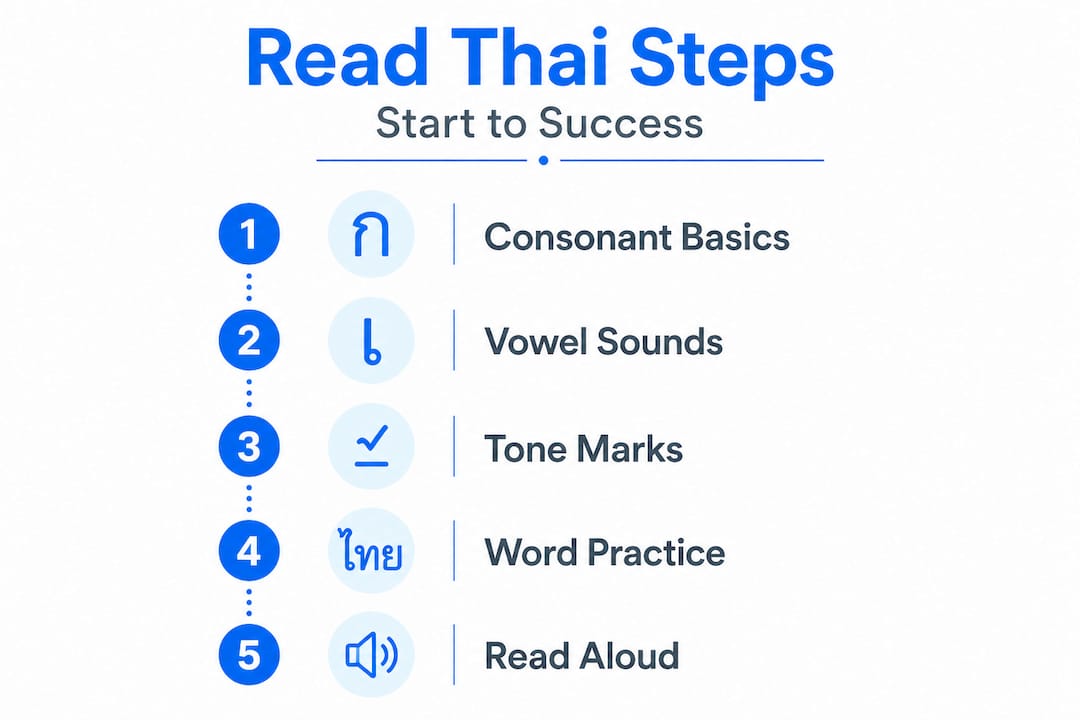
Here’s a practical starting sequence:
- Learn the middle class consonants first. These 9 consonants follow the most predictable tone rules, which makes them the best entry point.
- Add high class consonants second. Once you can recognize tone patterns in middle class words, high class rules feel like a natural extension.
- Introduce short and long vowels in pairs. Pairing them immediately helps you hear and see the contrast, so the difference sticks.
- Familiarize yourself with tone marks using real examples. Don’t just copy the marks; say the words aloud so your ear connects the mark to the pitch.
- Use recognition tools daily. Apps, digital flashcards, and spaced repetition software build visual memory faster than handwriting drills alone.
Memorization vs. contextual deconstruction:
| Approach | Method | Best for |
|---|---|---|
| Rote memorization | Repeat consonants by name until recalled | Short-term retention of symbols |
| Contextual deconstruction | Break known words into parts and identify letters | Long-term recognition and reading fluency |
Pro Tip: Write out five Thai words you already know phonetically (like สวัสดี for sawasdee) and try to identify the consonants and vowels in each one. This immediately connects abstract letters to sounds you already know.
Short versus long vowels deserve special attention here. The difference between สน (sŏn, meaning thread) and สาน (sǎan, meaning to weave) is literally one vowel length. Getting this distinction wrong changes not just pronunciation but the entire meaning of what you’re saying. A solid pronunciation and tones guide will show you how to train your ear for this distinction early, before bad habits form.
The good news for Singapore-based learners is that you’re already used to navigating multiple scripts in daily life, from Chinese characters on Chinatown signage to Tamil text on MRT notices. That multilingual visual awareness actually gives you a head start in recognizing Thai letters as distinct symbols rather than just “foreign squiggles.”
Step 2: Decode real Thai words and phrases
After getting the building blocks, it’s time to put them into practice with real, functional language that’s relevant for daily life.
Reading isolated letters is one thing. Reading actual words that mean something to you is where real progress happens. Thai reading methodologies generally fall into three camps. The traditional approach involves memorizing consonants by their acrophonic names and working through vowels and tone rules systematically. The deconstruction method starts with known phrases, breaks them into syllables, and identifies the individual letters from there. The third approach uses apps and spaced repetition systems specifically for visual recognition.
For most adult learners, the deconstruction method produces the fastest real-world reading gains because it anchors abstract letters to words that already have meaning and emotional relevance. Here’s how to apply it step by step:
- Choose a word you already know in Thai. Start with something simple, like ข้าว (khao, rice) or น้ำ (nam, water).
- Write or type the Thai spelling and look at each component. Identify the initial consonant, the vowel, the tone mark if present, and the final consonant.
- Say the word aloud as you identify each part. Your ear confirms what your eyes are learning.
- Repeat with a related phrase. If you decoded ข้าว (rice), try ข้าวผัด (khao phat, fried rice) next and spot the shared syllable.
- Add new words from a real context. Use a Thai restaurant menu, a screenshot of a Thai supermarket sign, or a travel app set to Thai language.
Reading Thai words in context, such as off a real menu or a street sign photo, activates pattern recognition far faster than studying isolated letters from a textbook.
Pro Tip: Set your phone’s language to Thai for one hour each day. You’ll be surprised how quickly your brain starts recognizing frequently appearing words like settings, home, and back just from repetition in a real interface.
Mobile apps are genuinely useful at this stage, especially those that use spaced repetition. Some learners report reaching basic reading fluency in as few as nine days with intensive daily app practice. That’s not typical for most people juggling work and study, but it shows what’s possible when recognition training is prioritized over perfection. Pair app use with a structured reading skills guide to make sure you’re not developing blind spots.
Flashcards remain one of the highest-value tools available. The key is to put the Thai word on one side and a picture or English definition on the other, not a romanized transliteration. Forcing your brain to connect Thai script directly to meaning, without a phonetic middleman, is what builds real reading fluency. You can also browse basic Thai phrases for ready-made content to practice with.
Common challenges and how to troubleshoot
You’ve started reading and decoding, but there are some stumbling blocks every learner faces. Let’s tackle them now so you can keep improving.
Thai reading has a few consistent trouble spots that trip up almost every beginner. Knowing what to expect makes them far easier to handle.
- Consonant clusters: Some syllables begin with two consonants together, like กร or พร. Each consonant has a different sound in initial versus final position, and clusters follow their own pronunciation rules. Practice spotting these by looking at common Thai words that begin with clusters.
- Silent vowel carriers: The consonant อ (or) often acts as a placeholder for vowels rather than producing its own sound. Beginners see it and try to pronounce it as a consonant when it’s actually structural.
- No-space text: When you hit a long string of Thai text with no visual breaks, train yourself to look for recognizable syllable shapes rather than trying to find word boundaries. Phrase-level spacing will guide you once you know what a phrase boundary looks like visually.
- Short vs. long vowels: As mentioned earlier, vowel length is meaning-critical. The edge cases in Thai reading also include duplicate consonants inherited from Sanskrit and Pali that now serve tone-class purposes rather than producing distinct sounds.
Many Thai consonants that appear to be duplicates, such as multiple ways to write the “s” or “t” sound, were preserved from Sanskrit and Pali to maintain their original spelling. Today, they primarily function to indicate tone class rather than to produce different sounds.
The most effective way to work through consonant clusters is to practice them in context, not in isolation. Find common words that contain the cluster you’re struggling with and read them repeatedly in different sentences. Tone exercises are also essential at this stage. The tone exercises available for learners can help you drill the tonal patterns that consonant classes produce, which directly sharpens your reading accuracy.
For no-space reading, one trick that works well is to read Thai text out loud slowly. Your brain begins to segment naturally as you try to vocalize unfamiliar syllable combinations. Over time, the phrase boundaries become as obvious to you as word spaces are in English. Combine this with a solid foundation in grammar basics and you’ll recognize common grammatical patterns that also help you spot where one idea ends and another begins.
Why the fastest path isn’t always best: our experience teaching Thai reading
Before wrapping up, let’s reflect on what actually works from extensive experience teaching Thai to beginners in Singapore.
We see it consistently. A new student arrives having spent two weeks with a popular language app, able to approximate Thai sounds and recite a few phrases, but completely lost when faced with a real Thai text. The app gave them audio patterns without visual grounding. When they finally sit down with actual Thai script, they feel like they’re starting from zero.
The shortcut culture around language learning is seductive. “Learn 100 Thai words in a weekend.” “Speak Thai in 30 days.” These promises appeal to busy professionals and students in Singapore who want results fast. But reading Thai specifically does not respond well to shortcuts. The tonal system, the consonant class rules, and the no-space writing convention are all interconnected. Pull on one thread without understanding the others and the whole fabric unravels when you hit real-world text.
What actually works, based on teaching hundreds of local students, is a structured, progressive approach where each layer of knowledge genuinely supports the next. Learners who take the time to understand why consonant classes determine tone, not just which tones they produce, develop reading intuition that transfers to unfamiliar words. That’s the goal: not just recognizing a fixed list of words, but being able to approach any new Thai word and make a reasonable attempt at reading it.
Singapore learners have a specific advantage too. The multilingual environment here means most students already understand that one script system is not inherently harder or easier than another. They’ve already learned to read in at least two languages. That cognitive flexibility is valuable when approaching Thai, and a structured reading guide that accounts for this background can significantly accelerate progress compared to generic approaches designed for English-only learners.
Community also matters more than most self-study guides admit. Students who practice reading with a partner, in a class, or with a native-speaking instructor catch errors earlier, hear correct tones modeled clearly, and stay motivated through the genuinely difficult middle phase of learning when recognition is inconsistent and confidence is fragile.
Next steps: learn Thai efficiently with local resources
If you’re ready for structured progress and want local support, here’s how to keep your momentum going.
Reading Thai on your own can take you a good distance, but there’s a point where structured instruction makes a dramatic difference in both speed and accuracy.

At Thai Explorer, located directly above Tanjong Pagar MRT, our native Thai instructors understand exactly where Singapore learners get stuck. Whether you prefer group Thai courses for the energy and peer practice, or private lessons for a pace and focus tailored entirely to you, the curriculum is built around practical communication from Day One. Our alignment with the CU-TFL standards means your reading progress is measurable and meaningful. You can also supplement any course with our in-depth reading guide to reinforce what you’re learning between lessons.
Frequently asked questions
How long does it take to read basic Thai?
Most learners can read common words and short texts within a few weeks of daily practice. With intensive spaced repetition methods, some learners reach basic recognition in under two weeks.
What should I learn first: consonants or vowels?
Start with consonants, specifically the middle class, since 44 consonants in three classes form the structural backbone that determines how vowels and tones are read in any given word.
Do I need to memorize all tone rules before I can read?
No. Start with basic tone recognition through exposure to real words, and the rules become clearer naturally over time. Prioritizing the script early for tones and pronunciation does not require mastering every rule before you begin reading.
Why aren’t there spaces between Thai words?
Thai uses spaces to separate phrases, not individual words. This makes context and pattern recognition the key skills for identifying where one word ends and the next begins.